


Taiwan’s overtaking of South Korea in GDP per capita is not a temporary anomaly, but the result of deeper structural problems in the South Korean economy says Chang Young-chul, the former CEO of Korea Asset Management Corp.
Chang says that while it reflects Taiwan’s own gains, it also highlights weakening growth momentum in South Korea. As design and foundry capabilities become more important in the AI era, Seoul risks losing competitiveness if it relies too heavily on memory chips.
IMF forecasts showing Taiwan widening its lead over South Korea have fueled debate in Seoul over memory chip dependence, industrial policy and the country’s broader economic trajectory.
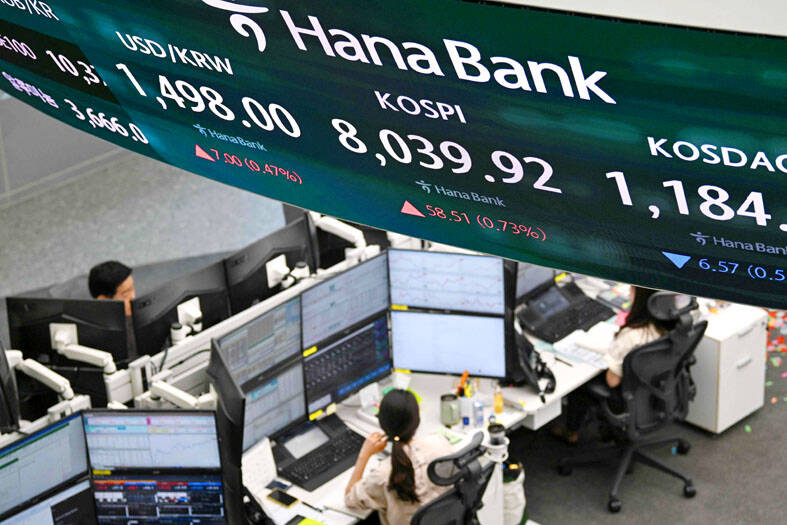
Photo: AFP
Taiwan’s GDP per capita is projected to exceed South Korea’s by more than US$10,000 within five years, according to the IMF’s World Economic Outlook 2026, a forecast that has stirred unease in Seoul over the country’s semiconductor dependence and broader economic weaknesses.
RISING GDP
The IMF estimates Taiwan’s GDP per capita would rise 6.6 percent from US$39,489 last year to US$42,103 this year, while South Korea’s would increase 3.3 percent from US$36,227 to US$37,412. Taiwan overtook South Korea last year for the first time in 22 years. In 2002, Taiwan’s GDP per capita stood at US$13,356, compared with South Korea’s US$12,952, but South Korea moved ahead again in 2003.
The Chosun Ilbo says Taiwan’s growth is being driven by the global semiconductor boom, while South Korea’s recent gains have relied heavily on AI-fueled memory-chip earnings at Samsung Electronics Co and SK Hynix Inc.
The Seoul-based outlet warns that, given that semiconductors account for a crucial part of South Korea’s economy, a fall in memory prices could reduce the country to a subcontracting role in a Taiwan-led chip supply chain unless it narrows gaps in system semiconductors, foundry services and packaging.
LONG-TERM DIFFICULTIES
You Jae-hee, a professor at Hongik University and vice president of the Institute of Semiconductor Engineers, tells the Taipei Times that South Korea could face long-term difficulties if its semiconductor industry remains too focused on memory.
Although the country is benefiting from strong demand for commodity memory and high-bandwidth memory (HBM) driven by AI data-center expansion, memory is only one part of a finished semiconductor system and remains vulnerable to demand slowdowns, price declines and design changes. To reduce that vulnerability, South Korea also needs to strengthen its system-semiconductor design capabilities, including in high-mix, low-volume segments.
You says Taiwan and South Korea have developed different semiconductor industry structures. Taiwan has built a more horizontal ecosystem centered on Taiwan Semiconductor Manufacturing Co (TSMC, 台積電), with fabless designers, foundries and backend firms dividing roles and collaborating, making it better suited to customized, small-volume chip production.
South Korea, by contrast, relies more on vertically integrated companies that handle design, production and sales under one roof, an approach that has given it an edge in memory, where large-scale investment and mass production are critical.
However, he says that structure can make South Korean firms appear to be competitors to major technology customers, while constraints such as limits on factory expansion, the mismatch between Seoul-area talent concentration and capital-region plant restrictions, and public resistance to support for chaebol could further weaken competitiveness.
STABLE POLITICAL STRUCTURE
Chang says Taiwan also benefits from its political structure.
“Taiwan’s political structure is more stable, which boosts its economy,” he says. “In comparison, South Korea has industry, labor and fiscal law difficulties. South Korea has fallen behind Taiwan due to excessive political regulation, a rigid labor market, a policy environment at odds with the market economy and inefficient government fiscal management, which have hurt corporate competitiveness and domestic investment.”
Rising prices since the pandemic have added to South Korea’s economic woes.
Chang says the won is significantly undervalued against the US dollar and the New Taiwan dollar, warning that in an economy dependent on imported raw materials for processing and export, a weak currency can raise inflation and production costs rather than improve competitiveness.
Chang says the won’s weakness is due to the current administration’s monetary policies, including frequent cash subsidies to citizens, business restrictions and worsening US diplomatic ties. He says that South Korea would struggle to contain inflation, boost the won and overcome Taiwan unless its political situation stabilizes.

Taiwan’s English education system is being pulled apart by three opposing forces. Bilingual Nation 2030 pulls students toward English and global communication. Artificial Intelligence (AI) readiness pulls them toward digital judgment, verification and AI-mediated work. But Taiwan’s old exam culture pulls them back toward memorization, grammar drills, timed reading and correct answers. If the education system keeps using old exams to define success, it risks producing graduates who are neither genuinely bilingual nor genuinely AI-ready, but trained for tasks machines can already perform. The first force is Bilingual Nation 2030. Launched in 2018, the policy aimed to “help Taiwan’s workforce connect

“Taiwan’s Opposition Leader Comes to US With a Message Straight Out of Beijing” read a May 31 headline in the Wall Street Journal. Top US administration officials and members of Congress almost certainly read the WSJ, and if there was a bullet point takeaway that people in Washington should absorb ahead of Chinese Nationalist Party (KMT) Chair Cheng Li-wun’s (鄭麗文) arrival in DC on June 9, that headline is it. The last few columns have discussed this very topic, and the timing is not coincidental. While those top officials likely do not read the Taipei Times, judging by the number

With weighty, anxiety-inducing geopolitical topics dominating the headlines, checking in on the wild and weird state of local politics can take some of the edge off. This November’s elections will determine who will be in charge of fixing potholes in your neighborhood, not the potholes in Taiwan’s complicated geopolitical space. Recently, after an online interview with a Taipei-based journalist, I commented that Taipei journalists never go further than the MRT can take them. He laughed and agreed. Naturally, the Taipei mayoral race is eating up much of the press attention. TAIPEI CITY Democratic Progressive Party (DPP) candidate Puma Shen (沈伯洋) has
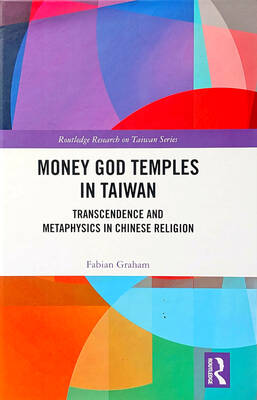
As someone who normally steers clear of books with “transcendence” or “metaphysics” in their subtitles, this reviewer — a casual observer of local belief systems since the 1990s — found Fabian Graham’s Money God Temples in Taiwan a challenging read. Those who’ve only dipped their toes into temple culture will likely need to parse several sections with special care if they’re to keep up with the author, a British ethnographic researcher whose previous books have investigated religious practices among ethnic Chinese in Southeast Asia. This scholarly volume examines a facet of Taiwan’s religious landscape that didn’t exist a century ago, and


 RSS
RSS