


May 18 to May 24
Gathered on Yangtou Mountain (羊頭山) on Dec. 5, 1972, Taiwan’s hiking enthusiasts formally declared the formation of the “100 Peaks Club” (百岳俱樂部) and unveiled the final list of mountains.
Famed mountaineer Lin Wen-an (林文安) led this effort for the Chinese Alpine Association (中華山岳協會). Working with other experienced climbers, he chose 100 peaks above 10,000 feet (3,048m) that featured triangulation points and varied in difficulty and character. The list sparked an alpine hiking craze, inspiring many to take up mountaineering and competing to “conquer” the summits.
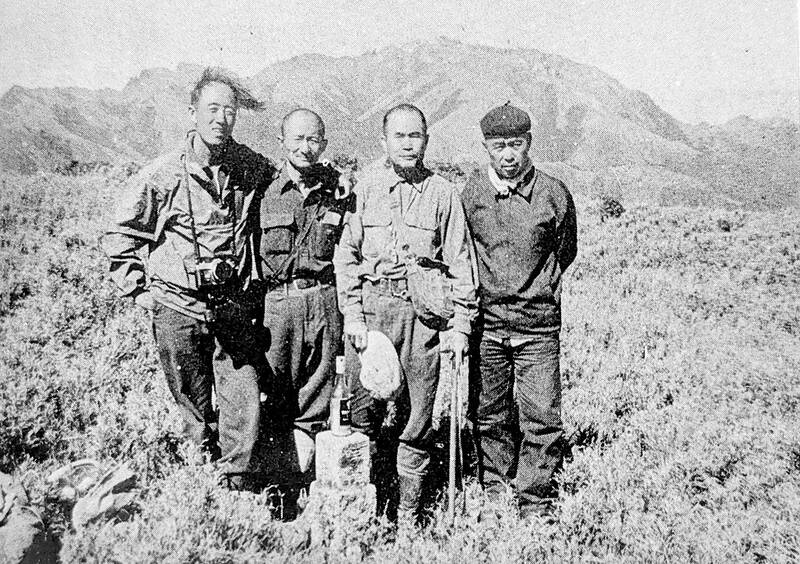
Photo courtesy of National Central Library
A common misconception is that the 100 Peaks represent Taiwan’s 100 tallest mountains. In fact, several fall under the 10,000-foot threshold — such as Lu Mountain (鹿山), which was found to be 2,981m in the 1980s.
There was considerable discussion during that time about reselecting the peaks, but the mountaineering community opted to preserve the original list out of respect for Lin, who died of exhaustion on May 20, 1975 after getting lost while hiking Zhongxue Mountain (中雪山). He was 65.
Today, most people still follow this list.
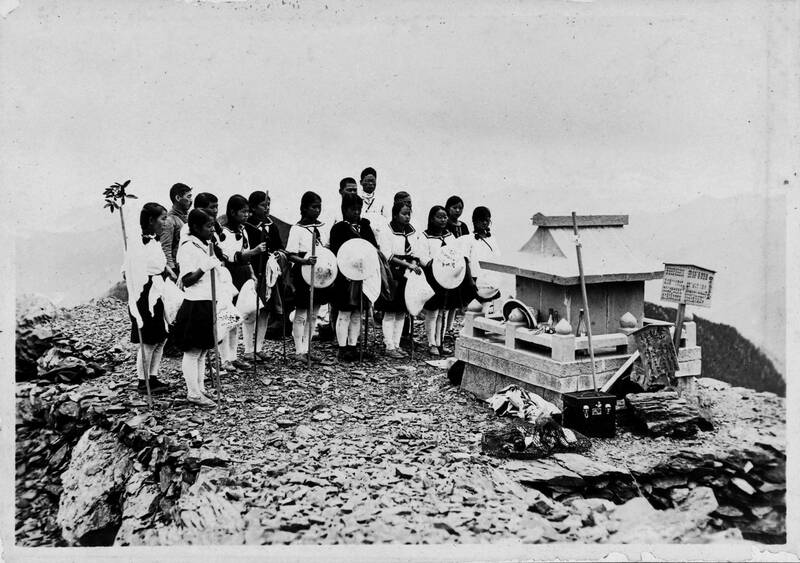
Photo courtesy of National Academy for Education Research
EARLY INTEREST
Recreational mountaineering gained popularity in Taiwan during the 1920s. In 1918 and 1922, the Taiwan News organized expeditions to climb Taiwan’s highest peak, Jade Mountain (玉山), publishing detailed booklets about the journeys that helped spark public interest, writes Lin Mei-chun (林玫君) in Centenary History of Taiwan Mountaineering (台灣登山一百年).
Hiking clubs were formed at schools, and photos from that era often show students summiting Jade Mountain in full uniform. The Taiwan Alpine Association was established in 1926. Its first objective was to summit the treacherous Dabajian Mountain (大霸尖山), completing it the following year with the help of local Indigenous guides and porters.
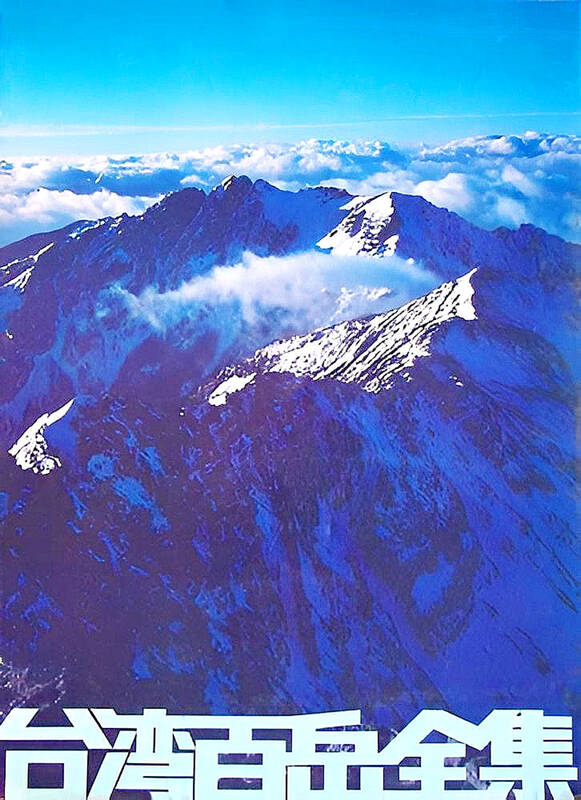
Photo courtesy of Outdoor Life Magazine
At the time, most climbers were Japanese, although there was a significant Taiwanese minority. Mountaineering ceased in 1943 as World War II intensified, and with trails falling into disrepair, activity was slow to resume after the war.
Although the association was revived in May 1946, early postwar activity was limited to occasional hikes in the Taipei area. It was not until former Taipei mayor and tourism advocate Yu Mi-chien (游彌堅) led a New Year’s Day ascent of Jade Mountain in 1952 that a major peak was summited again.
In the following years, the China Youth Corps began organizing mountaineering treks to build character for the anti-communism effort. Access to Taiwan’s peaks remained restricted and hikers had to obtain permits before entering.
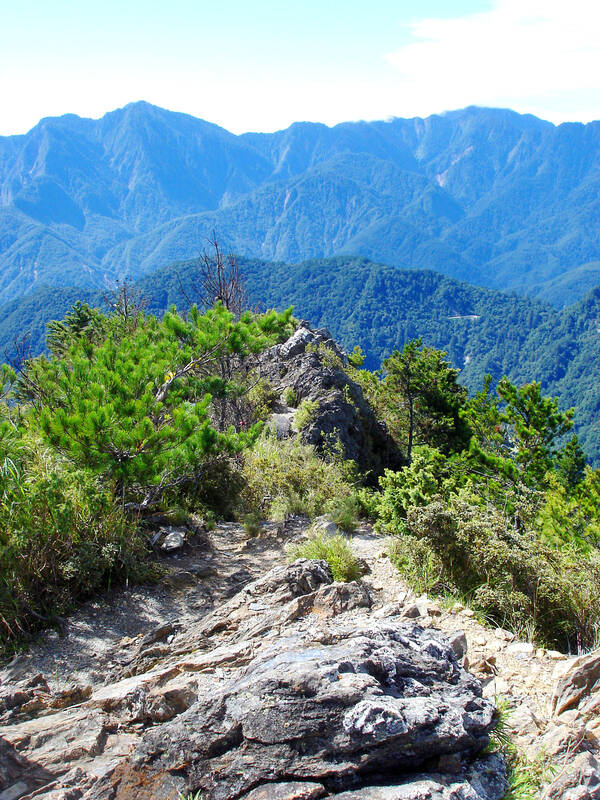
Photo courtesy of Wikimedia Commons
INTREPID PIONEER
Born in Taipei in 1916, Lin developed an early interest in hiking after climbing Guanyin Mountain (觀音山) as a teenager. He took part in various hiking activities during the Japanese era, but it wasn’t until after World War II that he began to focus on Taiwan’s highest peaks, writes Chang Su-bing (張素玢) in History of Mountaineering in Taiwan (台灣登山史).
In January 1955, Lin scaled his first “100 peak” at Beidawu Mountain (北大武山), alongside three companions and Indigenous guides. They also summitted Nandawu (南大武) on the same expedition. The following year, he climbed Hehuan West Peak (合歡西峰) with Hsing Tian-cheng (邢天正), Ting Tung-san (丁同三) and Tsai Ching-chang (蔡景璋) — the quartet would be later dubbed the “Four Heavenly Kings of Mountaineering.”
Lin was known for his meticulous preparation in an era with few resources. Hsing recalled that before each climb, Lin carefully drew detailed ridge-line maps, noting elevations, ascent and descent differentials, and calculating routes from topographic data. He compiled these into small field booklets, which he consulted and updated throughout the expeditions.
Armed with this knowledge, he became a sought-after guide and pioneered many new routes and multi-peak treks. In 1960, during a climb of Xiugulan Mountain (秀姑巒山), a South Korean hiker slipped into a deep ravine. Lin reportedly descended into the riverbed without hesitation and located the severely wounded man.
In 1971, the Alpine Association organized an unprecedented Central Mount Range “grand traverse” to mark the 60th anniversary of the Republic of China. Lin planned the expedition, which covered roughly 300km and included 60 peaks above 3,000m. Two teams set out from opposite ends of the range, meeting in the middle at Cicai Lake (七彩湖) after 32 days.
MAKING THE LIST
Association member Shen Sung-lai (沈送來) first raised the idea of compiling Taiwan’s top 100 peaks, and Lin was tasked with the selection process.
At that time, Hsing was the only person to have completed the full list. Born in Hebei Province, he fled the Chinese Civil War in 1948 and later joined the Nationalist forces in Vietnam. The unit was stranded in Phu Quoc Island before being relocated to Taiwan in 1953.
Hsing did not begin hiking until 1957 at age 47, but within a decade he had climbed more than 200 of Taiwan’s peaks above 3,000m.
A prolific writer, Hsing penned numerous articles and compiled one of Taiwan’s earliest lists of high peaks, grouping them into his own poetic classification system. Although he assisted Lin with the selection process — including proposing the inclusion of Liushun Mountain (六順山), the final peak added to the list — he declined to formally join the 100 Peak Club.
In a 1972 article for Wilderness (野外) magazine, Hsing explained that he climbed mountains “for the sake of climbing mountains,” viewing them as a way to understand the natural world and cultivate character.
This made Lin the first official member of the club, having completed the list when he summited Liwu Main Peak (立霧主山) on May 22, 1972. Ting completed it that November, six days before the club’s inauguration.
However, no new members joined the club over the following year, raising concerns that the challenge was too difficult – until Tsai made it in April 1974. In December 1975, the club gained its first female member, Yang-chang Pi-lien (楊張碧蓮).
Critics have since noted that while the list inspired widespread interest in mountaineering, it turned it into a competition where climbers place too much focus on completing the peaks.
As Hsing told Taiwan Panorama in 1986, “Climbing is not about rushing, nor is it about following others … Every step, every glance upward or downward should be taken with attention; otherwise it is like entering a treasure trove and leaving empty-handed. If that is the case, what does it really mean to have completed the 100 peaks?”
Taiwan in Time, a column about Taiwan’s history that is published every Sunday, spotlights important or interesting events around the nation that either have anniversaries this week or are tied to current events.

Taiwan’s English education system is being pulled apart by three opposing forces. Bilingual Nation 2030 pulls students toward English and global communication. Artificial Intelligence (AI) readiness pulls them toward digital judgment, verification and AI-mediated work. But Taiwan’s old exam culture pulls them back toward memorization, grammar drills, timed reading and correct answers. If the education system keeps using old exams to define success, it risks producing graduates who are neither genuinely bilingual nor genuinely AI-ready, but trained for tasks machines can already perform. The first force is Bilingual Nation 2030. Launched in 2018, the policy aimed to “help Taiwan’s workforce connect
It seems every few days one bumps into one of those “real man” comments in which Taiwan is urged to “face reality” or similar, and “make a deal,” with the speaker implying that soon it will be too late. “Deal” advocates always present themselves as having a superior grip on reality, and the manly ability to make the “hard choice.” Their testosterone-laden language often echoes that of Taiwan sellout advocates. Note that such commentary always specifies a process (“make a deal, work with, make progress”), never the end state of what occupation by a violent authoritarian colonialist state will entail. In
June 1 to June 7 "If all Taiwanese were as afraid of dying as you, then what would happen?” Physician Shih Chiang-nan (施江南) reportedly said this to his wife Chen Chiao-tung (陳焦桐) after she urged him to stop intervening on behalf of Taiwanese soldiers stranded overseas after serving in the Japanese Army during World War II. Shih had clashed with high-ranking officials over the issue, engaged in several heated arguments with Taiwan governor-general Chen Yi (陳儀) and allegedly shouted at general Ko Yuan-fen (柯遠芬), chief of staff of the Taiwan Garrison Command, over

“Taiwan’s Opposition Leader Comes to US With a Message Straight Out of Beijing” read a May 31 headline in the Wall Street Journal. Top US administration officials and members of Congress almost certainly read the WSJ, and if there was a bullet point takeaway that people in Washington should absorb ahead of Chinese Nationalist Party (KMT) Chair Cheng Li-wun’s (鄭麗文) arrival in DC on June 9, that headline is it. The last few columns have discussed this very topic, and the timing is not coincidental. While those top officials likely do not read the Taipei Times, judging by the number


 RSS
RSS