


It seems every few days one bumps into one of those “real man” comments in which Taiwan is urged to “face reality” or similar, and “make a deal,” with the speaker implying that soon it will be too late. “Deal” advocates always present themselves as having a superior grip on reality, and the manly ability to make the “hard choice.” Their testosterone-laden language often echoes that of Taiwan sellout advocates.
Note that such commentary always specifies a process (“make a deal, work with, make progress”), never the end state of what occupation by a violent authoritarian colonialist state will entail. In fact, that is always skirted by advocates of “the deal.” When pressed on what will happen after the deal-breaking of the People’s Republic of China (PRC) herds Taiwanese into concentration camps, remakes Taiwan’s educational system, executes pro-democracy types and plunders its economy, advocates of “the deal” always retreat to: “it depends on the deal.”
CONFLICTED THINKING
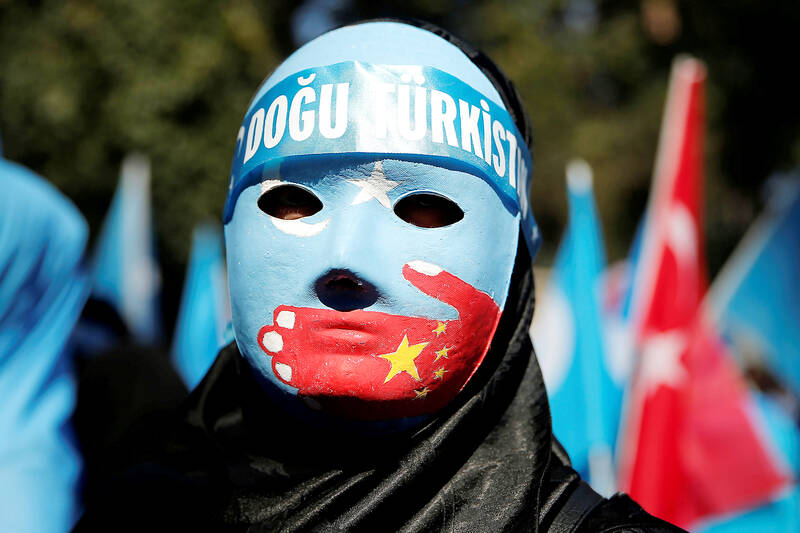
Photo: Reuters
In other words, magical thinking.
This discourse is strange and conflicting in other ways. Typically the same people that urge Taiwan to “make a deal” also deprecate its defensive capabilities and discourage purchases of arms from abroad. Thus, on one hand they argue for dealmaking, on the other, they argue for the removal of the leverage that would increase Taiwan’s position at the negotiating table.
That exposes another issue with this kind of thinking. If Taiwan was better able to resist a PRC attack, then it would not need to make a deal. Hence, advocates of any “deal” must first reduce the nation’s ability to resist. That indeed appears to be the political strategy of certain political parties in Taiwan: start by reducing defense, then finish by demanding a deal that makes Taiwan part of the PRC.
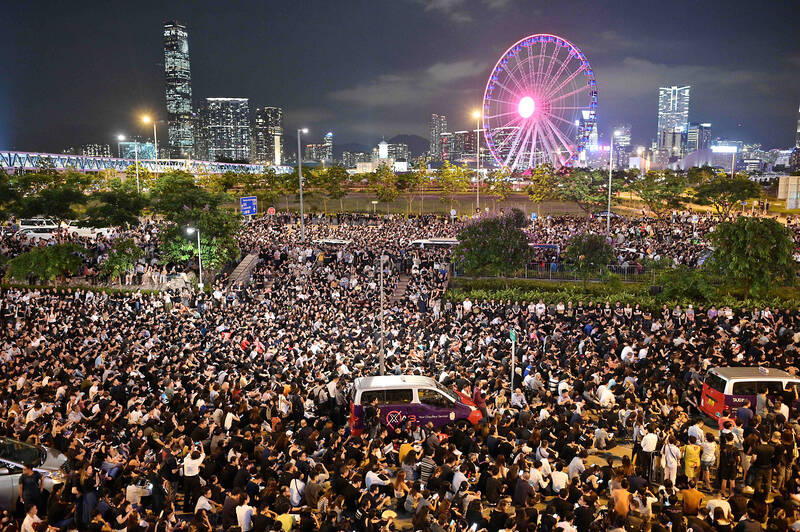
Photo: AFP
Of course, the PRC considers Taiwan to already be part of China. How can it then publicly “make a deal” with “splittists” and “separatists?” One aspect of “make a deal” magical thinking is that it focuses on what Taiwan must do, never considering whether Beijing would ever enter into a “deal.” The massive military build-up, far larger than what Beijing needs to wreck the island’s economy and society, suggests that what Beijing wants is not a deal but unconditional surrender, preferably without a fight.
That runs completely counter to the implied outcome of “make a deal,” under which Taiwan preserves some ghostly autonomy, the details which are always elusive and never specified by deal advocates. PRC dictator Xi Jinping (習近平) said in 2019 that “provided that national sovereignty, security and development interests are ensured, following peaceful reunification, the social system and way of life of our compatriots in Taiwan will be fully respected, and their private property, religious beliefs and legal rights and interests will be fully safeguarded.”
Yes, just as in Tibet and East Turkestan.
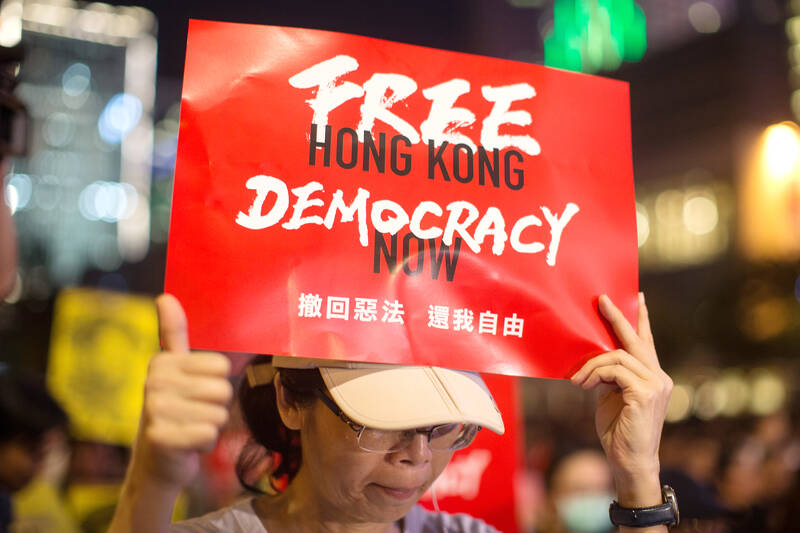
Photo: EPA-EFE
VOLUNTARY SURRENDER
As an excellent piece by Richard McGregor and Jude Blanchette pointed out in a piece published by the Lowy Institute on a future occupation of Taiwan by the PRC, tolerant and inclusive language like Xi’s words above has been gradually eroded and replaced by the more ominous “the complete unification of the motherland” (祖國完全統一).
“This phrase features prominently in Party documents, leadership speeches and scholarly writing,” they observe, adding that “the emphasis on ‘complete’ unification signals that acceptable outcomes must fully eliminate Taiwan’s separate political identity rather than merely managing it.”
Given such an understanding, can any deal be made?
The paradox of “make a deal” is that if the PRC is powerful enough to coerce Taiwan into making a deal, then it does not need to make a deal. It can simply take it. If the PRC isn’t powerful enough to coerce Taiwan into surrender, then there is no point in Taipei making a deal, because Beijing cannot take it. Hence, effectively, advocates of “make a deal” are actually arguing for voluntary surrender (that is why they also attack the military). And we all know what surrender conditions are worth.
Moreover, if time is on the PRC side, as many advocates of “the deal” contend, why should the PRC make a deal? Isn’t Taiwan going to (magically, always magically) come into the fold someday?
HONG KONG KNOWS
In the fantasy world of “make a deal,” Hong Kong plays a pivotal role (never Tibet or East Turkestan). Deal supporters point to Hong Kong: “See? Things aren’t so bad there.” In fact, the “deal” that Hong Kong got, as a 2016 Hong Kong University survey found, increased Hong Kong support for Taiwan independence to new levels, 35 percent overall, the highest ever.
“Among 18-29-year olds, support for Taiwan nationhood stands at 67 percent,” said a Hong Kong Free Press report.
These numbers remained relatively stable through 2018, but rose from 35 to 44 percent in 2019. If joining the PRC peacefully is so wonderful, why did Hong Kongers quickly become supportive of Taiwan independence?
Another reason that the “make a deal” advocates do not talk about the realities of the deal is that it would be a massive betrayal of all of the nations around Taiwan. Once the PRC is ensconced in Taiwan they will redirect their energy to pursuing the wars against Japan and the Philippines, and likely elsewhere, that the PRC has always dreamed of. Advocates of the deal are thus advocates of all the hegemonic, expansionist warfare that will follow. This is another way that “make a deal” types sound remarkably like Taiwan sellout types, always implying that history stops with the “peace deal.” Naturally, good Taiwan boys will be sent to the front lines to fight their former allies, an irony PRC planners will no doubt relish.
Finally, the “make a deal” advocates seem to come from the higher economic strata of society. Partly this is an artifact of selection: such individuals are more likely to have access to the media and leisure time to use it. Rather like the businessman Koo Hsien-jung (辜顯榮) opening the gates of Taipei to the incoming Japanese in 1895, deal advocates often appear to be arguing that Taiwan make a deal that will inevitably spare their wealth, with the clear implication that only the poor and powerless will suffer, after all.
Nothing stops any “make a deal” advocate from moving to the PRC and pursuing a life there, a fact true of all PRC supporters in Taiwan. What these advocates of voluntary surrender really want is for everyone in Taiwan to join them on the funeral pyre of Taiwan’s independence, democracy and economy, like pagan kings who executed their wives and servants to ease their own deaths.
For such people, the cruelty of “making a deal” is the whole point. That, in the end, is why they never specify what the outcome of “the deal” really is.
Notes from Central Taiwan is a column written by long-term resident Michael Turton, who provides incisive commentary informed by three decades of living in and writing about his adoptive country. The views expressed here are his own.

Ajay Verma, a consultant gastroenterologist at Kettering general hospital in Northamptonshire, says our gut is a “complex machine.” “It is constantly providing us with the nutrition we need, initially to grow and develop, and then for us to survive, thrive and repair from injury and illness.” How can we keep it functioning well? Put simply: “Make sure what you put into it is balanced, and that you clear out its waste products adequately,” Verma says. “In a general gastroenterology clinic, the most common conditions we see are irritable bowel syndrome (IBS), gastroesophageal reflux disease, inflammatory bowel disease and constipation,” says Nisha
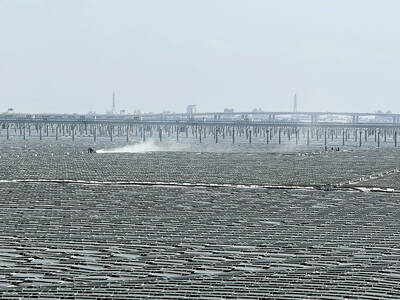
The arithmetic is straightforward and uncomfortable. By the end of 2025, Taiwan had committed itself to a 50-30-20 electricity mix — half natural gas, 30 per cent coal, 20 per cent renewables. The Ministry of Economic Affairs’s (MOEA) own monthly energy reports tell a different story. Natural gas reached 47.8 per cent of generation last year. Coal stood at 35.4 per cent, comfortably above its target ceiling. Renewables came in at 13.1 per cent, well short of the 20 per cent Taipei had pledged a decade earlier. Installed renewable capacity reached roughly half of the 12 gigawatts (GW) the government
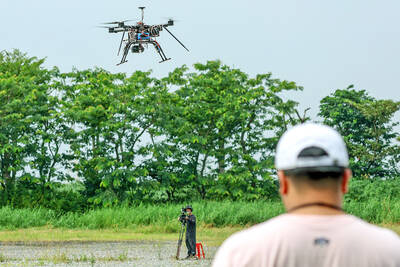
Taiwan’s drone exports are taking off, fuelled by the war in Ukraine, as Taiwanese companies seek a stake in the fast-growing global market for unmanned aerial vehicles (UAV). Low-cost drones used for reconnaissance and strikes are in high demand as governments around the world boost defense spending in the face of intensifying conflicts. A relative new player in the increasingly competitive industry, Taiwan’s pitch is to be an “Asian hub” for the production of UAVs and components free of Chinese materials, or “non-red.” That means its UAVs can be up to three times more expensive than their Chinese competitors, like the world’s biggest
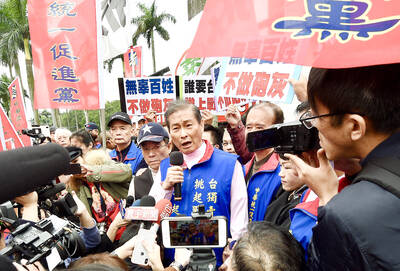
There are shadowy cabals plotting to sell out Taiwan to be annexed by China, by invasion if necessary. Fortunately, they are buffoons. In 2019, former Bamboo Union gangster and founder of the China Unification Promotion Party (CUPP), Chang An-le (張安樂, colorfully known as “White Wolf”), led a protest at the Legislative Yuan against comments made by then-premier Su Tseng-chang (蘇貞昌) that in the event of an attack by China, he would never surrender, but would protect the nation by fighting to the end, even if he only had a broom. Chang had party members bring a wooden casket that they


 RSS
RSS