


Taiwan’s drone exports are taking off, fuelled by the war in Ukraine, as Taiwanese companies seek a stake in the fast-growing global market for unmanned aerial vehicles (UAV).
Low-cost drones used for reconnaissance and strikes are in high demand as governments around the world boost defense spending in the face of intensifying conflicts.
A relative new player in the increasingly competitive industry, Taiwan’s pitch is to be an “Asian hub” for the production of UAVs and components free of Chinese materials, or “non-red.”
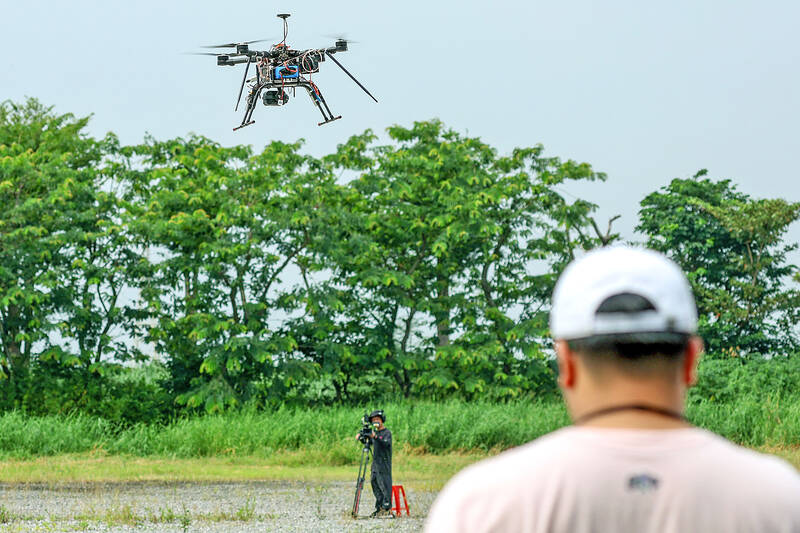
Photo: AFP
That means its UAVs can be up to three times more expensive than their Chinese competitors, like the world’s biggest manufacturer DJI, which benefit from their massive scale. Nevertheless, Taiwanese companies have recorded a surge in sales as Russia’s full-scale invasion of Ukraine, where drones have been used extensively by both sides, drives demand.
China’s export restrictions on drones in recent years have also opened up an opportunity for Taiwanese firms, which have been struggling to secure sufficient sales at home.
“Domestically there’s not enough demand,” said Samara Duerr, a policy analyst at the Research Institute for Democracy, Society and Emerging Technology (DSET), a Taiwan government-backed think tank.
“So it’s reaching internationally to help bring scale and experience so that it has this capacity and knows how to have a surge ability later on.”
Taiwan’s drone exports soared to 181,159 units in the first four months of this year, nearly 20 times higher than the same period last year, and more than the entire year, official trade data show.
The vast majority went to the Czech Republic, followed by Poland. DSET believes most units are bought or funded by charitable organizations and donated to Ukraine.
Max Lo, chairman of AeroSoarX, which makes military and dual-use drones, said Taiwanese companies had to look abroad to stay viable.
Although Taiwan is trying to build a domestic drone industry, budget hold-ups in the opposition-controlled legislature means government orders are not keeping pace.
“If we don’t have the local demand, government support or budget, how can we sustain the production line?” said Lo.
“That’s the reason I visit Ukraine, I visit Poland. I let them know, okay, we have this or that; we have production still available.”
‘DRONE SHIELD’
Taiwan is a global powerhouse in AI technology and semiconductor chip manufacturing, and hopes to build on that experience in the drone industry.
The nation aims to have a monthly production capacity of 100,000 drones by 2030, compared with its previous target of 15,000 by 2028.
Chiou Chyou-huey (邱求慧), director general of the Industrial Development Administration, said the “vast majority” of Taiwan’s drone exports were non-red, but several industry insiders said that they suspect most of them are not.
Taiwan wants to be able to produce enough drones on its own to repel a potential attack from China, which claims the island is part of its territory, and embed itself into global UAV supply chains, like it has done with chips.
“We call it the drone shield,” Lo said. “That will become another protection (for Taiwan).”
But the government’s plan to procure more than 200,000 Taiwanese-made drones as part of a nearly US$40 billion defense spending proposal has been blocked in the legislature, hindering progress.
Taiwanese companies also face challenges breaking into a market already dominated by China — and their drones and components lack battlefield experience.
“Even though it is hard to question Taiwan’s industrial prowess, it is all about this question of practical application,” said Marcin Jerzewski, head of the Taiwan office of the European Values Center for Security Policy.
“Would Taiwanese drones be combat-ready?”
CUT-THROAT COMPETITION
Another issue is that Ukraine, which has become one of the most advanced UAV manufacturing hubs in the world, could stop needing Taiwanese drones once the conflict is over and flood the market with its own units.
Competition is “cut-throat” and growing fast, said Collin Koh, a military expert at the S. Rajaratnam School of International Studies in Singapore.
“Taiwan will have to find its niche,” Koh said.
Where Taiwan can compete against China is in “micro components” such as lithium-ion cells, said Artur Savchii, an analyst at Snake Island Institute, a Ukrainian think tank.
“That’s where Taiwan can replace China and I think this is a big area for cooperation,” Savchii said.
Ultimately every region is striving for “maximum localization” of supply chains, Yaroslav Azhnyuk, founder of Ukrainian drone company The Fourth Law said.
Taiwanese drone makers are increasingly partnering with companies abroad, as they carve out a place in the non-red market. Among them is Thunder Tiger, which has a joint venture to make drone motors in the US state of Ohio.
General manager Gene Su said he sees the biggest opportunities in the United States where concerns over Chinese security threats are driving demand for non-red drones and components.
Thunder Tiger also wants to set up production lines in Europe but countries there are more price sensitive, Su said.
“Once we’re getting bigger, our costs are lower, and then we can compete with the Chinese,” he said.
Ajay Verma, a consultant gastroenterologist at Kettering general hospital in Northamptonshire, says our gut is a “complex machine.” “It is constantly providing us with the nutrition we need, initially to grow and develop, and then for us to survive, thrive and repair from injury and illness.” How can we keep it functioning well? Put simply: “Make sure what you put into it is balanced, and that you clear out its waste products adequately,” Verma says. “In a general gastroenterology clinic, the most common conditions we see are irritable bowel syndrome (IBS), gastroesophageal reflux disease, inflammatory bowel disease and constipation,” says Nisha

And so, in the wake of US President Donald Trump’s trip to the People’s Republic of China (PRC), all the experts on the Strait of Hormuz suddenly became experts on US-China-Taiwan relations. The Internet has certainly expanded human knowledge. Lots of these sudden experts made noise this week about Trump’s words after the meeting with PRC dictator Xi Jin-ping (習近平). Trump is going to sell out Taiwan! Longtime Taiwan commentator J. Michael Cole summed the situation up neatly in the Guardian: “We need to keep in mind that he has a tendency to say many things — sometimes contradicting himself within
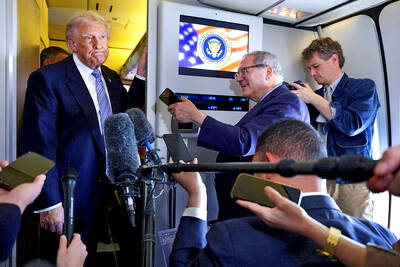
Last week US President Donald Trump was asked by a reporter whether he would speak on the phone to the President of Taiwan. “l’ll speak to him. I speak to everybody. We have that situation very well in hand,” Trump said. This marked the second time in a couple of weeks he had said he would talk to the President of Taiwan. In 2016 he famously took a call from then-president Tsai Ing-wen (蔡英文), when he was president-elect. Despite warnings that the apocalypse was nigh because of a phone call, the world quickly forgot about the conversation between two democratically-elected presidents.
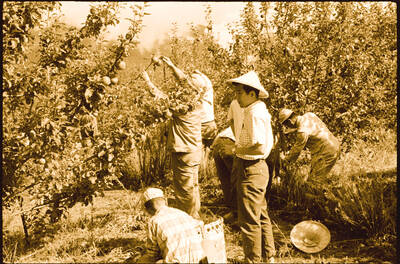
May 25 to May 31 Few believed that apples could be cultivated on a commercial scale in Taiwan’s high mountains. When horticulturalist Cheng Chao-hsiung (程兆熊) first proposed the idea in 1955, both American and Taiwanese colleagues dismissed it as implausible, arguing that temperate fruit could not be reliably grown on a subtropical island, especially on rugged terrain. However, it was this terrain in the Central Mountain Range where many Chinese Civil War veterans were resettled in the late 1950s. With limited job prospects and no family in Taiwan, they were placed on cooperative farms aimed toward self-sufficiency. Some say the conditions


 RSS
RSS