


The Taiwanese and Chinese coast guards had a standoff near the strategically located Pratas Islands (Dongsha Islands, 東沙群島) in the north of the South China Sea, the Coast Guard Administration (CGA) said yesterday.
The two sides engaged in intense radio exchanges over sovereignty claims during the 33-hour standoff. China Coast Guard vessel 3501 eventually left the restricted waters, 26.6 nautical miles (49.2km) west of the Pratas Islands, at 5pm yesterday, the CGA said.
Lying approximately between southern Taiwan and Hong Kong, the Taiwan-controlled Pratas are seen by some security experts as vulnerable to Chinese attack due to their distance — more than 400km from Taiwan proper.
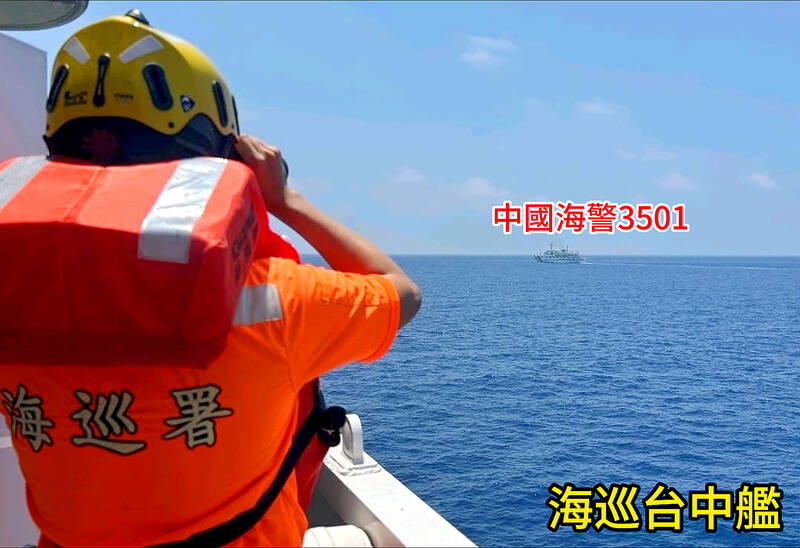
Photo courtesy of the CGA
The CGA said on Saturday it had spotted China Coast Guard vessel 3501 heading to the Pratas and immediately sent its own ship, which broadcast warnings, and the two sides “engaged in an intense verbal confrontation over sovereignty via radio.”
The Chinese ship broadcast that it was on a routine mission.
“The People’s Republic of China has sovereignty and jurisdiction over the Dongsha Islands,” it broadcast. “Our vessel is conducting a routine patrol mission. Please do not interfere with our operations.”
The CGA ship responded, according to video provided by the government.
“Your actions only show that China’s so-called ‘peace’ is a deception, and the international community will not support you. Do not undermine peace; instead, you should return and pursue democracy, which is the proper way to serve your country,” the CGA ship broadcast. “You are instructed to immediately change course and leave our waters. Otherwise, our vessel will take necessary action in accordance with the law.”
China’s Taiwan Affairs Office did not respond to a request for comment.
China’s wording on having jurisdiction and sovereignty was unusual, as was the length of its stay in the waters so close to the Pratas, said a CGA official, speaking on condition of anonymity due to the sensitivity of the situation.
The coast guard said on Friday night it had driven off the Chinese research ship Tongji (同濟號) in waters close to the island for the second time this month.
The Pratas atoll, which is also a national park, is only lightly defended, protected by the coast guard rather than the military.
In January, the government said a Chinese reconnaissance drone flew over the Pratas.
According to the CGA, China operates more than 120 oceanographic research vessels, which have been increasingly active across the Indo-Pacific, including about 41 operating near Taiwan.
It added that over the past three years, their range has expanded from the First Island Chain to the Second Island Chain, reaching as far as Guam, and even into the Third Island Chain, including Hawaii.
On Saturday, National Security Council Secretary-General Joseph Wu (吳釗燮) detailed the 100 Chinese ships operating in the First Island Chain in a social media post.

DRONE CENTRAL: Taiwan aims to become Asia’s democratic hub for drones, with most exports focused on high-quality military-grade models, an official said Taiwan’s drone industry is expected to expand significantly by 2030, producing 100,000 units per month and exporting half of them, the Ministry of Economic Affairs said yesterday. Current drone production capacity is about 15,000 units per month, but the industry can quickly scale up as demand increases, Industrial Development Administration Director-General Chiou Chyou-huey (邱求慧) told a news conference in Taipei. Taiwan’s drone output grew 2.5-fold last year to NT$12.9 billion (US$408.3 million) under a government program to develop the uncrewed vehicle sector, he said. The Executive Yuan in October last year approved plans to invest NT$44.2 billion into domestic production of uncrewed aerial
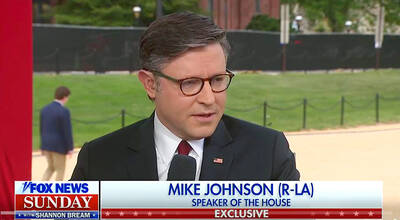
RESOLUTE BACKING: Two Republican senators are planning to introduce legislation that would impose immediate sanctions on China if it attempts to invade Taiwan US House of Representatives Speaker Mike Johnson on Sunday reaffirmed US congressional support for Taiwan, saying the US and “all freedom-loving people” have a stake in preventing China from seizing Taiwan by force. Johnson made the remarks in an interview with Fox News Sunday on US President Donald Trump’s summit with Chinese President Xi Jinping (習近平) last week. In an interview that aired on Friday on Fox News, just as Trump wrapped up a high-stakes visit to China, he said he has yet to green-light a new US$14 billion arms package to Taiwan and that it “depends on China.” “It’s a very good
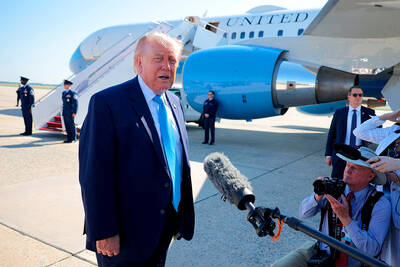
US President Donald Trump yesterday said he would speak to President William Lai (賴清德) as his administration considers whether to move ahead with a US$14 billion weapons sale to Taiwan — a potential arms deal that has drawn criticism from China. “Well, I’ll speak to him. I speak to everybody,” Trump told reporters yesterday when asked if he had any plans to call his counterpart, although he did not offer a time frame for when such a conversation could take place. Trump previously said he would speak to the person “that’s running Taiwan,” without specifying who he meant. “We have that situation very

SPEAKING UP: If he had the opportunity to talk with Trump, Lai said he would tell the US president that China was undermining peace in the region The future of Taiwan must not be decided by external forces nor can it be held hostage by fear, division or short-term gain, President William Lai (賴清德) said yesterday in an address marking the second anniversary of his inauguration. Speaking at the Presidential Office, Lai said democracy is the most important part of Taiwan’s identity, and it is not a gift from heaven. Taiwan’s democracy is rooted in the sacrifices and devotion of many generations, and while differences are inevitable, he urged the ruling and opposition parties to demonstrate unity in confronting external threats and upholding national interests. “Taiwan’s future cannot be decided


 RSS
RSS