


A signaling system malfunction disrupted high-speed rail (HSR) services beginning at 8am today, with trains temporarily reduced to three northbound and three southbound trains per hour as authorities conduct inspections.
The malfunction occurred on a section of track in Miaoli County during pre-operation checks early this morning, forcing northbound and southbound trains to use a single track, the HSR operator said.
The regular schedule has been replaced with three hourly trains offering only nonreserved seating in each direction, stopping at every station, it said, adding that business class cars would still have reserved seating.
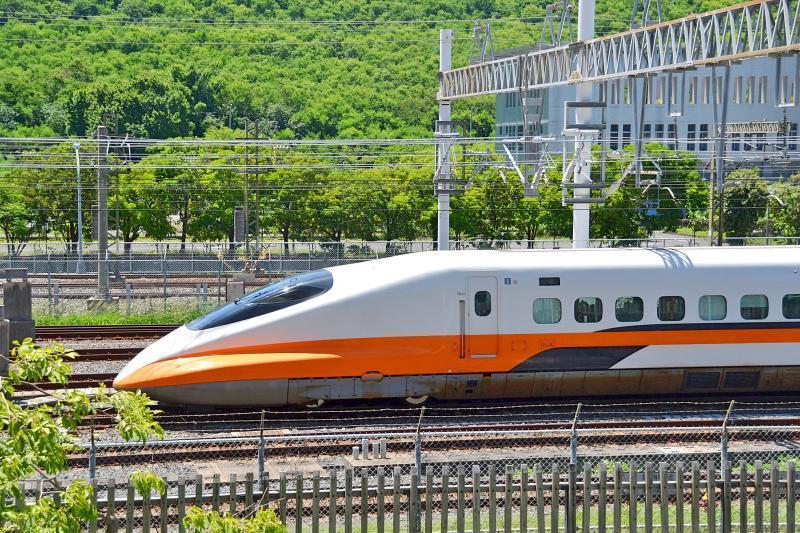
Photo: Hou Cheng-hsu, Taipei Times
Departures from terminal stations are scheduled at the top of the hour, 20 minutes past and 40 minutes past, it said.
Passengers who arrive at their destination 30 to 60 minutes late would be offered a 50 percent refund, while those who arrive more than an hour late or do not use their tickets may receive a full refund, the HSR said.
Passengers with reserved-seat tickets who board trains today could also receive a refund of the price difference at any HSR ticket office within one year of the ticket's departure date, the railway said.
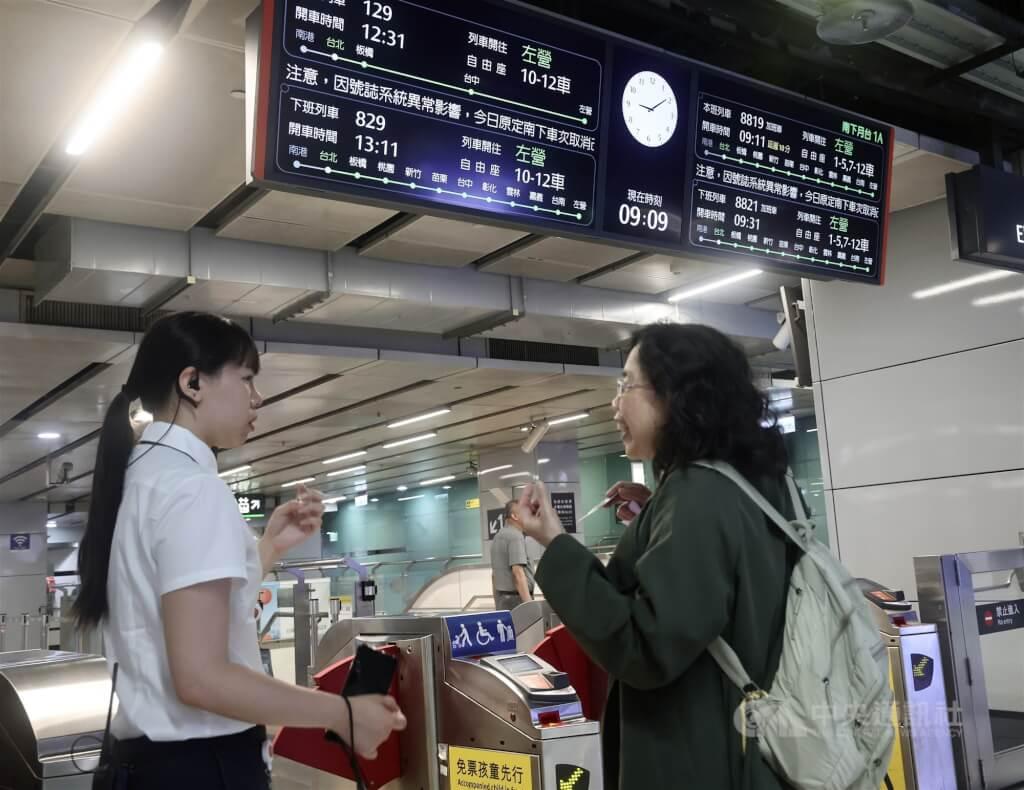
Photo: CNA
At the start of a meeting of the Legislative Yuan’s Transportation Committee this morning, which was delayed due to the HSR malfunction causing officials to be late, Deputy Minister of Transportation and Communications Lin Kuo-hsien (林國顯) said that emergency response protocols had been activated and the Taiwan Railways Corp is coordinating alternative transport.
A full system inspection would not be carried out until tonight, he added.
The HSR carries up to 240,000 passengers per day and more than 300,000 on holidays, Democratic Progressive Party Legislator Lee Kun-tse (李昆澤) said to emphasize the impact of the malfunction.
The disruption has not only delayed the committee meeting, but also significantly affected people’s work, daily life and schooling, Lee said.
There were 25 rail operation incidents in 2024 and 43 last year, as well as multiple delays already occurring this year, he said, highlighting the need for the Ministry of Transportation and Communications to address these issues as soon as possible.
Signaling failures are rare, but pose a serious disruption, Chinese Nationalist Party (KMT) Legislator Hung Meng-kai (洪孟楷) said, urging authorities to prepare for the possibility that normal reserved-seat services may not resume today.
Passengers traveling today should be informed in advance so they can arrive at their station early or otherwise adjust their plans, Hung said.
The issue has been reported to safety authorities and is being investigated, but as the system cannot be fully shut down, repairs cannot be carried out yet, Lin said, adding that the reduced service would continue for now.
The last major HSR delay occurred on April 25, 2013. It was also the first large-scale, system-wide suspension that was not caused by a natural disaster since its opening six years prior.
At that time, a malfunction in the signaling equipment at Taichung Station prevented trains from departing for the first service of the day, leading to a suspension of services for about four hours.
Service gradually resumed on the Taipei-Hsinchu section starting at about 9:30am, and full operations were restored at 11:30am.
A total of 21 southbound and 23 northbound trains were canceled, affecting about 35,000 passengers.
Additional reporting by CNA

DRONE CENTRAL: Taiwan aims to become Asia’s democratic hub for drones, with most exports focused on high-quality military-grade models, an official said Taiwan’s drone industry is expected to expand significantly by 2030, producing 100,000 units per month and exporting half of them, the Ministry of Economic Affairs said yesterday. Current drone production capacity is about 15,000 units per month, but the industry can quickly scale up as demand increases, Industrial Development Administration Director-General Chiou Chyou-huey (邱求慧) told a news conference in Taipei. Taiwan’s drone output grew 2.5-fold last year to NT$12.9 billion (US$408.3 million) under a government program to develop the uncrewed vehicle sector, he said. The Executive Yuan in October last year approved plans to invest NT$44.2 billion into domestic production of uncrewed aerial
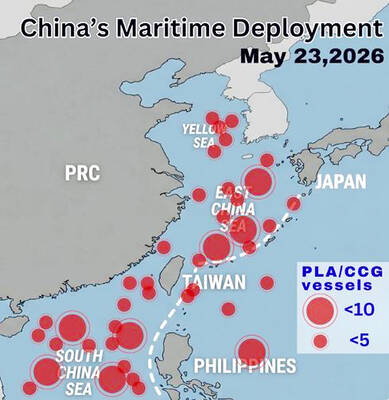
WARNING: China should stop engaging in actions that undermine regional peace and stability, as it would only build resentment among people across the Strait, the CGA said China has deployed more than 100 navy, coast guard and other vessels in waters from the Yellow Sea to the South China Sea and the western Pacific since US President Donald Trump and Chinese President Xi Jinping (習近平) met in Beijing, National Security Council Secretary-General Joseph Wu (吳釗燮) said yesterday. “In this part of the world, #China is the one & only PROBLEM wrecking the #StatusQuo & threatening regional peace & stability,” Wu wrote on X. In a separate post, he said Beijing was coercing Taiwan’s maritime domain, calling it illegal and provocative, after the Coast Guard Administration (CGA) expelled a

VERBOSE VESSELS: A CGA cutter and a China Coast Guard exchanged verbal barbs for more than a day in Taiwanese-controlled waters before the Chinese vessel left The Taiwanese and Chinese coast guards had a standoff near the strategically located Pratas Islands (Dongsha Islands, 東沙群島) in the north of the South China Sea, the Coast Guard Administration (CGA) said yesterday. The two sides engaged in intense radio exchanges over sovereignty claims during the 33-hour standoff. China Coast Guard vessel 3501 eventually left the restricted waters, 26.6 nautical miles (49.2km) west of the Pratas Islands, at 5pm yesterday, the CGA said. Lying approximately between southern Taiwan and Hong Kong, the Taiwan-controlled Pratas are seen by some security experts as vulnerable to Chinese attack due to their distance — more than
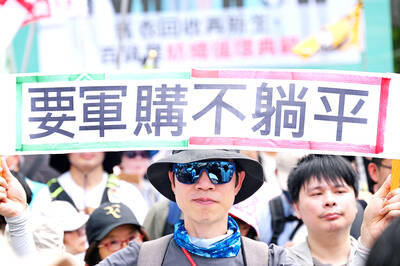
More than 8,000 people took part in a rally in Taipei yesterday to express support for more defense spending, after the opposition slashed the Cabinet’s proposed NT$1.25 trillion (US$39.6 billion) special defense budget and capped it at NT$780 billion. The demonstrators urged the Cabinet to propose another bill. Taiwan Economic Democracy Union convener Lai Chung-chiang (賴中強) said the main problem of the passed budget plan is the removal of funding for critical items, not just that the total amount is smaller. Critical budget items included purchasing or developing uncrewed vehicles, Strong Bow (強弓) missile systems, additional ammunition, artificial intelligence-powered combat systems and Taiwan-US


 RSS
RSS