


China has deployed more than 100 navy, coast guard and other vessels in waters from the Yellow Sea to the South China Sea and the western Pacific since US President Donald Trump and Chinese President Xi Jinping (習近平) met in Beijing, National Security Council Secretary-General Joseph Wu (吳釗燮) said yesterday.
“In this part of the world, #China is the one & only PROBLEM wrecking the #StatusQuo & threatening regional peace & stability,” Wu wrote on X.
In a separate post, he said Beijing was coercing Taiwan’s maritime domain, calling it illegal and provocative, after the Coast Guard Administration (CGA) expelled a Chinese research vessel that intruded in Taiwan’s restricted waters.
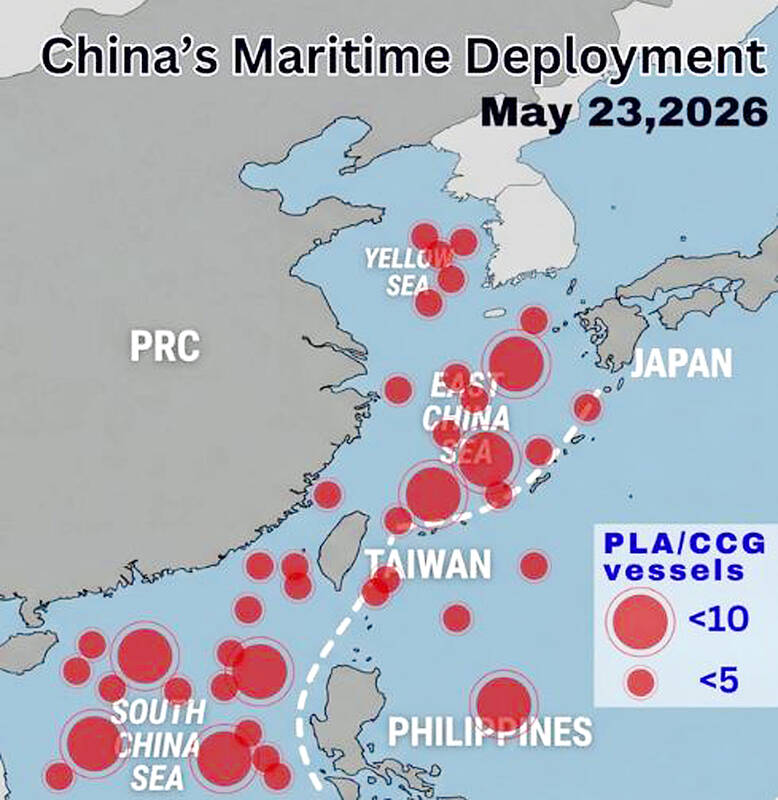
Photo: Screen grab from National Security Council Secretary-General Joseph Wu’s X account
Wu also attached a video with English subtitles to the post, showing Taiwan’s efforts to counter China’s intrusions into the nation’s exclusive economic zone.
Beijing has made becoming a maritime power a core strategy, the video said.
China has more than 120 oceanographic research vessels of various types, which have expanded their operations across the Indo-Pacific region, it said.
Over the past three years, Chinese vessels’ area of activity has expanded from the first island chain to the third island chain, even reaching Hawaii, the video said, adding that China’s navigation range has expanded to the Indian Ocean, the Atlantic Ocean, Australia and the Arctic Ocean.
When the Chinese oceanographic research vessel Tong Ji (同濟號) entered Taiwan’s contiguous zone — its 24 nautical mile (44.4km) zone of restricted waters — earlier this month, the coast guard immediately dispatched vessels to monitor it, the video said.
It showed footage of the coast guard broadcasting warnings to the Chinese ship, telling it that it was in restricted waters, and to retrieve its sampling equipment and “leave immediately.”
“For those entering Taiwan’s waters, CGA vessels maintain continuous monitoring and assertively expel them,” the video said.
It also called upon like-minded countries to jointly uphold the rules-based international order and deter illegal Chinese surveying to “ensure peace, stability and prosperous development in the Indo-Pacific region.”
The coast guard said it has twice this month detected the Tong Ji in waters around Taiwan.
The vessel was observed lowering into the water ropes suspected to be holding scientific instruments for “illegal” survey operations, it added.
After the Tong Ji ignored its warnings, the coast guard approached it, and rocked the vessel and used searchlights to interfere with its operations, forcing the Chinese ship to retrieve its equipment and sail out of Taiwanese waters, the coast guard said.
Ocean Affairs Council Minister Kuan Bi-ling (管碧玲) on Friday said that by using non-military research vessels to intrude into Taiwan’s waters, China is trying to blur the boundaries of restricted waters around Taiwan proper and its outlying islands, as well as test the coast guard’s law enforcement capabilities and deplete its resources.
The incursions have significant strategical meaning, as data collected could help the Chinese People’s Liberation Army gather hydrological data, acoustic signatures and anti-submarine data on the Taiwan Strait, Kuan said.
The Tong Ji during its mission near Taiwan from Friday last week to Wednesday deployed research equipment including a conductivity-temperature-depth system, a turbulence profiler and a gravity corer, likely to conduct seawater sampling and seabed surveys, the coast guard said, adding that such data could be used for strategic military purposes.
Taiwan’s maritime sovereignty would not be provoked, the coast guard said, warning China against actions that undermine regional peace and stability, as it would only breed resentment among the people on both sides of the Strait.
Additional reporting by AFP and Chiu Chun-fu
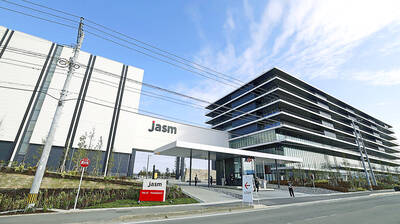
The subsidiary of Taiwan Semiconductor Manufacturing Co (TSMC, 台積電) in Kumamoto, Japan, turned a profit in the first quarter of this year, marking the first time the first fab of the unit has become profitable since mass production started at the end of 2024. According to the contract chipmaker’s financial statement released on Friday, Japan Advanced Semiconductor Manufacturing Inc (JASM), a joint venture running the fab in Kumamoto, posted NT$951 million (US$30.19 million) in profit in the January-to-March period, compared with a loss of NT$1.39 billion in the previous quarter, and a loss of NT$3.25 billion in the first quarter of
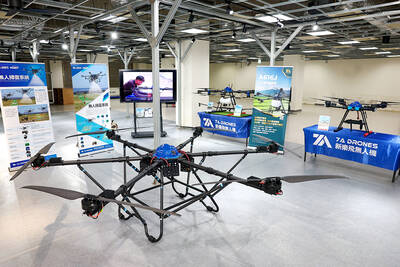
DRONE CENTRAL: Taiwan aims to become Asia’s democratic hub for drones, with most exports focused on high-quality military-grade models, an official said Taiwan’s drone industry is expected to expand significantly by 2030, producing 100,000 units per month and exporting half of them, the Ministry of Economic Affairs said yesterday. Current drone production capacity is about 15,000 units per month, but the industry can quickly scale up as demand increases, Industrial Development Administration Director-General Chiou Chyou-huey (邱求慧) told a news conference in Taipei. Taiwan’s drone output grew 2.5-fold last year to NT$12.9 billion (US$408.3 million) under a government program to develop the uncrewed vehicle sector, he said. The Executive Yuan in October last year approved plans to invest NT$44.2 billion into domestic production of uncrewed aerial
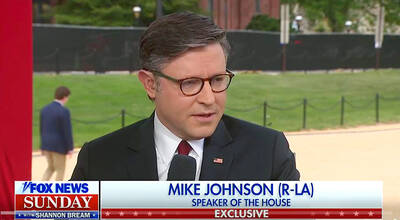
RESOLUTE BACKING: Two Republican senators are planning to introduce legislation that would impose immediate sanctions on China if it attempts to invade Taiwan US House of Representatives Speaker Mike Johnson on Sunday reaffirmed US congressional support for Taiwan, saying the US and “all freedom-loving people” have a stake in preventing China from seizing Taiwan by force. Johnson made the remarks in an interview with Fox News Sunday on US President Donald Trump’s summit with Chinese President Xi Jinping (習近平) last week. In an interview that aired on Friday on Fox News, just as Trump wrapped up a high-stakes visit to China, he said he has yet to green-light a new US$14 billion arms package to Taiwan and that it “depends on China.” “It’s a very good
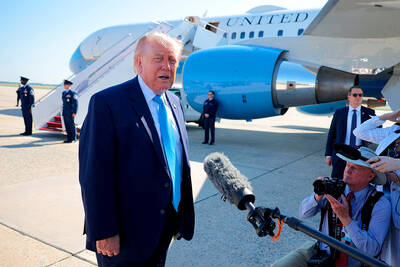
US President Donald Trump yesterday said he would speak to President William Lai (賴清德) as his administration considers whether to move ahead with a US$14 billion weapons sale to Taiwan — a potential arms deal that has drawn criticism from China. “Well, I’ll speak to him. I speak to everybody,” Trump told reporters yesterday when asked if he had any plans to call his counterpart, although he did not offer a time frame for when such a conversation could take place. Trump previously said he would speak to the person “that’s running Taiwan,” without specifying who he meant. “We have that situation very


 RSS
RSS