


US President Donald Trump yesterday said he would speak to Taiwanese President William Lai (賴清德) as his administration considers whether to move ahead with a US$14 billion weapons sale to the self-ruling island - a potential arms deal that has drawn criticism from China.
“Well, I’ll speak to him. I speak to everybody,” Trump told reporters yesterday when asked if he had any plans to call his counterpart, although he did not offer a timeframe for when such a conversation could take place.
Trump has previously said he would speak to the person “that’s running Taiwan,” without specifying who he meant.
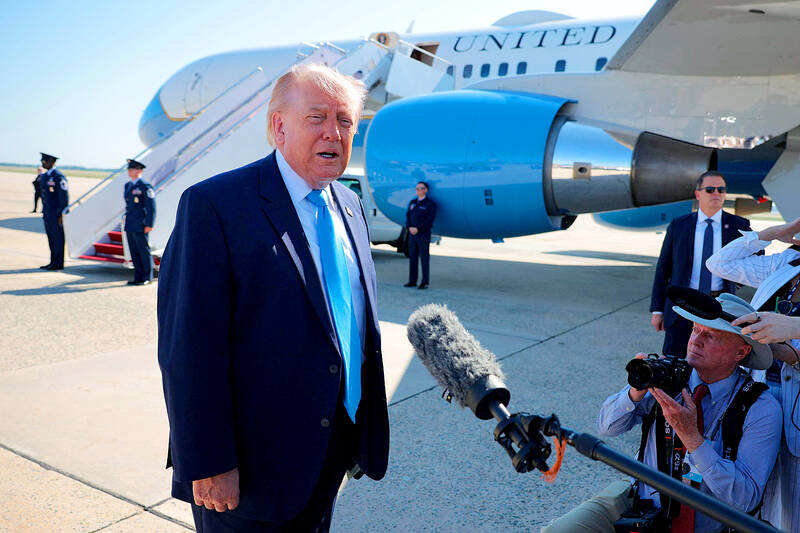
Photo: Getty Images via AFP
“We have that situation very well in hand. We had a great meeting with President Xi,” Trump added. “We’ll work on that Taiwan problem.”
Trump’s comments follow a summit with Chinese President Xi Jinping (習近平) last week in Beijing in which the Chinese president delivered a blunt warning that relations between the world’s two largest economies could descend into conflict if they did not manage the issue of Taiwan properly.
A democratically self-governing island that China claims as its territory, Taiwan has long been a geopolitical flashpoint between Washington and Beijing. China has opposed the pending US arms package for Taiwan. Scrapping the sale, however, could draw bipartisan scrutiny in Washington.
Trump said last week he did not make any commitment to Xi about the pending sale and that he would make a decision on the matter in a “fairly short period” of time.
Meanwhile, President William Lai Ching-te (賴清德) yesterday, on the second anniversary of his inauguration, told a press conference that if he could speak directly with Trump, he would convey that Taiwan is committed to maintaining the status quo in the Taiwan Strait and continuing to strengthen its self- defense capabilities in response to growing military pressure from China.
He said China is the main destabilizing force in the region, as Beijing continues to expand its military presence in the East and South China seas while carrying out exercises extending into the western Pacific.
In contrast, Lai said, “Taiwan is a guardian of peace and stability in the Taiwan Strait,” and he reiterated that Taiwan is a sovereign and independent country whose democratic way of life should not be viewed as provocative.
“No country has the right to annex Taiwan,” he said.
Lai also said “we hope this military procurement can continue,” referring to a pending US$14 billion arms package the US is considering selling to Taiwan.
The US has a long-standing policy of strategic ambiguity over whether it would come to the aid of Taiwan if it is attacked by China, with Washington reserving the right to use force but never explicitly saying whether it would actually intervene. But negotiating any arms transfers with Xi risks flouting diplomatic policy.
US-Taiwan relations have been dictated since 1982 by US President Ronald Reagan’s “six assurances,” which take a deliberately vague stance toward the island’s sovereignty but explicitly state that the US would not consult with China on arms sales to Taiwan and would not revise the Taiwan Relations Act, which requires Washington to provide the island with defensive arms.
Taiwan Semiconductor Manufacturing Co (TSMC, 台積電), the world’s largest foundry service provider, yesterday said that global semiconductor revenue is projected to hit US$1.5 trillion in 2030, after the figure exceeds US$1 trillion this year, as artificial intelligence (AI) demand boosts consumption of token and compute power. “We are still at the beginning of the AI revolution, but we already see a significant impact across the whole semiconductor ecosystem,” TSMC deputy cochief operating officer Kevin Zhang (張曉強) said at the company’s annual technology symposium in Hsinchu City. “It is fair to say that in the past decade, smartphones and other mobile devices were
US-CHINA SUMMIT: MOFA welcomed US reassurance of no change in its Taiwan policy; Trump said he did not comment when Xi talked of opposing independence US President Donald Trump yesterday said he has not made a decision on whether to move forward with a major arms package for Taiwan after hearing concerns about it from Chinese President Xi Jinping (習近平). Trump’s comments on Taiwan came as he flew back to Washington after wrapping up critical talks in which both leaders said important progress was made in stabilizing US-China relations even as deep differences persist between the world’s two biggest powers on Iran and Taiwan. “I will make a determination,” Trump said, adding: “I’ll be making decisions. But, you know, I think the last thing we need right
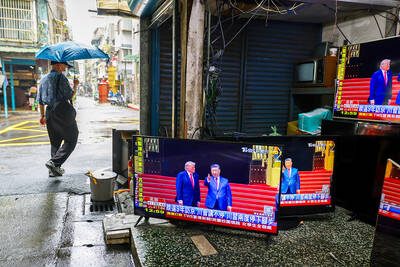
TAIWAN ISSUE: US treasury secretary Scott Bessent said on the first day of meetings that ‘it wouldn’t be a US-China summit without the Taiwan issue coming up’ There were no surprises on the first day of the summit between US President Donald Trump and Chinese President Xi Jinping (習近平), the Mainland Affairs Council (MAC) said yesterday, as the government reiterated that cross-strait stability is crucial to the Asia-Pacific region, as well as the world. As the two presidents met for a highly anticipated summit yesterday, Chinese state media reported that Xi warned Trump that missteps regarding Taiwan could push their two countries into “conflict.” Trump arrived in China with accolades for his host, calling Xi a “great leader” and “friend,” and extending an invitation to visit the White House
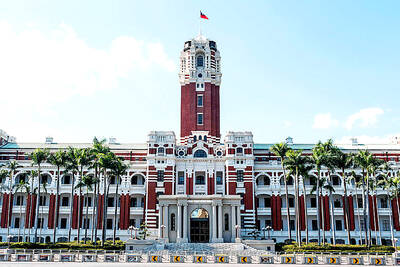
SECURITY: Taipei presses the US for arms supplies, saying the arms sales are not only a reflection of the US security commitment to Taiwan but also serve as a mutual deterrent against regional threats Taiwan is committed to preserving the cross-strait “status quo” and contributing to regional peace and stability, the Presidential Office said yesterday. “It is an undeniable fact that the Republic of China is a sovereign and independent democratic nation,” Presidential Office spokeswoman Karen Kuo (郭雅慧) reiterated, adding that Beijing has no right to claim sovereignty over Taiwan. The statements came after US President Donald Trump warned against Taiwanese independence. Trump wrapped up a state visit to Beijing on Friday, during which Chinese President Xi Jinping (習近平) had pressed him not to support Taiwan. Taiwan depends heavily on US security backing to deter China from carrying


 RSS
RSS