


US President Donald Trump yesterday said he has not made a decision on whether to move forward with a major arms package for Taiwan after hearing concerns about it from Chinese President Xi Jinping (習近平).
Trump’s comments on Taiwan came as he flew back to Washington after wrapping up critical talks in which both leaders said important progress was made in stabilizing US-China relations even as deep differences persist between the world’s two biggest powers on Iran and Taiwan.
“I will make a determination,” Trump said, adding: “I’ll be making decisions. But, you know, I think the last thing we need right now is a war that’s 9,500 miles [15,289km] away.”
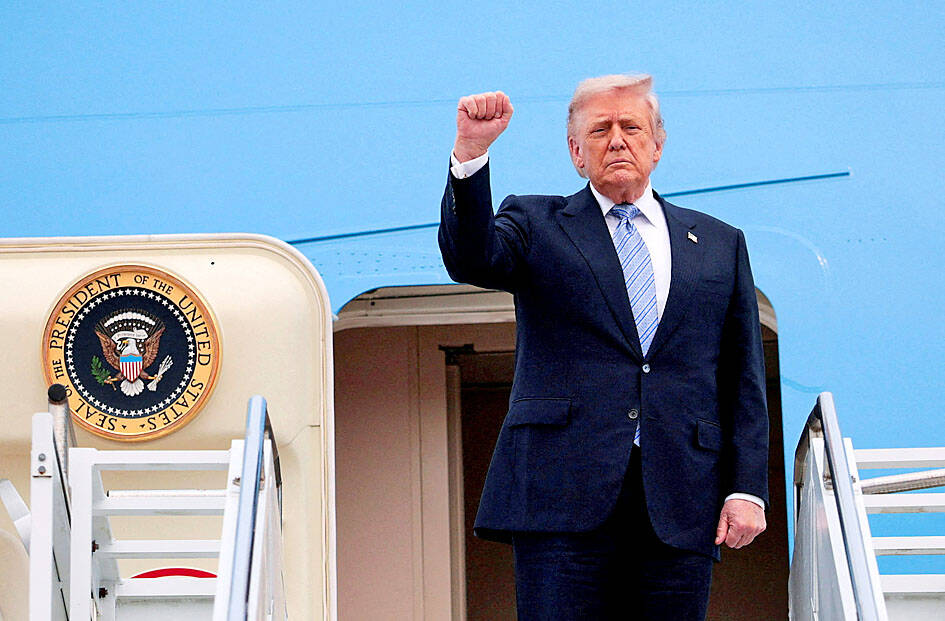
Photo: Reuters
The Trump administration in December authorized a record-setting US$11 billion weapons package for Taipei, but it has yet to move forward. Lawmakers also approved a US$14 billion arms sale to Taiwan in January, but the sale cannot advance until Trump formally sends it to Congress. China opposes such sales and has suggested that Washington’s relationship with Taiwan is the key factor in US-China ties.
The US president said Xi also reiterated China’s strong opposition to Taiwan’s independence
“I heard him out,” Trump said. “I didn’t make a comment.”
Photo: CNA
In Taipei, the Ministry of Foreign Affairs (MOFA) said in a statement last night that arms sales to Taiwan are not only a clear security commitment under the Taiwan Relations Act, but also a form of collective deterrence against regional threats.
It thanked Trump for his continued support for security in the Taiwan Strait since his first term, adding that close Taiwan-US cooperation has long been a cornerstone of stability in the region.
The statement also said Taiwan is a sovereign and independent democracy, and that China’s military threat remains the region’s primary source of insecurity.
With Beijing continuing to expand its military capabilities, project power globally, and conduct operations around the Taiwan Strait such as gray-zone tactics and military harassment, the ministry said effective collective deterrence is crucial to maintaining regional peace and stability.
Taiwan’s foremost priority is to preserve the status quo and uphold its self-defense capabilities, protect the freedom and democracy of 23 million people, and ensure that peace and stability in the Taiwan Strait are not undermined, it said.
Minister of Foreign Affairs Lin Chia-lung (林佳龍) also welcomed US reassurance on no change in its Taiwan policy.
A MOFA statement released earlier yesterday said Taiwan was closely monitoring developments in US-China relations and took note of remarks made by US Secretary of State Marco Rubio during an interview with NBC News in Beijing on Thursday following the first day of Trump-Xi meetings.
Rubio confirmed that Taiwan came up in Trump’s talks with Xi, but added that the US policy toward Taiwan is unchanged.
US arms sales to Taiwan “did not feature prominently” in the Trump-Xi talks, Rubio was quoted by NBC News as saying.
Xi told Trump that mishandling the countries’ disagreements over Taiwan could push China-US relations to a “dangerous place.”
Rubio said that it would be a terrible mistake for China to pursue what it calls “reunification” by force or through any coercive means.
“Any forced change in the status quo and the situation that’s there now would be bad for both countries,” he said.
Lin thanked the US’ reaffirmation of its support for and commitment to peace and stability in the Taiwan Strait, and its reiteration that its Taiwan policy remains unchanged, the statement said.
As a responsible member of the international community, Taiwan will continue to bolster its self-defense capabilities and remain committed to working with the US and all nations that value freedom and democracy to maintain peace, stability and prosperity in the Taiwan Strait and the wider region, it said.
A senior Taiwanese security official said that Taiwan shares the same interests as the US and other parties in the Indo-Pacific region.
“The first island chain is particularly crucial to peace and stability in the western Pacific and the Indo-Pacific, and at the core of this is Taiwan,” the official said, referring to an area stretching from Japan through Taiwan and the Philippines.
Next Wednesday marks two years since President William Lai (賴清德) took office and Taipei is closely monitoring whether China would escalate its military deployments in the region after the Trump-Xi summit and around Lai’s anniversary, the official said.
The Chinese Ministry of National Defense did not immediately respond to a request for comment.
China staged its last major war games around Taiwan in late December.
The Ministry of Transportation and Communications yesterday inaugurated the Danjiang Bridge across the Tamsui River in New Taipei City, saying that the structure would be an architectural icon and traffic artery for Taiwan. Feted as a major engineering achievement, the Danjiang Bridge is 920m long, 211m tall at the top of its pylon, and is the longest single-pylon asymmetric cable-stayed bridge in the world, the government’s Web site for the structure said. It was designed by late Iraqi-British architect Zaha Hadid. The structure, with a maximum deck of 70m, accommodates road and light rail traffic, and affords a 200m navigation channel for boats,
PRECISION STRIKES: The most significant reason to deploy HIMARS to outlying islands is to establish a ‘dead zone’ that the PLA would not dare enter, a source said A High Mobility Artillery Rocket System (HIMARS) would be deployed to Penghu County and Dongyin Island (東引) in Lienchiang County (Matsu) to force the Chinese military to retreat at least 100km from the coastline, a military source said yesterday. Taiwan has been procuring HIMARS and Army Tactical Missile Systems (ATACMS) from the US in batches. Once all batches have been delivered, Taiwan would possess 111 HIMARS units and 504 ATACMS, which have a range of 300km. Considering that “offense is the best defense,” the military plans to forward-deploy the systems to outlying islands such as Penghu and Dongyin so that
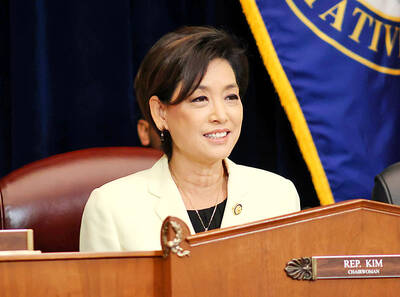
‘CLEAR MESSAGE’: The bill would set up an interagency ‘tiger team’ to review sanctions tools and other economic options to help deter any Chinese aggression toward Taiwan US Representative Young Kim has introduced a bill to deter Chinese aggression against Taiwan, calling for an interagency “tiger team” to preplan coordinated sanctions and economic measures in response to possible Chinese military or political action against Taiwan. “[Chinese President] Xi Jinping [習近平] has directed the People’s Liberation Army to be ready to invade Taiwan by 2027. China has a plan. America should have one too,” Kim said in a news release on Thursday last week. She introduced the “Deter PRC [People’s Republic of China] aggression against Taiwan act” to “ensure the US has a coordinated sanctions strategy ready should

TAIWAN ISSUE: US treasury secretary Scott Bessent said on the first day of meetings that ‘it wouldn’t be a US-China summit without the Taiwan issue coming up’ There were no surprises on the first day of the summit between US President Donald Trump and Chinese President Xi Jinping (習近平), the Mainland Affairs Council (MAC) said yesterday, as the government reiterated that cross-strait stability is crucial to the Asia-Pacific region, as well as the world. As the two presidents met for a highly anticipated summit yesterday, Chinese state media reported that Xi warned Trump that missteps regarding Taiwan could push their two countries into “conflict.” Trump arrived in China with accolades for his host, calling Xi a “great leader” and “friend,” and extending an invitation to visit the White House


 RSS
RSS