


The White House’s decision to take a 9.9 percent stake in Intel Corp is looking like very shrewd business indeed. Since the government bought in at US$20.47 a share last August, the US chipmaker’s surging stock price has delivered the US a US$43 billion return.
One of the reasons the investment has so far proved so sound is that the White House has made sure of it. According to The Wall Street Journal, Howard personally pushed deals on Intel’s behalf with some of the most lucrative clients imaginable. They include Nvidia Corp, the company at the heart of the AI revolution; SpaceX, which would like to be; and now, reportedly, Apple Inc — a crown jewel client that would be the firmest stamp of approval yet on the Intel turnaround project.
Under the “preliminary” deal, the The Wall Street Journal reported, Intel’s foundry business would handle some of Apple’s chip needs, though which products are involved has not been confirmed. TF International Securities analyst Ming-Chi Kuo (郭明錤), a longtime observer of Apple’s supply chain, wrote earlier this month that Apple had “kicked off low-end/legacy iPhone, iPad and Mac” chip manufacturing with Intel.
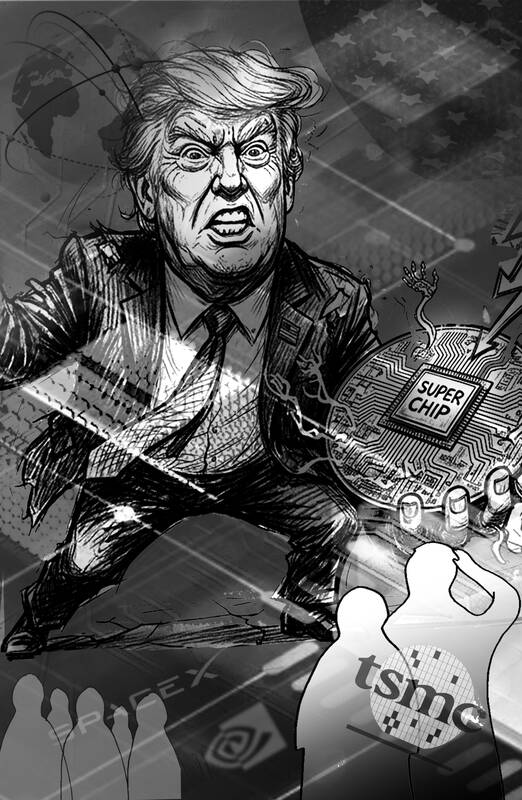
Illustration: Tania Chou
The two companies have worked together before, of course. Intel used to be Apple’s chip supplier for Macs before Apple announced in 2020 that it would fare better by designing its own chips and then having Taiwan Semiconductor Manufacturing Co (TSMC, 台積電) make them. Analysts point to this move to “Apple Silicon” as foundational to its sustained success with hardware, allowing it to achieve greater cost and performance efficiencies. Consumers feel it when they use Apple products in concert with one another — the vertical integration of hardware and software is what has given Apple its edge.
Apple’s preference would have been to keep things humming along like this, but the AI revolution had other ideas. Even with its vast riches and influence, the iPhone maker has not been insulated from choked supply chains. In Apple’s earnings call last month, chief executive officer Tim Cook discussed how Apple’s chief supply challenge was getting enough access to the super-sophisticated manufacturing facilities needed to produce its chips. Just like the makers of memory chips, TSMC stands to generate better revenue from making chips used in AI data centers than it does from those built for smartphones. Apple has been pushed down the pecking order. “Apple therefore needs to cultivate a new supplier while it still holds bargaining power,” Kuo wrote.
Enter Intel, with promises of a super-sophisticated machine of its own — the 14A advanced manufacturing node. And before that, the 18A node. It is not until technology reaches consumers that it gets an appealing name, such as “iPhone” or “Pentium,” but what you need to know about 18A and 14A is that they are Intel’s last gasps at a comeback. The strategy is to try to emulate TSMC’s success by luring companies with semiconductor designs — such as Apple or Nvidia — to have their chips custom-built there. That differs from the old Intel, which would only design and make its own chips and then sell them, mostly to companies making PCs. It continues to do this, but only by attracting large outside clients would Intel’s so-called foundry business be viable, the company has said.
Getting the foundry off the ground has been difficult and slow. One issue has been poor yields — the number of usable chips in a production run. Another barrier has been an apparent hesitancy among chip designers to work with Intel, given that it is simultaneously a rival chip designer.
The supply chain crunch, with a side of political pressure, seems to have put those concerns to one side and opened a window of opportunity for Intel. “If Intel can make the parts, they’ll have customers lined up around the block to use them,” said Stacy Rasgon, a semiconductor analyst at Bernstein. “And given where Trump is, might you be a little willing to put a little bit of volume there and test it out a little earlier than maybe you might have otherwise? Possibly.”
There are certainly political benefits for Apple in partnering with Intel this year, as it does what it can to smooth any disruption to its business from US President Donald Trump’s lofty demands to build more in the US and lessen reliance on China. However, a “little bit of volume” is not sufficient for an Intel turnaround — nor for the broader goal of the US becoming self-sufficient in chipmaking. Kuo notes that even with the new Apple-Intel arrangement, TSMC would “still retain over 90 percent of supply share.”
Still, it has been a reassuring year so far for the formerly trailblazing Intel, and, for now, the geopolitical cards are heavily stacked in its favor. Apple, with its exacting standards, is credited with imparting extreme quality and consistency into the electronics supply chain abroad and is now being called upon to do the same in the US. Intel CEO Lip-Bu Tan (陳立武) told CNBC last week that the 14A manufacturing process is set to be a “major, major breakthrough” in its efforts to reach parity with TSMC. On that, he still must prove the company can deliver.
However, after years on the brink of failure, Intel might finally have success in its sights.
Dave Lee is Bloomberg Opinion’s US technology columnist. He was previously a correspondent for the Financial Times and BBC News. This column reflects the personal views of the author and does not necessarily reflect the opinion of the editorial board or Bloomberg LP and its owners.
KMT Chairwoman Cheng Li-wun’s (鄭麗文) recent visit to Beijing and her upcoming visit to Washington will serve as a high-level test of her diplomatic mettle. In Beijing, Cheng was received with symbolic gestures, a warm reception, and high-level access. In Washington, she will receive far less pomp and far sharper questions about the KMT’s vision for the future of Taiwan. Her challenge will be to persuade Washington that the KMT’s engagement with China can coexist with strong deterrence. Cheng’s April 7-12 visit to mainland China coincided with an intense period of conflict in Iran. Despite the strategic significance of Cheng’s trip,

The closure of the Strait of Hormuz has sent the vast Asian chemicals industry into a tailspin. Deprived of the likes of Qatari natural gas and Saudi Arabian oil, the region’s fertilizer and plastics plants are slowing production or even shutting down. Everywhere except China, that is. In petrochemicals, China is unique. As well as a traditional industry that uses oil and gas as feedstock, it has parallel output that relies on its abundant domestic coal. Unsurprisingly, India and other regional powers want to copy and paste the Chinese method. This would not be easy — or climate friendly. The
Indonesian President Prabowo Subianto says he knows how to fix the problems facing Indonesia. Yet his economic mismanagement and authoritarian tendencies are steering the nation toward a familiar mix of currency instability and political chaos. The world’s fourth-most populous nation risks reversing the hard-won democratic and business reforms that came after the Asian Financial Crisis in 1997. At that time, the rupiah collapsed and the political upheaval that followed forced former president Haji Mohamed Suharto from power. Prabowo’s administration is ignoring similar warning signs. That disconnect was apparent in a national address on Wednesday, when Prabowo projected the swagger that has
“Of course you can choose not to be Taiwanese, just do not stay here,” chairwoman of Taipei 101 operator Taipei Financial Center Corp Janet Chia (賈永婕) said in an online interview with local entertainer Tai Chih-yuan (邰智源), triggering intense discussion on social media, with politicians across party lines weighing in. In the interview, which was aired on May 14, Chia and Tai’s discussion over a meal in Taipei 101 covered Chia’s career change from entertainer to chairwoman and US climber Alex Honnold’s free solo climb up the Taipei 101 building. During the interview, Chia said, “Being on this land, we


 RSS
RSS