


The National Chungshan Institute of Science and Technology yesterday showcased its locally developed variants of the Vision 60 robotic patrol dog, which it plans to deploy on the nation’s outlying territories in the South China Sea.
The variants were produced under the Joint Lab project — created by the institute and domestic companies — and assembled with domestically produced motors, lenses and artificial intelligence (AI) systems alongside licensed tech from the US, Missile and Rocket Systems Research Division deputy director Jen Kuo-kang (任國光) told the media event at a military base in Taipei’s Dazhi (大直) area.
Taiwan has built up its strengths in motors, lenses and AI, and with more manufacturers, the nation would be able to ensure a stable supply of components once variants enter mass production.
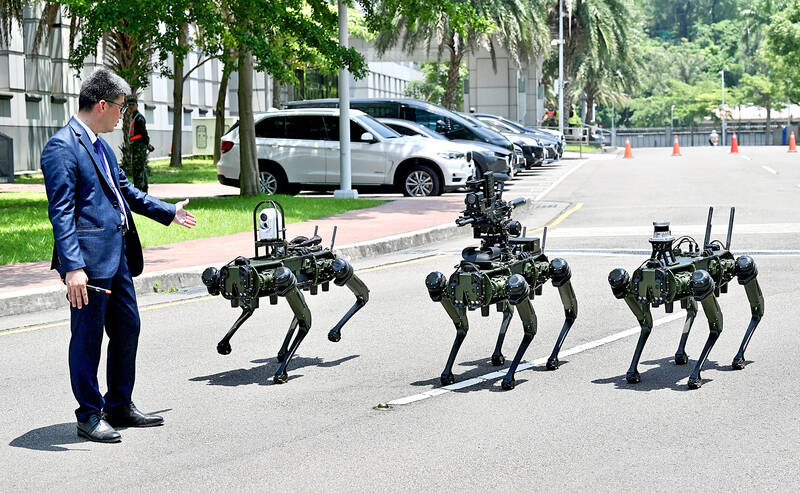
Photo: Lo Pei-de, Taipei Times
The variants are based on the Vision 60 frame, Quadrupedal Unmanned Ground Vehicle (Q-UGV), or robodogs, manufactured by Ghost Robotics, Jen said.
The platform weighs 52.4kg and can travel at 2.5m/s, even when carrying a 10kg load, he added.
The robodog has an operational limit of three hours, Ghost Robotics said, but idling during its patrol can extend its operational limit to 10 hours, Jen said, adding that the battery exhaustion rate varies based on the load it is carrying.
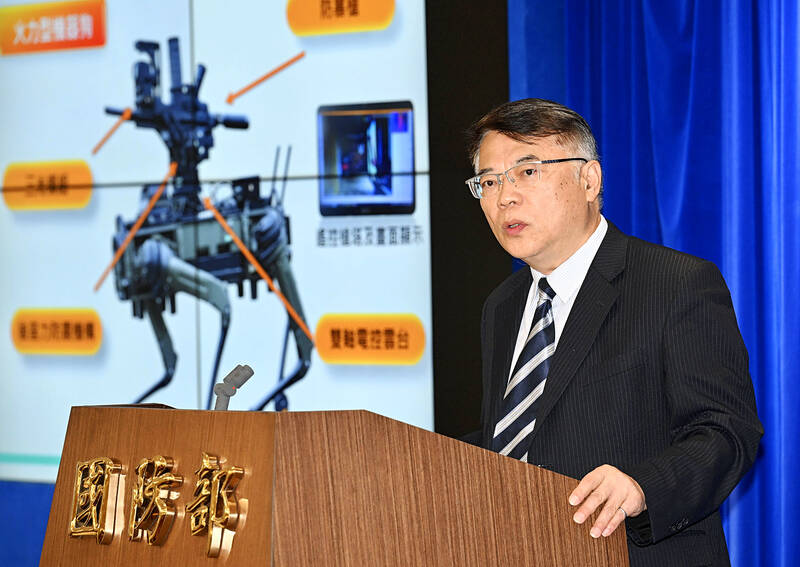
Photo: Lo Pei-de, Taipei Times
The system could eventually be integrated with uncrewed ground vehicles and drones to form a three-dimensional battlefield network, the institute said.
The three variants are the light detection and ranging (LiDAR) variant, a reconnaissance model and an armed version.
The LiDAR model carries a 32-line 3D LiDAR and a thermal imaging sensor module, and is capable of autonomous patrols, obstacle avoidance and 3D spatial awareness, the institute said.
The armed model employs AI to recognize and engage multiple targets using heat-sense capabilities to hit targets up to 150m away, the institute said.
The reconnaissance model has visible-light and infrared sensor modules and can auto-track moving targets while sharing that data with a command center, it said.
Jen said some branches of the military, including the Marine Corps and the Coast Guard Administration, have expressed interest, as the platforms would be useful in defending the Taiwan-controlled Pratas Islands (Dongsha Islands, 東沙群島) and Spratly Islands (Nansha Islands, 南沙群島) in the South China Sea.
“The Marines believe there is a pressing need, including for the coast guard in Nansha and Dongsha, for patrols and inspection on beaches and the coastline,” he said.
The army has also expressed interest, saying the platforms could help provide perimeter patrols, Jen said, but added that none have yet placed a formal order.
The institute said it would continue talks with the army and requested maps of areas that the platforms might be tasked with covering, adding that the military leadership could include their use during the annual Han Kuang military and urban resilience exercises.
Asked whether such platforms could simultaneously retain reconnaissance and offensive capabilities, Jen said there is a payload limit for all variants.
The institute specializes in reducing the size of weapons systems for mounting on the robodogs, he said, adding that the armed model already has such capability once the tri-optical system is integrated.
The armed model employs AI to recognize and engage multiple targets using heat-sense capabilities to hit targets up to 150m away, the institute said.
The reconnaissance model has visible-light and infrared sensor modules and can auto-track moving targets while sharing that data with a command center, it said.
Jen said some branches of the military, including the Marine Corps and the Coast Guard Administration, have expressed interest, as the platforms would be useful in defending the Taiwan-controlled Pratas Islands (Dongsha Islands, 東沙群島) and Spratly Islands (Nansha Islands, 南沙群島) in the South China Sea.
“The Marines believe there is a pressing need, including for the coast guard in Nansha and Dongsha, for patrols and inspection on beaches and the coastline,” he said.
The army has also expressed interest, saying the platforms could help provide perimeter patrols, Jen said, but added that none have yet placed a formal order.
The institute said it would continue talks with the army and requested maps of areas that the platforms might be tasked with covering, adding that the military leadership could include their use during the annual Han Kuang military and urban resilience exercises.
Asked whether such platforms could simultaneously retain reconnaissance and offensive capabilities, Jen said there is a payload limit for all variants.
The institute specializes in reducing the size of weapons systems for mounting on the robodogs, he said, adding that the armed model already has such capability once the tri-optical system is integrated.

‘NO SECURITY RISK’: The Railway Bureau reassured the public that the technicians’ activities were limited to technical guidance and did not involve sensitive systems The Railway Bureau yesterday said it had invited eight Chinese technicians to assist with an airport MRT construction project. The bureau issued the confirmation after an Internet user said Chinese nationals had entered the construction zone of Taiwan Taoyuan International Airport’s Terminal 3 project. They asked why “individuals from an enemy state” were allowed access to such a major national infrastructure project, which raised serious concerns over Taiwan’s industrial safety, sensitive systems and information security. The bureau’s Northern Region Engineering Branch Office said subcontractor Taiwan Handle Industrial Co (台灣手把工業) of the Taoyuan airport MRT’s “Contract No. CU05 Project A14 Station Civil, MEP &

A US uncrewed surface vessel (USV) encountered multiple Chinese warships during an autonomous transit of the Taiwan Strait, US defense company Seasats said in a statement on Wednesday. Seasats announced that a Lightfish USV had completed the first autonomous transit of the Taiwan Strait. Over five days, the USV traversed the entire length of the Strait while constantly monitoring surface vessel traffic, the company said. The Lightfish encountered multiple Chinese warships, one of which was a Chinese People’s Liberation Army Navy (PLAN) Type 056 corvette, it said. The Chinese vessels were operating “well within Taiwan’s exclusive economic zone without transmitting their identity via the

‘BOOMING’: ’ The number of partners we have here is incredible. You can see from their stock prices. They’re doing so well, they’re so happy,’ Jensen Huang said Nvidia Corp’s spending in Taiwan has ballooned to about US$150 billion a year, 10 times the US$10 billion to US$15 billion the company spent five years ago, Nvidia chief executive officer Jensen Huang (黃仁勳) said yesterday, suggesting Taiwan’s strategic importance in the global artificial intelligence (AI) supply chain. “Taiwan is the epicenter of the AI revolution. This is where the chips come, packaging comes. This is where the systems are made. This is where AI supercomputers were created,” Huang said at a meeting for the company’s employees in Beitou-Shilin Technology Park (北投士林科技園區) in Taipei, the planned site of Nvidia’s Taipei headquarters. “Taiwan
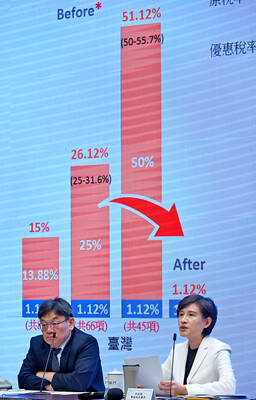
GREATER REACH? Auto parts and wood products would face tariffs of up to 15%, matching those targeting the EU, Japan and South Korea, Vice Premier said The US has announced that preferential tariff treatment for Taiwan’s non-semiconductor Section 232 goods would take effect retroactively from May 1, the Executive Yuan said yesterday. The US government yesterday posted a notice on the Federal Register’s public inspection Web site previewing tariff concessions for Taiwan under a memorandum of understanding (MOU) on Taiwan-US investment after two months of negotiations. The MOU signed on Jan. 15 stipulated three major preferential tariff arrangements: a 15 percent “reciprocal” tariff rate for Taiwan without stacking most-favored nation (MFN) rates; preferential Section 232 treatment for semiconductors and related products; and preferential Section 232 treatment for non-semiconductor


 RSS
RSS