


There were no surprises on the first day of the summit between US President Donald Trump and Chinese President Xi Jinping (習近平), the Mainland Affairs Council (MAC) said yesterday, as the government reiterated that cross-strait stability is crucial to the Asia-Pacific region, as well as the world.
As the two presidents met for a highly anticipated summit yesterday, Chinese state media reported that Xi warned Trump that missteps regarding Taiwan could push their two countries into “conflict.”
Trump arrived in China with accolades for his host, calling Xi a “great leader” and “friend,” and extending an invitation to visit the White House in September.
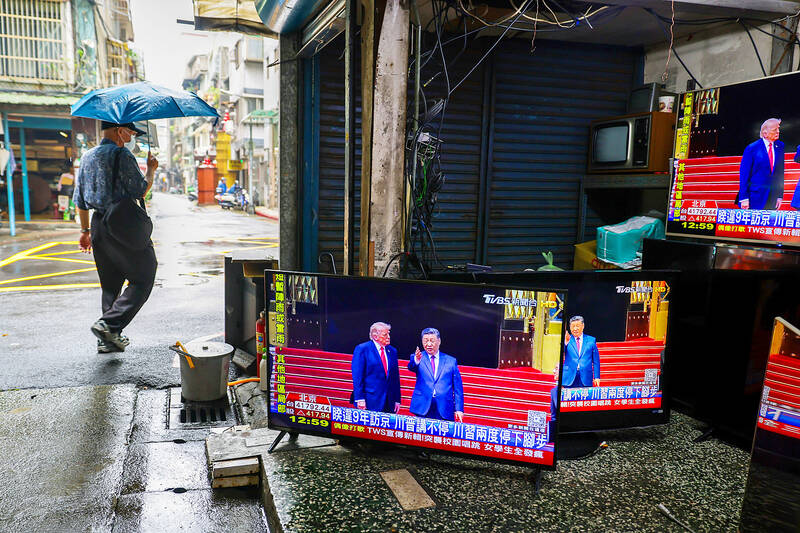
Photo: Ritchie B. Tongo, EPA
Beyond the pomp as he welcomed Trump, Xi in less effusive tones said the two sides “should be partners and not rivals” and immediately highlighted the issue of Taiwan.
“The Taiwan question is the most important issue in China-US relations,” Xi said, according to remarks published by the Xinhua news agency shortly after the start of the talks, which lasted two hours and 15 minutes.
“If mishandled, the two nations could collide or even come into conflict, pushing the entire China-US relationship into a highly perilous situation,” Xi added.
Trump on Monday said that he would speak with Xi about US arms sales to Taiwan, a departure from Washington’s previous insistence that it would not consult Beijing on the matter.
The White House said the initial talks yesterday had been “good,” although it did not mention Taiwan in the readout.
Adam Ni (倪淩超), editor of newsletter China Neican, said that while Xi’s “blunt language” was not uncommon in party state media, it was unusual coming from the leader himself.
China has been “signaling a desire for US compromise on Taiwan,” said Chong Ja Ian (莊嘉穎), an assistant professor at the National University of Singapore.
Xi’s demand could suggest that China sees “some opportunity to convince Trump,” he said.
Trump yesterday did not comment to reporters regarding Taiwan, but US Secretary of the Treasury Scott Bessent told CNBC that Trump would say more “in the coming days.”
“It wouldn’t be a US-China summit without the Taiwan issue coming up,” said Bessent, who is with Trump in China.
“President Trump understands the issues here and understands the sensitivities around all this. Anyone who has been saying otherwise does not understand the negotiating style of Donald Trump,” Bessent added.
In Taipei, the Ministry of Foreign Affairs said that Beijing was “the sole risk to regional peace and stability.”
Taiwan would continue to cooperate with the US, and other countries that uphold freedom and democracy to ensure regional security and prosperity, a ministry spokesperson said.
Cabinet spokeswoman Michelle Lee (李慧芝) said that the government believes any actions that would “contribute to regional stability and manage the risks posed by authoritarian expansion” should be viewed positively.
The government’s national security and diplomatic teams have remained in close contact with the US side during the Trump-Xi meeting, Lee said, adding that Taipei is grateful Washington has repeatedly reiterated its firm support for Taiwan.
Xi told Trump that peace and stability across the Taiwan Strait was the greatest common denominator to the US and China, but also to the Asia-Pacific region, as well as to the world, MAC Deputy Director Liang Wen-chieh (梁文傑) said.
The council did not consider Xi’s statements to be particularly severe or unusual, as Chinese senior government officials have made similar statements.
“We want to emphasize it is China, not Taiwan, that seeks to destroy the status quo. Taiwan seeks to maintain the status quo of the Republic of China and the Taiwanese way of life. The biggest risk that threatens peace across the Taiwan Strait is China’s military intimidation, and deployment of military aircraft and vessels to harass Taiwan,” Liang said.
The US’ Taiwan Relations Act stipulates that the scale of the arms sales to Taiwan depends on the level of military threat China poses, he said.
If Beijing wants Washington to stop selling defensive weapons to Taiwan, it should cease intimidating Taiwan militarily, he said.
China dispatched three military aircraft and six military ships to operate around Taiwan while Trump and Xi met in Beijing, he added.
Asked what he would consider as a surprise, Liang said that many experts were concerned whether Taiwan’s interests would be damaged due to China’s demands.
“All people in Taiwan should form a united front against the Chinese Communist Party (CCP). However, we are seeing that the Chinese Nationalist Party (KMT) Chairwoman Cheng Li-wun (鄭麗文) urged Trump in an interview with Japanese media — which was published on Wednesday — to state that he opposes Taiwan independence,” Liang said.
“She has turned into a propaganda machine for the CCP, making the KMT a political party comparable to the he pro-establishment camp in Hong Kong,” he added.
Additional reporting by CNA

‘NO SECURITY RISK’: The Railway Bureau reassured the public that the technicians’ activities were limited to technical guidance and did not involve sensitive systems The Railway Bureau yesterday said it had invited eight Chinese technicians to assist with an airport MRT construction project. The bureau issued the confirmation after an Internet user said Chinese nationals had entered the construction zone of Taiwan Taoyuan International Airport’s Terminal 3 project. They asked why “individuals from an enemy state” were allowed access to such a major national infrastructure project, which raised serious concerns over Taiwan’s industrial safety, sensitive systems and information security. The bureau’s Northern Region Engineering Branch Office said subcontractor Taiwan Handle Industrial Co (台灣手把工業) of the Taoyuan airport MRT’s “Contract No. CU05 Project A14 Station Civil, MEP &

A US uncrewed surface vessel (USV) encountered multiple Chinese warships during an autonomous transit of the Taiwan Strait, US defense company Seasats said in a statement on Wednesday. Seasats announced that a Lightfish USV had completed the first autonomous transit of the Taiwan Strait. Over five days, the USV traversed the entire length of the Strait while constantly monitoring surface vessel traffic, the company said. The Lightfish encountered multiple Chinese warships, one of which was a Chinese People’s Liberation Army Navy (PLAN) Type 056 corvette, it said. The Chinese vessels were operating “well within Taiwan’s exclusive economic zone without transmitting their identity via the
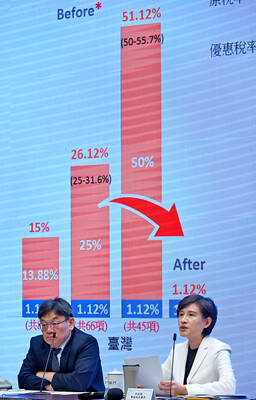
GREATER REACH? Auto parts and wood products would face tariffs of up to 15%, matching those targeting the EU, Japan and South Korea, Vice Premier said The US has announced that preferential tariff treatment for Taiwan’s non-semiconductor Section 232 goods would take effect retroactively from May 1, the Executive Yuan said yesterday. The US government yesterday posted a notice on the Federal Register’s public inspection Web site previewing tariff concessions for Taiwan under a memorandum of understanding (MOU) on Taiwan-US investment after two months of negotiations. The MOU signed on Jan. 15 stipulated three major preferential tariff arrangements: a 15 percent “reciprocal” tariff rate for Taiwan without stacking most-favored nation (MFN) rates; preferential Section 232 treatment for semiconductors and related products; and preferential Section 232 treatment for non-semiconductor
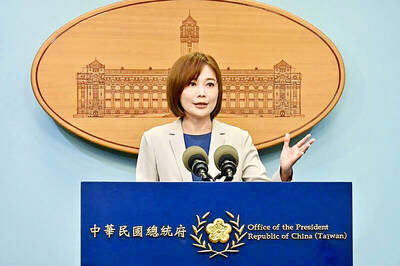
TIT-FOR-TAT: The US allegedly revoked the visa of a Chinese national working at Xinhua News Agency in the US in response to Beijing’s expulsion of Vivian Wang The Presidential Office yesterday condemned China for expelling a New York Times correspondent from Beijing following the newspaper’s interview with President William Lai (賴清德), saying the move highlighted Beijing’s suppression of press freedom and its threat to international news media. Taiwan has noted a series of recent incidents in which Beijing used similar tactics to “threaten and pressure international media outlets and journalists,” Presidential Office spokeswoman Karen Kuo (郭雅慧) said in a statement. “This concerns not only press freedom and freedom of expression, but also the safety of journalists, and Taiwan and relevant partners are paying close attention to the situation,” she


 RSS
RSS