


US House of Representatives Speaker Mike Johnson on Sunday reaffirmed US congressional support for Taiwan, saying the US and “all freedom-loving people” have a stake in preventing China from seizing Taiwan by force.
Johnson made the remarks in an interview with Fox News Sunday on US President Donald Trump’s summit with Chinese President Xi Jinping (習近平) last week.
In an interview that aired on Friday on Fox News, just as Trump wrapped up a high-stakes visit to China, he said he has yet to green-light a new US$14 billion arms package to Taiwan and that it “depends on China.”
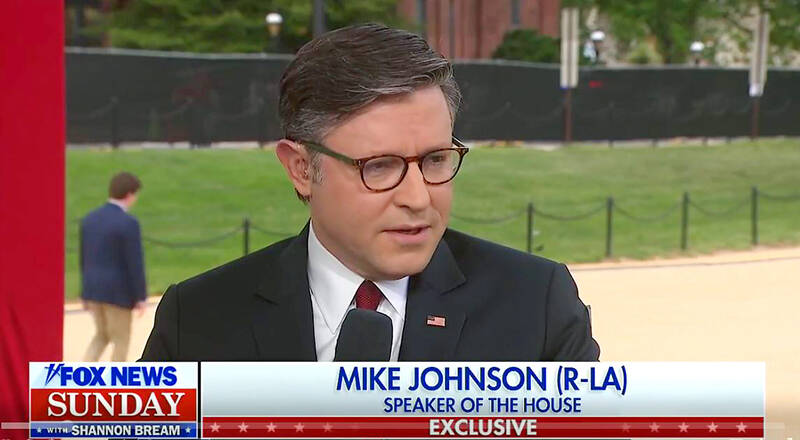
Photo: Screen grab from the Fox News Web site
“It’s a very good negotiating chip for us, frankly,” he said.
His comments raised concerns in Taiwan, which the government has sought to dispel, saying that the US’ official policy on Taiwan has not changed.
“Taiwan will not provoke or escalate conflict, but it will also not relinquish its national sovereignty and dignity, or its democratic and free way of life, under pressure,” President William Lai (賴清德) said in a statement, calling China “the root cause of undermining regional peace and stability and attempting to change the status quo.”
Johnson in the Fox News interview praised Lai’s statement, saying: “I thought that was a reasonable thing for the leader there to say.”
“China cannot just go take over land, and we’re going to stand strong and resolute by that. I know the Congress will,” he added.
US Trade Representative Jamieson Greer also sought to reassure observers that Washington’s Taiwan policy remained unchanged.
Speaking on ABC’s This Week, Greer said Trump had made no commitments to Xi regarding Taiwan and that the president retained authority over whether and when arms sales would proceed.
Meanwhile, US Senator Lindsey Graham said in an interview that aired on Saturday that he and US Senator Dan Sullivan plan to introduce legislation that would impose immediate economic sanctions on China in the event of an attempted invasion of Taiwan.
Speaking on NBC News’ Meet the Press, Graham said the proposed “preventive sanctions bill” would impose sweeping tariffs and economic penalties on Beijing as a deterrent against military action toward Taiwan.
Graham, a close ally of Trump, said he had not yet discussed the bill directly with Trump, but believed there was strong bipartisan support for it in Congress.
He said the US should clearly warn Beijing that any attack on Taiwan would result in severe economic consequences, adding that a similar warning to Russia before its invasion of Ukraine might have deterred Moscow from launching the war.
Graham also addressed Trump’s recent remarks that he was considering whether to approve a major arms sale package for Taiwan.
While saying the final decision rests with Trump, Graham said he would encourage the president to strengthen Taiwan’s defenses as much as possible to deter Chinese aggression.
He added that showing weakness on Taiwan would encourage Beijing to push further, while emphasizing that Washington’s goal remains maintaining the “status quo” and avoiding war or escalation.
Additional reporting by AP

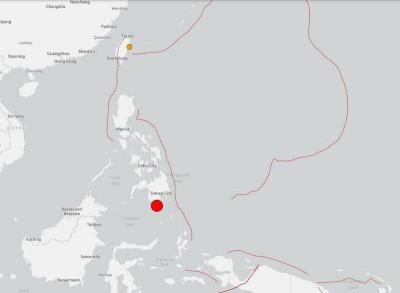
A magnitude 7.8 earthquake struck off the southern coast of Mindanao in the Philippines at 7:38am today, prompting the US Tsunami Warning System to issue an alert for neighboring countries, including Taiwan. The system issued a purple alert indicating a "tsunami threat." The potential threat zone includes Taiwan, the Philippines, Papua New Guinea, Yap and Palau. Philippine authorities were assessing the damage from the quake, with the office of civil defense seeking to verifying initial reports that 15 people had been killed and 129 injured in the region, mostly from falling debris. Arlene Hollero, disaster chief of Maasim town in the Philippines' Sarangani Province,

RESILIENCE: Taiwan plays a key role in semiconductors, energy, information infrastructure and advanced manufacturing, AIT Director Raymond Greene said Taiwan’s continued investment in deterrence and resilience remains vital, especially in uncrewed systems and other emerging technologies, American Institute in Taiwan (AIT) Director Raymond Greene said yesterday. Greene made the remarks at the annual National Strategic Summit on Supply Chain Resilience held by the Research Institute for Democracy, Society and Emerging Technology (DSET), a government-backed think tank. As Taiwan last year became the US’ fourth-largest trading partner and supply chain security is becoming more important, cooperation in emerging technologies continues to deepen between the two countries, he said. The US is committed to accelerating innovation, building key infrastructure, strengthening cooperation

The National Chungshan Institute of Science and Technology yesterday showcased its locally developed variants of the Vision 60 robotic patrol dog, which it plans to deploy on the nation’s outlying territories in the South China Sea. The variants were produced under the Joint Lab project — created by the institute and domestic companies — and assembled with domestically produced motors, lenses and artificial intelligence (AI) systems alongside licensed tech from the US, Missile and Rocket Systems Research Division deputy director Jen Kuo-kang (任國光) told the media event at a military base in Taipei’s Dazhi (大直) area. Taiwan has built up its strengths

‘GRAY ZONE’ PRESSURE: Beijing’s activities are intended to create the deceitful impression that China has jurisdiction over the area around Taiwan, the CGA said Taiwan’s rights over its territorial waters and exclusive economic zone must not be violated by any country, the Mainland Affairs Council said yesterday, adding that it will not accept any unprovoked actions. The council issued the remarks in response to the China Coast Guard conducting maritime enforcement drills near eastern Taiwan and claiming to fully exercise China’s maritime administrative law enforcement authority. The Coast Guard Administration (CGA) has been closely monitoring the situation and is taking concrete steps to defend the nation’s sovereignty and secure its waters, the council said. China has no sovereign rights over the waters off eastern


 RSS
RSS