


Taiwan’s continued investment in deterrence and resilience remains vital, especially in uncrewed systems and other emerging technologies, American Institute in Taiwan (AIT) Director Raymond Greene said yesterday.
Greene made the remarks at the annual National Strategic Summit on Supply Chain Resilience held by the Research Institute for Democracy, Society and Emerging Technology (DSET), a government-backed think tank.
As Taiwan last year became the US’ fourth-largest trading partner and supply chain security is becoming more important, cooperation in emerging technologies continues to deepen between the two countries, he said.
Photo courtesy of the Military News Agency
The US is committed to accelerating innovation, building key infrastructure, strengthening cooperation and maintaining its leading role in artificial intelligence (AI) development, while Taiwan plays a key role in semiconductors, energy, information infrastructure and advanced manufacturing, he said.
The two countries would ensure through concerted efforts that AI develops in a secure and resilient manner beneficial to shared prosperity, he said.
The markets of critical minerals and rare earths are highly concentrated, and have become the tools for political coercion, sabotaging supply chains, he said.
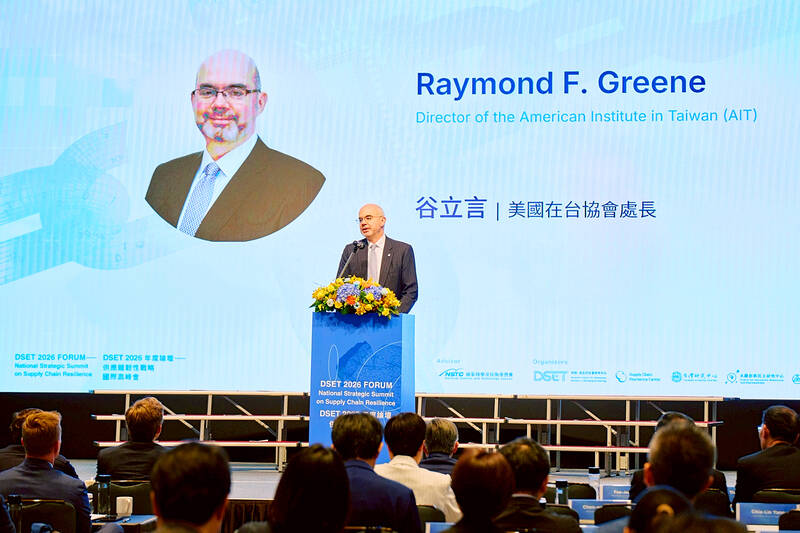
Photo courtesy of the DSET
The US is working with allies and partners, including Taiwan, to build diversified, secure and reliable supplies, he said.
As a globally essential energy exporter, the US is willing to deepen energy cooperation with Taiwan by providing a stable and reliable energy source to support the nation’s economic growth and security, he said.
He reiterated that the US opposes any unilateral changes to the “status quo.”
US Representative John Moolenaar, chair of the US House of Representatives Select Committee on the Chinese Communist Party (CCP), said in his video speech that the CCP has stepped up its efforts in provocation, harassment and coercion against Taiwan and the international community.
The biggest concern is that Chinese President Xi Jinping (習近平) has directed the Chinese People’s Liberation Army to be capable of taking control of Taiwan by force by next year, Moolenaar said.
Meanwhile, Beijing continues to expand “gray zone” operations, strengthen its cyber and electronic warfare capabilities and conduct exercises simulating potential blockade scenarios, he said.
Taiwan has shown its resilience as it has been facing increasingly complex security challenges, he said, adding that the nation’s commitment to bolstering its national security is an important foundation for the stable development of bilateral ties with the US.
Taiwan is not only an important trading partner to the US, but also a critical node in advanced manufacturing and global semiconductor supply chains, he said.
Deepening bilateral cooperation would not only promote reindustrialization in the US, but also bolster global supply chain resilience while safeguarding stability in the Indo-Pacific region, he said.
In addition to Greene and Moolenaar, former government officials, industry leaders and think tank representatives from Taiwan, the US, Japan and Ukraine were invited to the annual forum.
With four themes — semiconductors, AI, energy security and drone supply chain — the forum examined how democratic partners could deepen technology cooperation and enhance global supply chain resilience, attracting about 600 participants from government, industry and academia.
The forum has become an important platform for democratic allies to cooperate on technology and geopolitical issues, National Security Council adviser Lee Yuh-jye (李育杰) said.
Issues such as AI, semiconductors and “non-red” drone supply chains that were discussed at the forum are among the government’s major concerns, he said, adding that policy recommendations drawn from domestic and international tabletop exercises and real-world combat experiences mean a great deal to Taiwan.
The world is ushering a new wave of technological revolution characterized by AI, semiconductors, quantum technology, smart robotics and autonomous uncrewed vehicles, National Science and Technology Council Deputy Chairman Lin Faa-cheng (林法正) said.
Future technological competition would not be a contest between individual enterprises or countries, but one between ecosystems and international partnerships, he said.
With its world-class semiconductor industry, comprehensive supply chain network and a free and democratic system, Taiwan could attract more international businesses through complementary technological cooperation with like-minded countries, he said.

The National Chungshan Institute of Science and Technology yesterday showcased its locally developed variants of the Vision 60 robotic patrol dog, which it plans to deploy on the nation’s outlying territories in the South China Sea. The variants were produced under the Joint Lab project — created by the institute and domestic companies — and assembled with domestically produced motors, lenses and artificial intelligence (AI) systems alongside licensed tech from the US, Missile and Rocket Systems Research Division deputy director Jen Kuo-kang (任國光) told the media event at a military base in Taipei’s Dazhi (大直) area. Taiwan has built up its strengths

RIGHT DIRECTION: Taiwan’s efforts to prevent forced labor include a proposal to ‘fully prohibit’ employers from withholding workers’ documents, an official said Taiwan is to establish a mechanism to restrict imports of goods linked to forced labor, the Executive Yuan said yesterday, after the US proposed imposing additional tariffs on Taiwanese goods over labor concerns. “The Ministry of Labor and the Ministry of Economic Affairs are to establish an interministerial review procedure,” Executive Yuan spokesperson Michelle Lee (李慧芝) said at a news briefing in Taipei. “The government is to use the Foreign Trade Act [貿易法] as the legal basis to restrict imports of goods produced with forced labor” and bring its supply chain governance more in line with international standards on human rights, resilience

NOT IMMEDIATE: Taiwan has a chance to appeal the proposed 10 percent tariff before it starts, while other countries face a 12.5 percent tariff from the trade office Taiwan is among 60 economies determined by the US to have failed to impose or enforce a ban on the importation of goods produced with forced labor, according to a notice released on Tuesday by the Office of the US Trade Representative (USTR), which proposed imposing an additional 10 percent or more tariff on them. The USTR in a statement said that following an investigation, it had determined under Section 301 of the Trade Act of 1974 that the failure of the 60 economies to impose and effectively enforce a prohibition on the importation of goods produced with forced labor is

TIT-FOR-TAT: The US allegedly revoked the visa of a Chinese national working at Xinhua News Agency in the US in response to Beijing’s expulsion of Vivian Wang The Presidential Office yesterday condemned China for expelling a New York Times correspondent from Beijing following the newspaper’s interview with President William Lai (賴清德), saying the move highlighted Beijing’s suppression of press freedom and its threat to international news media. Taiwan has noted a series of recent incidents in which Beijing used similar tactics to “threaten and pressure international media outlets and journalists,” Presidential Office spokeswoman Karen Kuo (郭雅慧) said in a statement. “This concerns not only press freedom and freedom of expression, but also the safety of journalists, and Taiwan and relevant partners are paying close attention to the situation,” she


 RSS
RSS