


Taiwan’s English education system is being pulled apart by three opposing forces. Bilingual Nation 2030 pulls students toward English and global communication. Artificial Intelligence (AI) readiness pulls them toward digital judgment, verification and AI-mediated work. But Taiwan’s old exam culture pulls them back toward memorization, grammar drills, timed reading and correct answers. If the education system keeps using old exams to define success, it risks producing graduates who are neither genuinely bilingual nor genuinely AI-ready, but trained for tasks machines can already perform.
The first force is Bilingual Nation 2030. Launched in 2018, the policy aimed to “help Taiwan’s workforce connect with the world” and “attract international enterprises to Taiwan.” [1] But ChatGPT changed the terms of the debate. Sebastian Liao (廖咸浩), Dean of the Institute for Advanced Studies in Humanities and Social Sciences at National Taiwan University, argues that AI translation has made the instrumental case for mass English learning “technologically obsolete.”
His deeper warning is about cognitive cost: students forced to learn complex subjects through a language they have not mastered may “waste their youth, and even become semiliterate.”
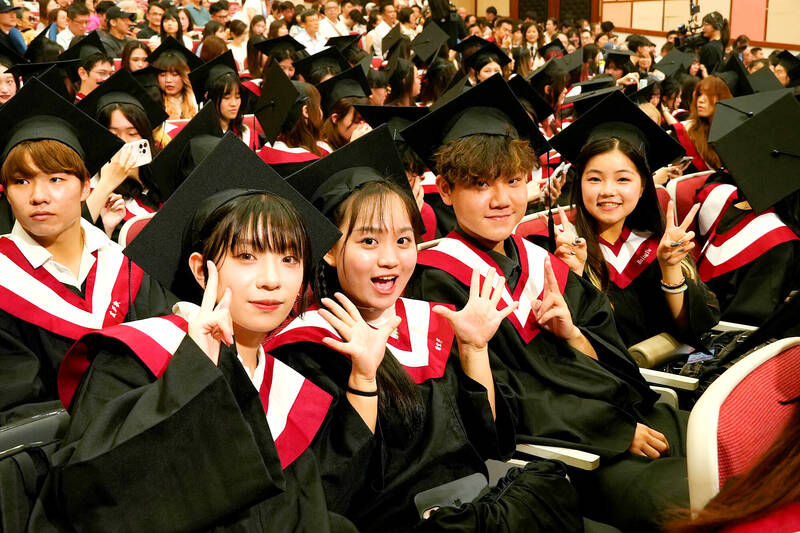
Photo courtesy of Shih Hsing University
He is not wrong. Badly designed English-medium instruction (EMI) can overload students and make them decode English instead of building knowledge. But that does not mean English and Mandarin are enemies. It means Taiwan’s bilingual push moved ahead without checking whether students, teachers, curricula and assessments were ready for it.
The second force is AI readiness. Taiwan’s policy push now aims to cultivate 500,000 AI professionals by 2040 and prepare citizens across disciplines to use AI effectively. But AI readiness is not just coding. It is the ability to command, audit, verify and improve AI outputs. The Ministry of Education’s (MoE) 2024 Guidelines for Digital Teaching Version 3.0 call for students to question AI outputs for accuracy, factuality and bias. Yet a Child Welfare League Foundation survey last year found that while 62.5 percent of Taiwanese adolescents used generative AI at least once a week, only 39.4 percent verified AI-generated information. That suggests false confidence, not AI readiness.
The third force is Taiwan’s exam-driven education culture. From the Comprehensive Assessment Program (CAP) for senior high school entrance to the General Scholastic Ability Test (GSAT) for university entrance, high-stakes exams still define success for students, parents, teachers, schools and cram schools. For English, the system still tests knowledge about language more than the ability to use language. Students memorize vocabulary, drill grammar patterns, race through reading passages and prepare formulaic responses.
But much of this work is now AI-supported or AI-automatable, from grammar correction and vocabulary support to translation, summaries and formulaic drafting. And soon, AI agents will do many of them with even less human input.
This creates a three-way tug-of-war. Exam culture pulls bilingual education toward test preparation rather than speaking, listening, persuasion, trust-building and intercultural judgment. It also pulls AI readiness away from open, guided practice by largely ignoring AI use and not assessing students on how to use it as assisted thinking that must be managed, questioned and monitored.
In short, bilingual education asks students to communicate. AI readiness asks them to judge. But exam culture still trains them to memorize, recognize and select.
This is becoming urgent because AI is rapidly moving from chatbots that help people write or think to agents that carry out workflows with less human supervision. Unfortunately, many entry-level knowledge jobs are built around language work like drafting, translating, editing, reporting and preparing presentations.
The warning signs are already visible. In September last year, Taiwan’s overall unemployment rate was 3.35 percent, but it was 11.60 percent for people aged 20 to 24 and 5.77 percent for those aged 25 to 29. University graduates had the highest unemployment rate by education level, at 4.53 percent. The World Economic Forum estimates that 39 percent of workers’ core skills will need updating by 2030. If schools continue to reward “robot skills,” graduates will enter the workforce trained to compete with AI in a losing battle.
Does this mean EMI or bilingual education is obsolete? Perhaps that is not the right question.
“What is becoming obsolete,” says Chang Yung-chun (張詠淳), Director of the Graduate Institute of Data Science at Taipei Medical University, “is the traditional, industrial-era model of education that assumes uniform learners, fixed curricula and teacher-centered knowledge transmission,” especially “when AI and digital tools are making more personalized forms of learning increasingly possible.”
Chang says that Taiwan’s falling birth rate makes international student recruitment increasingly necessary. He adds that based on his own teaching experience, when EMI is used well it can support internationalization and create real academic and social reasons for local and international students to use English together.
This means paying attention to the cognitive costs of EMI. As Liu Yeu-ting (劉宇挺), Dean of the School of Teacher Education at National Taiwan Normal University, notes students using a weaker language to learn complex content will struggle when “the language demands swamp the content goals.” But dismissing EMI, he says, risks a “deficit view” of language learning, where students are judged mainly by what they lack. Even students who never become fully bilingual can develop sharper language awareness, more flexible thinking and broader communication skills.
AI translation may reduce the transactional need for English, but it does not remove the need for deeper communicative and contextual skills.
Taiwan does not need to choose between Mandarin and English, but to build a system where strong Mandarin supports disciplinary thinking, purposeful English and EMI extend communicative reach, AI scaffolds learning rather than replaces it and assessment rewards process, performance and human judgment.
The good news is that Taiwan does not need to build this assessment system from scratch. Developed by the Language Training & Testing Center (LTTC), the General English Proficiency Test (GEPT) was Taiwan’s first large-scale localized English proficiency test to directly assess all four skills, and for more than 25 years it has included speaking and writing tasks that require learners to produce and interact in English. The GEPT iPrep platform also uses AI-powered scoring and diagnostic feedback to help test-takers at scale prepare for the test.
And the LTTC’s newer BEST Test of English Proficiency (BESTEP), designed for university students, continues in this direction by assessing four-skill academic communication as learning-oriented assessment. According to Jessica Wu (吳若蕙), Deputy CEO at the LTTC, BESTEP “integrates teaching, learning and testing” and human-machine hybrid scoring is being explored so automated scores can complement human raters for writing and speaking tasks.
In EMI classes, AI can support vocabulary work, summaries, translation checks, speaking rehearsal, feedback and formative assessment. But students must learn to question AI assistance, not hide behind it. If the Comprehensive Assessment Program (CAP) and General Scholastic Ability Test (GSAT) continue to dominate classroom practice, teachers will keep preparing students for the old exam culture.
The education ministry also cannot ask students to become AI-ready while leaving teachers to figure it out through one-off workshops. Language teachers need sustained training to become human-centered, AI-assisted learning designers.
Without that shift, Taiwan will keep pulling students in three directions at once. When the AI-driven workplace arrives, the strain will not just hurt the labor system. It will fail the students it was supposed to prepare.

It seems every few days one bumps into one of those “real man” comments in which Taiwan is urged to “face reality” or similar, and “make a deal,” with the speaker implying that soon it will be too late. “Deal” advocates always present themselves as having a superior grip on reality, and the manly ability to make the “hard choice.” Their testosterone-laden language often echoes that of Taiwan sellout advocates. Note that such commentary always specifies a process (“make a deal, work with, make progress”), never the end state of what occupation by a violent authoritarian colonialist state will entail. In

There are shadowy cabals plotting to sell out Taiwan to be annexed by China, by invasion if necessary. Fortunately, they are buffoons. In 2019, former Bamboo Union gangster and founder of the China Unification Promotion Party (CUPP), Chang An-le (張安樂, colorfully known as “White Wolf”), led a protest at the Legislative Yuan against comments made by then-premier Su Tseng-chang (蘇貞昌) that in the event of an attack by China, he would never surrender, but would protect the nation by fighting to the end, even if he only had a broom. Chang had party members bring a wooden casket that they
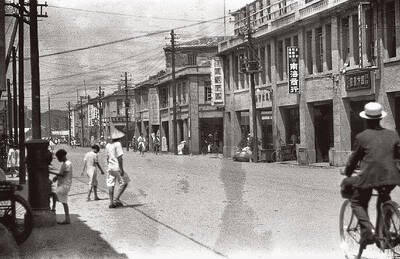
June 1 to June 7 "If all Taiwanese were as afraid of dying as you, then what would happen?” Physician Shih Chiang-nan (施江南) reportedly said this to his wife Chen Chiao-tung (陳焦桐) after she urged him to stop intervening on behalf of Taiwanese soldiers stranded overseas after serving in the Japanese Army during World War II. Shih had clashed with high-ranking officials over the issue, engaged in several heated arguments with Taiwan governor-general Chen Yi (陳儀) and allegedly shouted at general Ko Yuan-fen (柯遠芬), chief of staff of the Taiwan Garrison Command, over

Food prices have often played a major role in Taiwan’s history. The first major wave of migration from China occurred in 1628. A moderate drought, the Ming Dynasty maritime ban that prohibited fishing and trading (intended to reduce piracy) and a temporary tax, conspired to exhaust local resources, leading to famine in Fujian Province. The famed pirate and trader Zheng Zhilong (鄭芝龍), scooped up starving people from Fujian and transported them across the Taiwan Strait, where they settled under the Dutch. Two factors enabled Zheng. First, by 1624 he had settlements around today’s Beigang (北港) in Yunlin County with a small


 RSS
RSS