


There are shadowy cabals plotting to sell out Taiwan to be annexed by China, by invasion if necessary. Fortunately, they are buffoons.
In 2019, former Bamboo Union gangster and founder of the China Unification Promotion Party (CUPP), Chang An-le (張安樂, colorfully known as “White Wolf”), led a protest at the Legislative Yuan against comments made by then-premier Su Tseng-chang (蘇貞昌) that in the event of an attack by China, he would never surrender, but would protect the nation by fighting to the end, even if he only had a broom.
Chang had party members bring a wooden casket that they intended to give to Su, who they said should not call for resistance to a Chinese military invasion, because that would result in many Taiwanese fatalities. In a scuffle with police, Chang accidentally fell into the coffin.
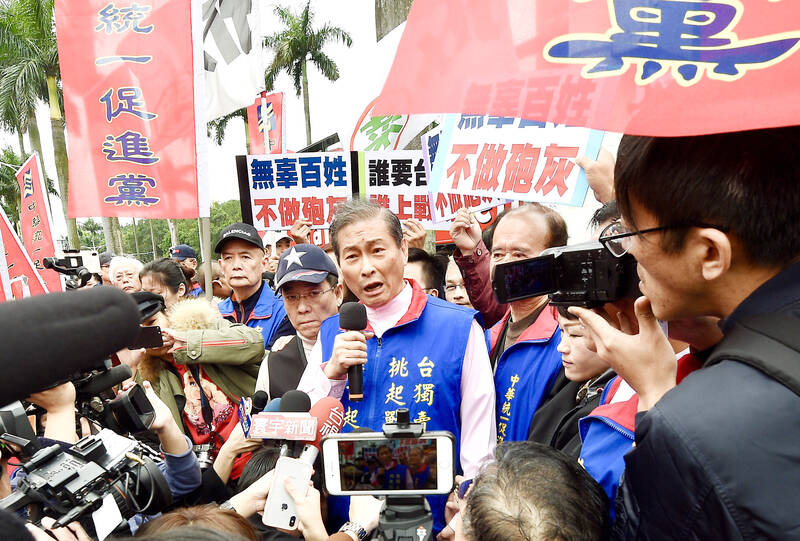
Photo: Peter Lo, Taipei Times
The official ideology of the Chinese Nationalist Party (KMT) is that Taiwan is a province of China, aka “the motherland.”
There are hardliners in the party who want to realize the dream of “reunification” sooner rather than later, but by using the political system to convince the public that this is the only viable path forward. There is no evidence of an organized cabal, but rather a loose network of ideologues sharing the same vision and goals.
The odds are stacked against them, but they are persistent and persevere.
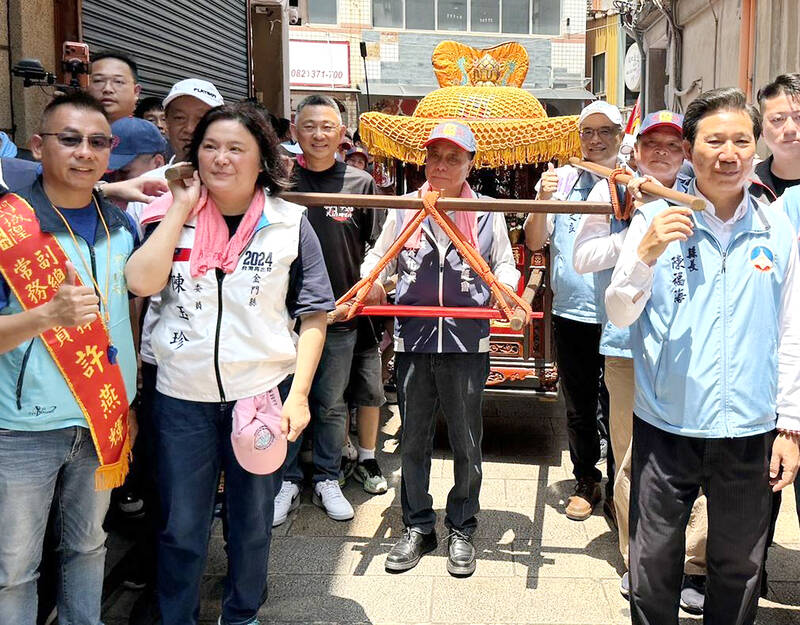
Photo: Wu Cheng-ting, Taipei Times
STRATEGY ONE
First, the reunificationists need to overcome opposition from within their own party, who want it to remain electable and not disappear from the political map like the pro-China New Party. Though their control is not absolute, broadly speaking these hardliners have succeeded more often than not in aligning the party with their agenda in the legislature and in electing Cheng Li-wun (鄭麗文) as party leader.
Though their legislative caucus is not entirely on board, party whip Fu Kun-chi (傅?萁) and his allies can marshal support through other means — especially hatred of the Democratic Progressive Party (DPP).
STRATEGY TWO
Second, the reunificationists need to tackle the core values that make annexation into China very unpopular and maintaining a separate identity and system so overwhelmingly popular.
Making it difficult for the ruling DPP administration to function appeals to both those who hate the DPP and want to see them blamed for failure and dysfunction, and those who want to undermine the credibility of the democratic system. Democracy is one of the core reasons Taiwanese do not want to be annexed by China.
They also want to, as Cheng put it, “make Taiwanese proud to be Chinese.” On this, they have little leverage other than friendly media outlets and spreading Chinese content online. They have not been very successful; the majority still identify as Taiwanese and few identify as purely Chinese.
STRATEGY THREE
Third, the reunificationists need to undermine confidence that Taiwan can successfully defend itself, while stoking fears of a Chinese invasion.
They frequently portray the DPP as “provoking” China, as if China’s increasingly threatening military moves are not of their own agency. Strengthening national defense is portrayed as turning Taiwan into an “ammo dump.”
Cheng and her ideological allies in the legislature initially tried to entirely quash the DPP’s proposed NT$1.25 trillion special military budget, but ran into opposition from the electability camp within the party. In the end, the ideologues had to back down, and an NT$780 billion package was passed.
However, within that final budget, they did score some victories. Most importantly, they entirely gutted the part of the budget intended to build up and strengthen the domestic defense industry, significantly weakening Taiwan’s self-reliance capabilities.
People are aware of the lessons of the war in Ukraine and the role their domestic drone and missile capabilities are playing. Taking away self-reliance takes away self-confidence.
The part of the budget that did pass was for purchases of US weapons systems. These are costly and easy to criticise, and will take many years to arrive — unlike domestic weapons systems that are cheaper and can be produced far more quickly, especially drones. This dramatically weakens Taiwan in the short term and hobbles it going forward.
They also need to undermine confidence that friendly nations will come to Taiwan’s aid in a crisis, especially the US and Japan. Here, they also face pushback from within the party.
Polling suggests they have been successful in weakening confidence in the US. President Donald Trump has made it easy for them, with transactional comments about Taiwan “stealing” the chip industry and referring to arms sales as a “bargaining chip.” His lack of support for Ukraine underscores fears that Trump may come to Taiwan’s aid, though his own comments on that have varied widely.
They have been less successful on Japan. Japanese Prime Minister Sanae Takaichi’s comments that a Taiwan contingency would be a Japanese contingency, increasing military buildup, moves to strengthen defense on islands near Taiwan and stronger coordination with the US and the Philippines, all underscore the importance Takaichi places on peace in the Taiwan Strait.
STRATEGY FOUR
Fourth, the reunificationists work to increase reliance on China to further integrate the two countries economies and systems. They have lost ground here, especially since the end of the Ma Ying-jeou (馬英九) administration in 2016.
The DPP has successfully disentangled some of the ties that Ma built up, but mostly the credit goes to the Chinese themselves cutting ties, their own economic weakness and marginalizing of Taiwanese businesses operating there and to the booming artificial intelligence economy that has restored the US as Taiwan’s top trading partner.
That does not mean they are not still trying. KMT legislator Jennifer Chen’s (陳玉珍) proposal to amend the Offshore Islands Development Act (離島建設條例) is winding its way through the legislature.
It is a radical plan that would see Kinmen, and eventually Matsu and Penghu deeply integrated with the Chinese economy, bypassing the national government and handing significant approval powers to the local governments. It is no coincidence that Chen is running to be Kinmen County commissioner. For more, see Michael Turton’s “ Notes from Central Taiwan: A KMT budget bill Beijing could love,” (May 14, page 12).
STRATEGY FIVE
Finally, the reunificationists need to present the case for why annexation is the only way out and inevitable.
Cheng is already laying the groundwork. She intends to present a “peace framework” to the Taiwanese public ahead of the 2028 elections. If the KMT takes power, she intends to see it implemented.
She has initiated contact with Chinese Communist Party (CCP) Secretary-General Xi Jinping (習近平). She is still far from striking an agreement with the CCP, but negotiations are ongoing.
However, the first four parts of their strategy need to be far more successful than they have been for this to work. The DPP remains the most popular party, the democratic system remains popular, voters still identify as Taiwanese, the US is the top trading partner and there remains some confidence that Taiwan can defend itself long enough for friendly nations to arrive — and that they will do so.
Cheng’s problem is that any peace framework with China will come with strings Taiwanese will not accept.
A bolder peace framework would see the CCP renounce the use of force against Taiwan. They will only agree to that in exchange for serious concessions on Taiwan’s sovereignty and a clear path to eventual “unification.”
A weaker version would see the CCP offer to scale back its aggressive military “gray zone” tactics, but only in exchange for far deeper integration between the two sides that would tie Taiwan’s system and economy to China’s, making it increasingly difficult to disentangle and increasingly reliant on China.
Taiwanese are not likely to accept any of this, but the KMT ideologues are not going to stop trying.
Donovan’s Deep Dives is a regular column by Courtney Donovan Smith (石東文) who writes in-depth analysis on everything about Taiwan’s political scene and geopolitics. Donovan is also the central Taiwan correspondent at ICRT FM100 Radio News, co-publisher of Compass Magazine, co-founder Taiwan Report (report.tw) and former chair of the Taichung American Chamber of Commerce. Follow him on X: @donovan_smith.

Ajay Verma, a consultant gastroenterologist at Kettering general hospital in Northamptonshire, says our gut is a “complex machine.” “It is constantly providing us with the nutrition we need, initially to grow and develop, and then for us to survive, thrive and repair from injury and illness.” How can we keep it functioning well? Put simply: “Make sure what you put into it is balanced, and that you clear out its waste products adequately,” Verma says. “In a general gastroenterology clinic, the most common conditions we see are irritable bowel syndrome (IBS), gastroesophageal reflux disease, inflammatory bowel disease and constipation,” says Nisha
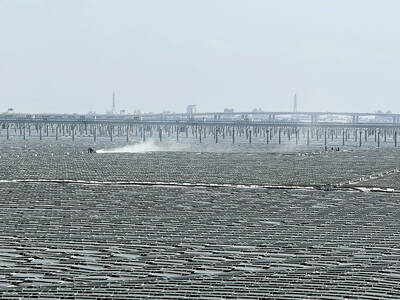
The arithmetic is straightforward and uncomfortable. By the end of 2025, Taiwan had committed itself to a 50-30-20 electricity mix — half natural gas, 30 per cent coal, 20 per cent renewables. The Ministry of Economic Affairs’s (MOEA) own monthly energy reports tell a different story. Natural gas reached 47.8 per cent of generation last year. Coal stood at 35.4 per cent, comfortably above its target ceiling. Renewables came in at 13.1 per cent, well short of the 20 per cent Taipei had pledged a decade earlier. Installed renewable capacity reached roughly half of the 12 gigawatts (GW) the government

Last week US President Donald Trump was asked by a reporter whether he would speak on the phone to the President of Taiwan. “l’ll speak to him. I speak to everybody. We have that situation very well in hand,” Trump said. This marked the second time in a couple of weeks he had said he would talk to the President of Taiwan. In 2016 he famously took a call from then-president Tsai Ing-wen (蔡英文), when he was president-elect. Despite warnings that the apocalypse was nigh because of a phone call, the world quickly forgot about the conversation between two democratically-elected presidents.
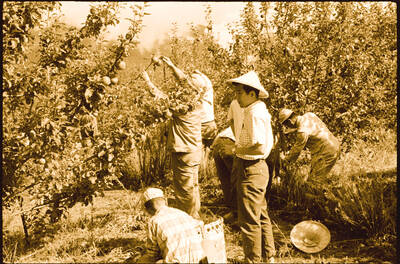
May 25 to May 31 Few believed that apples could be cultivated on a commercial scale in Taiwan’s high mountains. When horticulturalist Cheng Chao-hsiung (程兆熊) first proposed the idea in 1955, both American and Taiwanese colleagues dismissed it as implausible, arguing that temperate fruit could not be reliably grown on a subtropical island, especially on rugged terrain. However, it was this terrain in the Central Mountain Range where many Chinese Civil War veterans were resettled in the late 1950s. With limited job prospects and no family in Taiwan, they were placed on cooperative farms aimed toward self-sufficiency. Some say the conditions


 RSS
RSS