


The arithmetic is straightforward and uncomfortable. By the end of 2025, Taiwan had committed itself to a 50-30-20 electricity mix — half natural gas, 30 per cent coal, 20 per cent renewables. The Ministry of Economic Affairs’s (MOEA) own monthly energy reports tell a different story. Natural gas reached 47.8 per cent of generation last year. Coal stood at 35.4 per cent, comfortably above its target ceiling. Renewables came in at 13.1 per cent, well short of the 20 per cent Taipei had pledged a decade earlier.
Installed renewable capacity reached roughly half of the 12 gigawatts (GW) the government had said it would deliver. Having quietly slipped the 20 percent renewables deadline from last year to November of this year, Taipei has since conceded that the revised target is also unlikely to be met on schedule.
BLIND SPOT
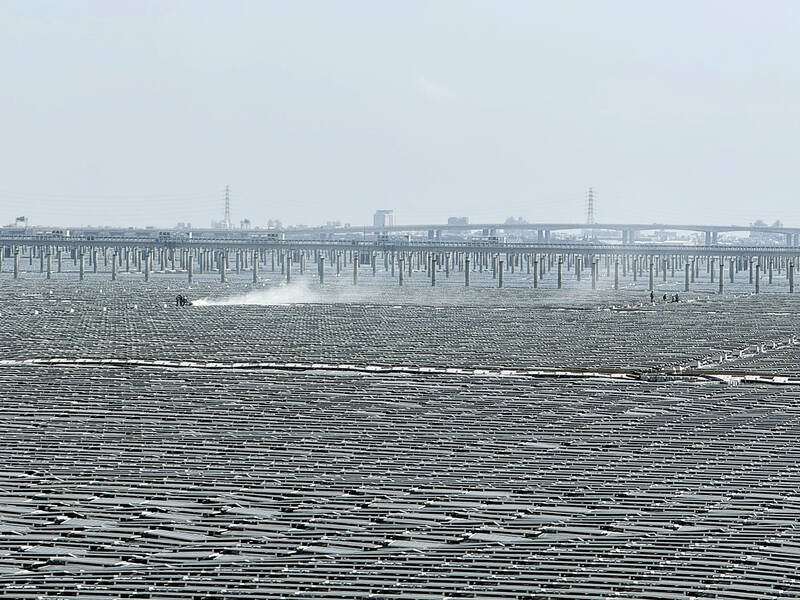
Photo courtesy of reader
That gap — between what the government promised and what it has built — frames this two-part feature. Electricity demand is rising sharply, driven by artificial intelligence (AI) infrastructure and semiconductor expansion, while the carbon-free share of the grid has shrunk rather than grown since 2016. That demand trajectory is itself a planning blind spot: official scenarios still treat consumption as broadly stable, even as AI-enabled services and electrified infrastructure push it up.
Taiwan’s per-capita CO2 emissions, at approximately 11.7 tonnes in 2024 (EDGAR / European Commission), remain roughly two-and-a-half times higher than France’s (4.8 tonnes) and more than three times higher than Sweden’s (3.6 tonnes), a gap that also reflects Taiwan’s continued reliance on fossil fuels in electricity generation.
Although excluded from the UN Framework Convention on Climate Change (UNFCCC) and the COP process for diplomatic reasons, Taiwan has voluntarily aligned with the Paris Agreement and, with the Climate Change Response Act (氣候變遷因應法) of February 2023, written the 2050 net-zero target into law. The gap between commitment and delivery is therefore a domestic accountability question — and by that yardstick, Taiwan is not on track.
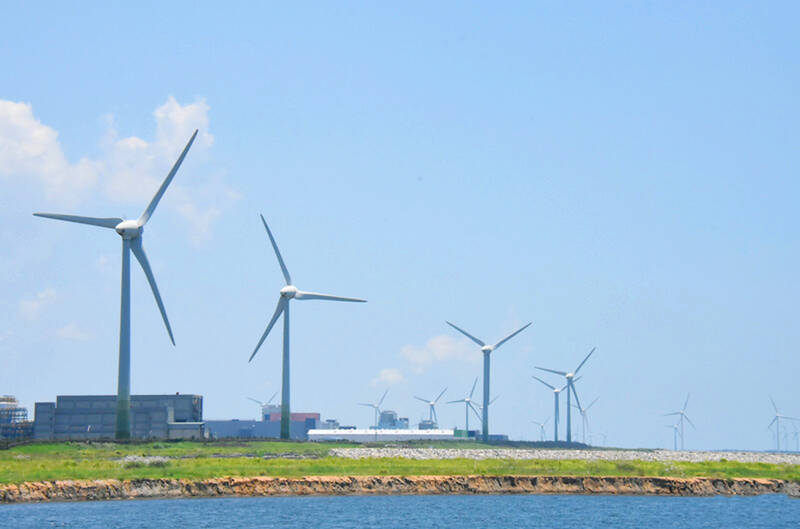
Photo: TT file photo
The standard explanations — geology, geography, capital — are not borne out by the data. The offshore wind resource in the Taiwan Strait is among the best in the world. The geothermal potential, as this paper documented in April, is enormous: Taiwan sits on an estimated 33 GW of reserves, of which only a sliver is exploited. Despite it being very challenging, project finance has remained available, with billions of US dollars and New Taiwan dollars raised under recent rounds of non-recourse project finance for offshore wind.
The shortfall is not in resources or in capital. It lies in the institutional follow-through, and in regulatory signals that have grown mixed for the firms Taiwan most needs. Solar is the clearest domestic illustration: writing in Taiwan Insight, Elizabeth Frost and Elena Yi-ching Ho (何宜靜) note that the renewable slowdown has been driven less by failed policy implementation than by public opposition to wind and solar projects, compounded in November last year when legislators from the opposition-controlled legislature, tightened the Environmental Impact Assessment regime for solar — a move some in the industry called the straw that broke the sector’s back.
Chao Chia-wei (趙家緯) and Ko Yun-ling (柯昀伶), writing in Taiwan Insight, reach a convergent diagnosis from the ground up: public trust in renewables has been eroded by corruption scandals around solar and offshore wind projects, while local resistance — over farmland repurposed for solar and the impact of offshore turbines on fisheries — has repeatedly stalled project permitting. The bottleneck, again, is social and institutional rather than physical.
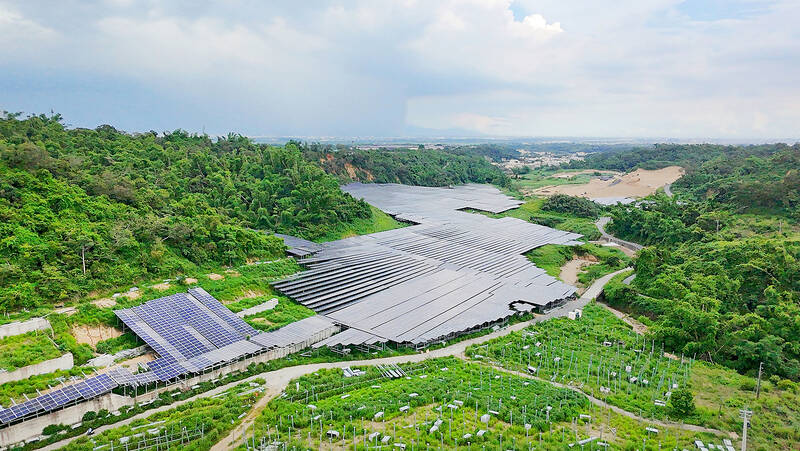
Photo: Lee Hui-chou, Taipei Times
The clearest signal of this drift is European. In November 2024, after months of friction during which several European developers withdrew, the EU and Taiwan reached an understanding under which Taipei committed not to use localization criteria in future offshore wind tenders. Brussels had challenged such criteria in Round 3 of the government’s Offshore Wind Zonal Development Auction Mechanism — administered by the Ministry of Economic Affairs, and divided into phases 3.1, 3.2 and the just-launched 3.3 — not only on cost-and-viability grounds, but because they were considered incompatible with WTO law.
The November 2024 understanding was supposed to close the file. It has not. The recently launched Round 3.3 tender, according to an EU source, appears to retain criteria linked to local investment thresholds — criteria on which Brussels has formally raised concerns with Taiwanese authorities.
The government frames the new criteria as concerning investment rather than content; for developers reading the fine print, the distinction is thinner than the official line suggests. Worse, the concerns expressed in 2024 turned out to be well-founded, with the large majority of Round 3.1 and 3.2 projects struggling to go ahead and several international companies confirmed to be leaving the market — a lose-lose outcome for international investors and for Taiwan’s energy security.
In a report published in October 2024 by the French Institute of International Relations (IFRI), the Taipei-based analyst Adrien Simorre documented what he called a fragmentation of responsibilities between private actors, the government and state-owned enterprises in the energy sector — a structural weakness that produces inadequate investment strategies even when headline targets are politically endorsed. The problem, in this reading, is rarely the absence of a policy: it is the difficulty of stabilizing it across rounds, ministries and electoral cycles.
The operator perspective cuts against the regulatory critique. A senior representative at a major European offshore wind developer with active Taiwan projects pushes back against the narrative of systemic blockage. Seven years from project award to commercial operation is what would be required almost anywhere in the world, this source argues, not a uniquely Taiwanese pathology.
Permit predictability has improved since 2022, and Round 2 feed-in tariffs were fully bankable with Taiwan Power Co (Taipower, 台電) as off-taker. The same source places the priority elsewhere: in executing tools Taipei has already designed.
TRILLION DOLLAR INVESTMENT
The National Development Council and Financial Supervisory Committee have spent two years promoting a so-called Trillion Dollar Invest-in-Taiwan Plan, which aims to redirect domestic pension funds and life insurance capital — currently invested largely overseas — into critical Taiwanese infrastructure, including offshore wind.
Executed at scale, it would allow early-round developers to partially exit their assets to long-duration domestic capital, replicating how the mature European offshore wind market works, while freeing developer balance sheets for the next wave of projects. The recommendation is unambiguous: not structural reform, but smarter execution of existing policy tools.
The geothermal case study brings a sectoral lens. Lin Po-keng (林伯耕), deputy general manager at FengYeu Green Energy (豐宇綠能), told this paper last month that the binding constraints in geothermal sit upstream — in early-stage exploration finance, in the overlap between geothermal permitting and pre-existing hot spring tourism law, and in the absence of a public risk-sharing scheme for confirmation drilling. Even where the resource is abundant and the technology mature, what holds development back is neither geology nor capital, but how public risk is shared.
So what is the real bottleneck? Taiwan has the industrial capacity to deliver: the supply chain has localized, and Round 2 closed on bankable terms. But the gap between announced trajectories and delivered megawatts has widened over three years, the signal to foreign developers remains mixed after Round 3.3, and the developers who have stayed are asking not for sweeping reform but for smarter execution of tools Taipei has already designed.
This is not gridlock. It is incomplete institutional follow-through, and the distinction matters because the cure for the two diagnoses is very different. Part 2 of this feature, to be published on 19 June, will take up the harder question: whether Taiwan’s institutional architecture can deliver that follow-through without borrowing more deliberately from the Japanese model of long-cycle, inter-agency energy planning.
Romain Blachier is a French energy and geopolitics specialist, France-Formosa Association president, contributor to several think tanks, former deputy mayor of Lyon, and a lecturer on energy markets and Indo-Pacific geopolitics at HEIP, ECAM, Universite Lyon 1, INSEEC and ILERI.

Ajay Verma, a consultant gastroenterologist at Kettering general hospital in Northamptonshire, says our gut is a “complex machine.” “It is constantly providing us with the nutrition we need, initially to grow and develop, and then for us to survive, thrive and repair from injury and illness.” How can we keep it functioning well? Put simply: “Make sure what you put into it is balanced, and that you clear out its waste products adequately,” Verma says. “In a general gastroenterology clinic, the most common conditions we see are irritable bowel syndrome (IBS), gastroesophageal reflux disease, inflammatory bowel disease and constipation,” says Nisha

And so, in the wake of US President Donald Trump’s trip to the People’s Republic of China (PRC), all the experts on the Strait of Hormuz suddenly became experts on US-China-Taiwan relations. The Internet has certainly expanded human knowledge. Lots of these sudden experts made noise this week about Trump’s words after the meeting with PRC dictator Xi Jin-ping (習近平). Trump is going to sell out Taiwan! Longtime Taiwan commentator J. Michael Cole summed the situation up neatly in the Guardian: “We need to keep in mind that he has a tendency to say many things — sometimes contradicting himself within

Last week US President Donald Trump was asked by a reporter whether he would speak on the phone to the President of Taiwan. “l’ll speak to him. I speak to everybody. We have that situation very well in hand,” Trump said. This marked the second time in a couple of weeks he had said he would talk to the President of Taiwan. In 2016 he famously took a call from then-president Tsai Ing-wen (蔡英文), when he was president-elect. Despite warnings that the apocalypse was nigh because of a phone call, the world quickly forgot about the conversation between two democratically-elected presidents.

May 25 to May 31 Few believed that apples could be cultivated on a commercial scale in Taiwan’s high mountains. When horticulturalist Cheng Chao-hsiung (程兆熊) first proposed the idea in 1955, both American and Taiwanese colleagues dismissed it as implausible, arguing that temperate fruit could not be reliably grown on a subtropical island, especially on rugged terrain. However, it was this terrain in the Central Mountain Range where many Chinese Civil War veterans were resettled in the late 1950s. With limited job prospects and no family in Taiwan, they were placed on cooperative farms aimed toward self-sufficiency. Some say the conditions


 RSS
RSS