


May 25 to May 31
Few believed that apples could be cultivated on a commercial scale in Taiwan’s high mountains. When horticulturalist Cheng Chao-hsiung (程兆熊) first proposed the idea in 1955, both American and Taiwanese colleagues dismissed it as implausible, arguing that temperate fruit could not be reliably grown on a subtropical island, especially on rugged terrain.
However, it was this terrain in the Central Mountain Range where many Chinese Civil War veterans were resettled in the late 1950s. With limited job prospects and no family in Taiwan, they were placed on cooperative farms aimed toward self-sufficiency.
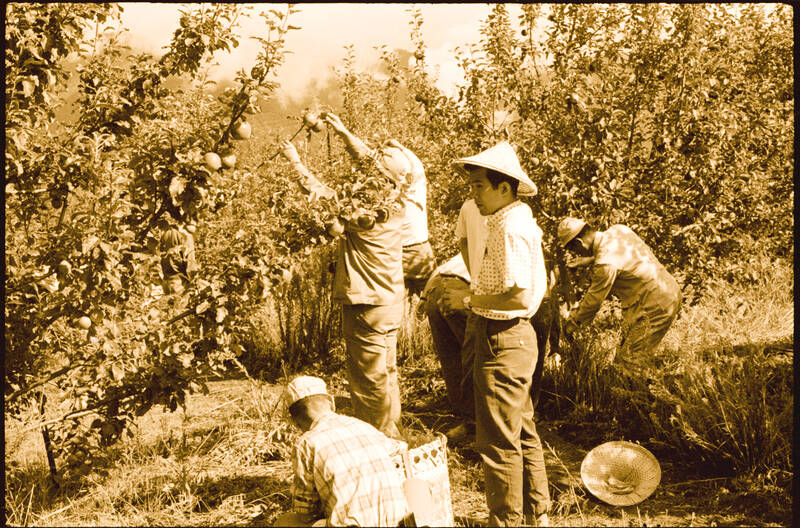
Photo courtesy of Academia Historica
Some say the conditions were harsher than military service. When Sung Ching-yun (宋慶雲) arrived at Fushoushan Farm (福壽山農場) in 1959, he recalled that workers labored for 10 hours a day, subsisting on pickled vegetables, salt-water rice and occasional meat.
Cheng had already demonstrated that apples and other high-quality deciduous fruit could be cultivated at 2,000m at the experimental orchard he built from scratch a year earlier. However, when Sung later imported thousands of fruit saplings for large-scale cultivation, many officials dismissed the move as wasteful in an era of austerity, and questioned whether large-scale production could succeed, states a Taiwan Panorama article.
With backing from Veterans Affairs Council minister Chiang Ching-kuo (蔣經國), high-mountain fruit cultivation gradually expanded. Between 1970 and 1979, the region enjoyed what would be later described as a “golden age” of apple production, which brought prosperity to both veteran farms and surrounding Indigenous communities.
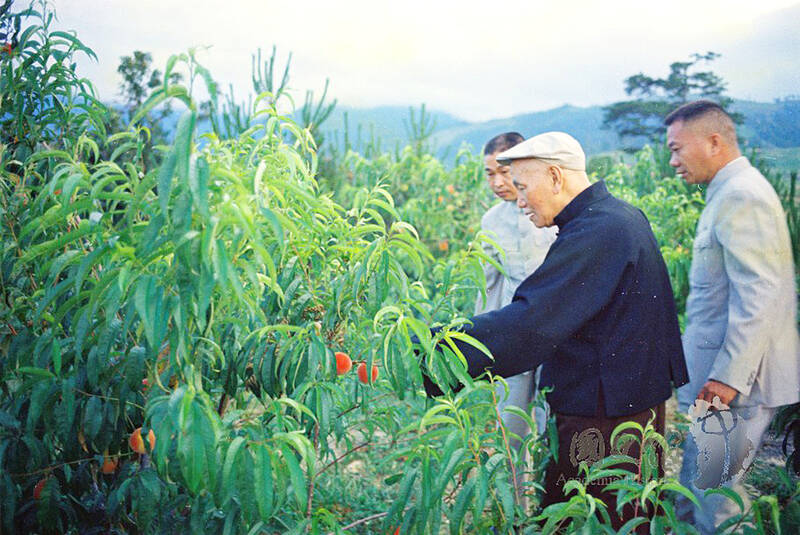
Photo courtesy of Academia Historica
RESETTLING VETERANS
Located in Taichung’s Heping Township (和平), Fushoushan was traditionally Indigenous Atayal territory. Its inhabitants practiced swidden agriculture, rotating crops and using companion planting. The Japanese reached the area in 1913 and, through force and enticement, introduced sedentary farming while planting limited numbers of deciduous fruit trees.
Huang Po-sung (黃柏松) writes in the book, A Study of the Veterans Affairs Council’s Establishment of Farms in the Lishan Area to Resettle Veterans (退輔會於梨山地區設置農場安置榮民之研究) that a few apple trees were grown by Japanese police stations, likely planted out of homesickness. None of the various fruit varieties was sold commercially, and few productive trees remained after World War II.
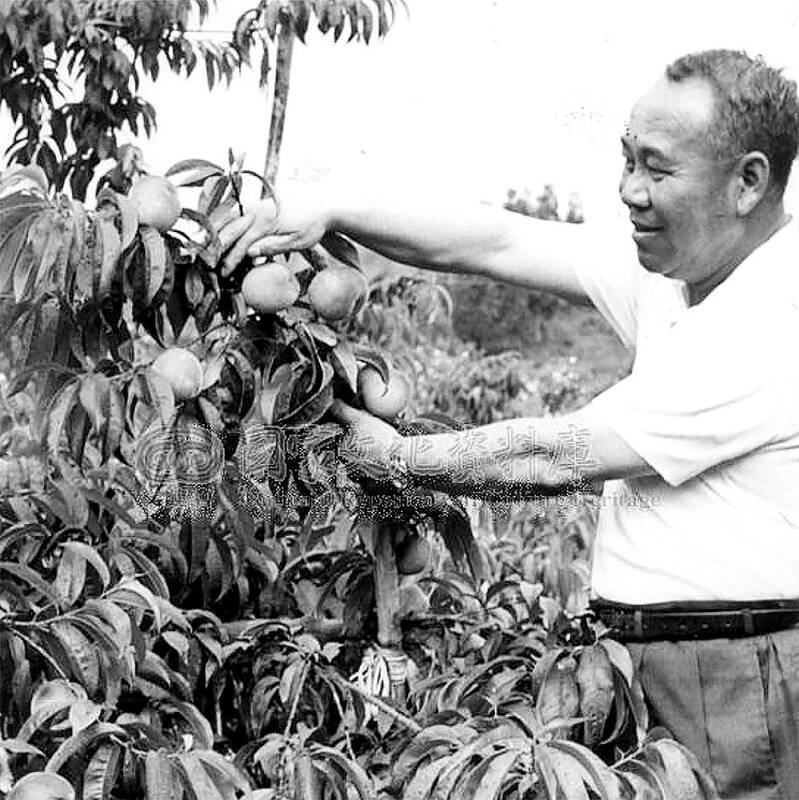
Photo courtesy of Fushoushan Farm
After the Chinese Civil War, large numbers of soldiers retreated to Taiwan with the Chinese Nationalist Party (KMT). Many were older career servicemen who left their family behind in China. In 1954, today’s Veterans Affairs Council was established to resettle them. The US, which had been urging Taiwan to reduce its armed forces to stabilize the economy, contributed financially to the program.
Since they were used to collective living, cooperative farming was seen as one solution. However, with little arable land available, most veteran farms were located on marginal terrain such as riverbeds, foothills and high mountains. Life was harsh and productivity remained low, and despite multiple policy adjustments, turnover rate remained high.
FATHER OF APPLES
In 1956, the government began building the Central Cross-Island Highway, with veterans consisting of more than half of the workforce. What became Fushoushan Farm was established on June 1, 1957 to provide fresh vegetables for the workers, as it took days to transport supplies to the work sites by foot.
The farm consisted of 800 hectares of arable land and lay at a key junction along the highway. It was already a hub for construction services, and it was strategically beneficial for national defense purposes by having former soldiers work there, Huang writes.
Cheng, who studied horticulture and literature in France during the 1930s, in 1954 founded the horticulture department at the Taiwan Provincial College of Agriculture. In his autobiography, he wrote that after being chided by his colleagues for his apple proposal, he became determined to prove them wrong, leading months-long expeditions into the mountains during summer vacations for three consecutive years. Before the highway was completed, the team carried their own rice and tents into the wilderness and foraged for greens.
He presented their findings in 1958 through a well-received exhibition at Taipei’s Zhongshan Hall, and obtained permission to set up an experimental orchard in Beidongyan Mountain (北東眼山). He began with about 60 apple varieties, along with other fruit crops, and shared his expertise with veteran farms and Indigenous communities. His success earned him the title “Taiwan’s father of apples.”
BOOM AND BUST
Fushoushan first experimented with fruit tree cultivation in 1958, and shifted toward large-scale planting the following year. Having grown up on an orchard in China’s Shandong Province, Sung brought his experience to the project. But with roughly 2,000 tree saplings about to arrive in Taiwan, he came under pressure to clear land rapidly, ultimately employing the traditional Indigenous method of controlled burning with assistance from local communities.
Apple, peach and plum trees were planted in the summer of 1960. After weathering typhoons and a pest epidemic, they began fruiting after several years.
“I was probably as excited and proud as a first-time father,” Sung told Taiwan Panorama.
Hung Po-yi (洪伯邑) and Hsiao Hui-tsen (蕭彗岑) write in “Political technology of apples: Territorial governance and the economy of high-mountain agriculture in Taiwan” (蘋果的政治技術:台灣高山農業的領域政治與經濟) that apples were most lucrative, selling for roughly twice the price of pears and peaches.
Before this, apples were imported mainly from Japan and the US. They were mostly consumed by US military personnel, and seen as a luxury good by Taiwanese. This notion helped boost the value of apples after domestic production began.
Indigenous residents also greatly benefited from the apple boom, either cultivating the fruit themselves or leasing land to Han farmers. A United Daily News report notes that by 1973, Sqoyaw Village (Huanshan, 環山), had become even more prosperous than Taichung City in some ways, with residents driving shiny cars and living in homes equipped with the latest appliances.
However, this golden era began to fade with the opening of large-scale imports of apples from the US in 1979. Trade liberalization in the 1990s further lowered barriers to imported fruit.
Following the 921 Earthquake in 1999 and severe landslides caused by subsequent typhoons and storms, public attention turned toward erosion and soil degradation linked to deforestation for betel nut and fruit cultivation. Policy shifted toward conservation and reforestation, while regulations imposed tighter restrictions on development in high-altitude areas above 1,500 meters.
Today, an estimated 99 percent of apples consumed in Taiwan are imported, with locally grown fruit being a niche boutique product.
Taiwan in Time, a column about Taiwan’s history that is published every Sunday, spotlights important or interesting events around the nation that either have anniversaries this week or are tied to current events.
Taiwan’s overtaking of South Korea in GDP per capita is not a temporary anomaly, but the result of deeper structural problems in the South Korean economy says Chang Young-chul, the former CEO of Korea Asset Management Corp. Chang says that while it reflects Taiwan’s own gains, it also highlights weakening growth momentum in South Korea. As design and foundry capabilities become more important in the AI era, Seoul risks losing competitiveness if it relies too heavily on memory chips. IMF forecasts showing Taiwan widening its lead over South Korea have fueled debate in Seoul over memory chip dependence, industrial policy and
“China wants to unify with Taiwan at the lowest possible cost, and it currently believes that unification will become easier and less costly as time passes,” wrote Amanda Hsiao (蕭嫣然) and Bonnie Glaser in Foreign Affairs (“Why China Waits”) this month, describing how the People’s Republic of China (PRC) is playing the long game in its quest to seize Taiwan. This has been a favorite claim of many writers over the years, easy to argue because it is so trite. Very obviously, if the PRC isn’t attacking Taiwan, it is waiting. But for what? Hsiao and Glaser’s main point is trivial,

And so, in the wake of US President Donald Trump’s trip to the People’s Republic of China (PRC), all the experts on the Strait of Hormuz suddenly became experts on US-China-Taiwan relations. The Internet has certainly expanded human knowledge. Lots of these sudden experts made noise this week about Trump’s words after the meeting with PRC dictator Xi Jin-ping (習近平). Trump is going to sell out Taiwan! Longtime Taiwan commentator J. Michael Cole summed the situation up neatly in the Guardian: “We need to keep in mind that he has a tendency to say many things — sometimes contradicting himself within
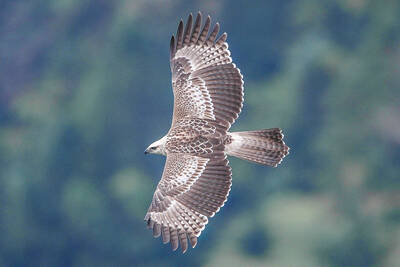
It took 12 years and months of standing in the same mountain location for director Liang Chieh-te (梁皆得) to capture a few seconds of footage: Taiwan’s largest resident raptor locking talons with its mate and spinning through the air in a courtship ritual. With only about 1,000 left in the wild and very short flight windows, the mountain hawk-eagle remains among Taiwan’s most elusive birds. The species generally produces only one offspring per year. Using forest cameras, the film crew and research teams document the arduous process the monogamous pairs go through for the chick to hatch and grow up, weathering


 RSS
RSS