


It took 12 years and months of standing in the same mountain location for director Liang Chieh-te (梁皆得) to capture a few seconds of footage: Taiwan’s largest resident raptor locking talons with its mate and spinning through the air in a courtship ritual.
With only about 1,000 left in the wild and very short flight windows, the mountain hawk-eagle remains among Taiwan’s most elusive birds.
The species generally produces only one offspring per year due to its wide territorial range. Using forest cameras, the film crew and research teams document the arduous process the monogamous pairs go through for the chick to hatch and grow up, weathering typhoons, predators and human-caused threats.
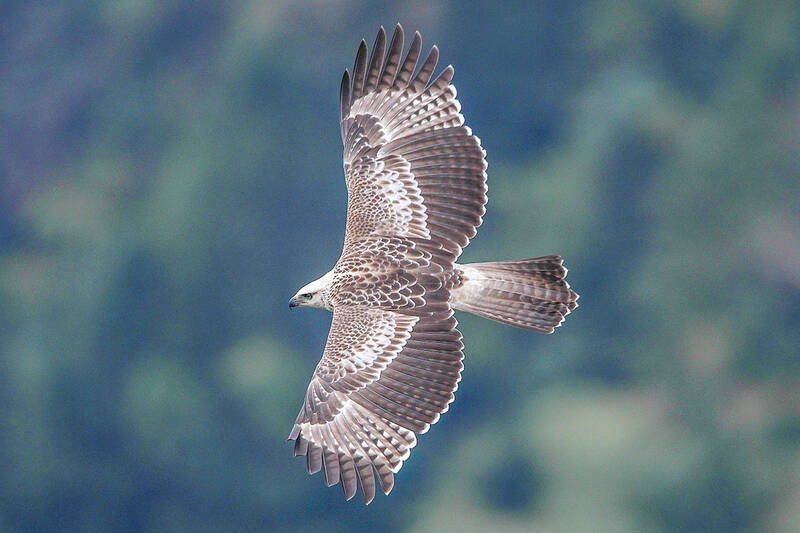
Photo courtesy of Cai Chang International
Fly, Mountain Hawk-Eagle (飛吧!熊鷹) seems to have footage for nearly every event: parents squabbling, fending off invading civets and several chicks that never make it to adulthood. Even those that successfully leave the nest face the challenge of establishing territory in habitats severely reduced and fragmented by human development. Many are later poisoned, caught in animal traps or hunted for their feathers, which hold cultural significance for Indigenous communities.
Having been making visually striking bird documentaries for more than three decades, Liang’s films are more than nature programs. The narratives are driven by the myriad pressures facing Taiwan’s birdlife, particularly the impact of human activity. Rather than focusing solely on spectacle, his work examines the possibilities of coexistence, often through the lens of individuals who devote their lives to protect these species.
Fly, Mountain Hawk-Eagle examines the complex overlap between wildlife conservation, economic development and preserving traditions that are themselves under threat from long histories of colonialism and modernization. The central conservationist featured is Sun Yuan-hsun (孫元勳), whose teams embark on grueling multi-day expeditions to install cameras and tag birds. The work is both physically demanding and hazardous, as crew members are shown being attacked by hornets and narrowly avoiding serious injury from a sudden talon swipe to the face.

Photo courtesy of Cai Chang International
The bird holds deep spiritual significance for the Indigenous Paiwan and Rukai communities, who associate it with the sacred hundred-pace viper due to the similarity in their triangular markings, particularly in the feathers of the subadults. Their use in headdresses follows complex social rules tied to hereditary status. According to the film, feathers were traditionally collected when naturally shed, which was seen as an auspicious sign. Over time, however, demand grew, giving rise to a lucrative trade that led to active hunting, with a single high quality feather fetching up to NT$60,000 on the black market.
Conservationists have tried to establish a feather repository modeled after the US, though concerns persist over access since not everyone can own a feather. The film also introduces Chung Chin-nan (鍾金男), an artisan who has been trying with mixed success to introduce high-quality imitation feathers to local villages.
Liang presents a range of perspectives on the substitute: some accept them, some argue that use should be strictly limited to cultural performances, while others worry that the wider access could further accelerate the erosion of traditional social structures.
“What if the mountain hawk-eagle is seen all over the skies, but Paiwan culture has disappeared?” one woman asks.
Nevertheless, some families have begun using the imitation feathers in weddings, and even ceremonies. Proponent and headwoman Ljuzem Djakudjakuc says that despite facing intense initial pushback, she persisted, recalling the words of her grandfather that status is defined by family lineage and community recognition rather than external objects.
Ultimately, the film avoids being overly preachy or framing Indigenous communities as antagonists to the birds at its center. With its limited scope, it offers a balanced glimpse of the ongoing negotiation, and the complexity of shifting cultural practices under modern conditions.
This discourse is central to Liang’s films. In the 2015 Fly, Kite Fly (老鷹想飛), he successfully drew public attention to the decline of black kites, many of which were poisoned after consuming prey that had ingested pesticide-treated crops. The film helped popularize a practical compromise, as some bean farmers shifted to non-toxic cultivation methods and marketed their produce under the “Eagle Red Bean” label.
Weaving these multiple storylines together with breathtaking aerial and mountain cinematography, Liang alternates between slow, observational stretches and narrative bursts, creating a well-paced rhythm. The result is an intimate, comprehensive view of this rarely-seen bird, as well as the humans involved in its survival.

Taiwan’s overtaking of South Korea in GDP per capita is not a temporary anomaly, but the result of deeper structural problems in the South Korean economy says Chang Young-chul, the former CEO of Korea Asset Management Corp. Chang says that while it reflects Taiwan’s own gains, it also highlights weakening growth momentum in South Korea. As design and foundry capabilities become more important in the AI era, Seoul risks losing competitiveness if it relies too heavily on memory chips. IMF forecasts showing Taiwan widening its lead over South Korea have fueled debate in Seoul over memory chip dependence, industrial policy and

“China wants to unify with Taiwan at the lowest possible cost, and it currently believes that unification will become easier and less costly as time passes,” wrote Amanda Hsiao (蕭嫣然) and Bonnie Glaser in Foreign Affairs (“Why China Waits”) this month, describing how the People’s Republic of China (PRC) is playing the long game in its quest to seize Taiwan. This has been a favorite claim of many writers over the years, easy to argue because it is so trite. Very obviously, if the PRC isn’t attacking Taiwan, it is waiting. But for what? Hsiao and Glaser’s main point is trivial,
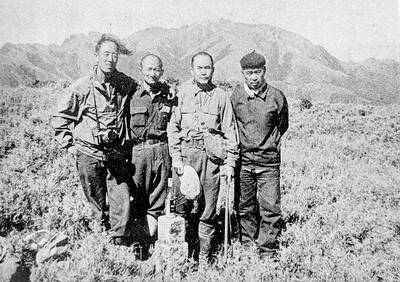
May 18 to May 24 Gathered on Yangtou Mountain (羊頭山) on Dec. 5, 1972, Taiwan’s hiking enthusiasts formally declared the formation of the “100 Peaks Club” (百岳俱樂部) and unveiled the final list of mountains. Famed mountaineer Lin Wen-an (林文安) led this effort for the Chinese Alpine Association (中華山岳協會). Working with other experienced climbers, he chose 100 peaks above 10,000 feet (3,048m) that featured triangulation points and varied in difficulty and character. The list sparked an alpine hiking craze, inspiring many to take up mountaineering and competing to “conquer” the summits. A common misconception is that the 100 Peaks represent Taiwan’s 100 tallest

The Chinese Nationalist Party (KMT), alongside their smaller allies the Taiwan People’s Party (TPP), are often accused of acting on behalf of the Chinese Communist Party (CCP). Some go so far as to call them “traitors.” It is not hard to see why. They regularly pass legislation to stymie the normal functioning of the ruling Democratic Progressive Party’s (DPP) administration, and they have yet to pass this year’s annual budget. They slashed key elements of the government’s proposed NT$1.25 trillion (US$40 billion) special military budget, and in the smaller NT$780 billion package they did pass, it is riddled with provisions that


 RSS
RSS