


“China wants to unify with Taiwan at the lowest possible cost, and it currently believes that unification will become easier and less costly as time passes,” wrote Amanda Hsiao (蕭嫣然) and Bonnie Glaser in Foreign Affairs (“Why China Waits”) this month, describing how the People’s Republic of China (PRC) is playing the long game in its quest to seize Taiwan. This has been a favorite claim of many writers over the years, easy to argue because it is so trite. Very obviously, if the PRC isn’t attacking Taiwan, it is waiting. But for what?
Hsiao and Glaser’s main point is trivial, but its construction is not. For years I have argued that writers should use the terms “annex” and “annexation” to describe what the PRC seeks to do to Taiwan. For too many, the word “unification” is a compromise that avoids using the erroneous and obviously pro-PRC term “re-unification,” while still enabling the writer to conceal what is actually happening. “Unification” posits that Taiwan is a part of China that has somehow drifted away. Whereas, Taiwan is not, and has never been, part of China.
NOT UNIFICATION, BUT ANNEXATION
Photo: AP
Note how “unification” suggests the end of a long and inevitable process, one that makes whole that which has been fractured. This “making whole” even implies that “unification” has a moral dimension to it, that it is somehow good, hardly injurious at all. It draws on the PRC’s constructed version of its history, the mythical “China” that is always breaking up yet always re-assembling itself into a united empire. Hiding behind that term “unification” is a teleological view of history in which absorption of neighbors is not conquest but the inevitable, tangible realization of historical myth.
“Unification” is thus a pro-PRC term that aligns itself with the PRC’s own propaganda that PRC annexation of Taiwan is inevitable. As I have noted in many columns, the idea of inevitability in the PRC annexation of Taiwan is an expansionist fantasy, an attempt to win with history what cannot be won without armies.
Using the term “unification,” the writer can obscure the existence of the bloody and brutal occupation that the word “annexation” automatically summons. Consider the recent sturdy, detailed piece at Lowy Institute on May 10 by Richard McGregor and Jude Blanchette: “After annexation: How China plans to run Taiwan.” They use the term “annexation” which flows inevitably into “occupation.” Because McGregor and Blanchette have forthrightly named the issue, they can then clearly itemize the consequences of PRC occupation. Good naming is good writing.
Photo: AP
Since “unification” appeals to the historical myth of Chinese unity, it evokes a certain sympathy in the reader. Poor China, thus amputated! It positions both Taiwan and the PRC as passive recipients of this historical process of unification, drawing a curtain over the PRC’s own agency and lust for Taiwan. Imagine if Hsiao and Glaser had said: “China wants to occupy Taiwan at the lowest possible cost.” A trite claim that no one could argue with, but one which is granted a certain dignity by calling it “unification” and not “organized savagery resulting in thousands of dead civilians.”
Indeed, another effect of “unification” is that because it invokes a ghostly historical process that occurs with or without the actions of actors, it makes it easier for Hsiao and Glaser to contend that the PRC is playing a waiting game. In their hands, the PRC is simply letting history reach its ineluctable destiny, taking no positive action. Air and sea incursions and “gray zone” intimidation, cable cutting, suppressing Taiwan’s international space and volumes of fake history? “Unification” tidily sweeps all that under the carpet.
RESISTANCE
Had Hsiao and Glaser chosen the term “annex” or “occupy” the reader would immediately realize that those terms require military action on the part of the PRC, since they imply resistance on the part of Taiwanese, making it more difficult for the reader to accept their imagined world where the PRC does nothing and Taiwan magically merges with it. If the Taiwanese are resisting, how can “unification” be achieved without force?
In the real world, despite thousands of years sitting just offshore of China, Taiwan has not of its own will ever entered the sovereignty of an entity on the other side of the Strait (or any other outside entity). Taiwan’s history is replete with resistance and revolts. Viewed in that light, the PRC is playing the “waiting game” because it is busy assembling the military it will need to invade and, more importantly, occupy Taiwan.
That observation shows another effect of “unification” positioned as an inevitable historical process: the writer does not have to ask about the people of Taiwan and their resistance. Instead, the writer need merely locate some positive data that the Taiwanese are progressing on that inevitable historical path. Sure enough, Hsaio and Glaser observe that “polls… show decreasing support for independence among Taiwan’s youth.” No doubt true (for the moment), but support for annexation to the PRC is a fringe position in Taiwan in every poll, a mere handful consider themselves “Chinese” and a majority of Taiwanese indicate they will resist if Taiwan is invaded or occupied.
They also cite Chinese Nationalist Party Chair Cheng Li-wun’s (鄭麗文) trip to the PRC as evidence of this sea-change in Taiwan, because she “reaffirmed her party’s opposition to independence and support for the so-called “1992 consensus,” the political formulation centered on the idea that the two sides of the strait belong to “one China.” Surely Beijing better than anyone understands how unpopular the fictional “1992 consensus” is in Taiwan.
Taiwan’s resistance to occupation is why Hsiao and Glaser are eventually forced to say that Beijing “believes that it can compel the island into capitulation without necessarily needing a full-scale invasion.” Once again, imagine if Hsiao and Glaser had honestly written “Beijing believes it can occupy Taiwan without a full-scale invasion,” the reader would easily see how “occupy” invokes “resistance.”
What is raising the cost of “unification”? What is forcing Beijing to “compel the island into capitulation”? Taiwanese resistance. That resistance is implied in their nod to the declining support for independence among Taiwanese youth: if resistance were not an issue, declines in it would not matter. Note too how “unification” positions all that resistance on the wrong side of history.
Finally, the word “unification” with all its implications of historical process make it possible for Hsiao and Glaser to write as if the real problem for Beijing were not Taiwanese resistance to occupation and its horrors, but US interference in “unification,” a favorite claim of pro-PRC propagandists. A common pro-China move is to make the Taiwan issue an issue between Beijing and Washington, in which Taiwan functions as a mere ideological prop. But Washington resists in part because Taiwan does.
All this goes to show that like Taiwan itself, commentators on the island’s situation should resist “unification.”
Notes from Central Taiwan is a column written by long-term resident Michael Turton, who provides incisive commentary informed by three decades of living in and writing about his adoptive country. The views expressed here are his own.


Taiwan’s English education system is being pulled apart by three opposing forces. Bilingual Nation 2030 pulls students toward English and global communication. Artificial Intelligence (AI) readiness pulls them toward digital judgment, verification and AI-mediated work. But Taiwan’s old exam culture pulls them back toward memorization, grammar drills, timed reading and correct answers. If the education system keeps using old exams to define success, it risks producing graduates who are neither genuinely bilingual nor genuinely AI-ready, but trained for tasks machines can already perform. The first force is Bilingual Nation 2030. Launched in 2018, the policy aimed to “help Taiwan’s workforce connect

“Taiwan’s Opposition Leader Comes to US With a Message Straight Out of Beijing” read a May 31 headline in the Wall Street Journal. Top US administration officials and members of Congress almost certainly read the WSJ, and if there was a bullet point takeaway that people in Washington should absorb ahead of Chinese Nationalist Party (KMT) Chair Cheng Li-wun’s (鄭麗文) arrival in DC on June 9, that headline is it. The last few columns have discussed this very topic, and the timing is not coincidental. While those top officials likely do not read the Taipei Times, judging by the number

With weighty, anxiety-inducing geopolitical topics dominating the headlines, checking in on the wild and weird state of local politics can take some of the edge off. This November’s elections will determine who will be in charge of fixing potholes in your neighborhood, not the potholes in Taiwan’s complicated geopolitical space. Recently, after an online interview with a Taipei-based journalist, I commented that Taipei journalists never go further than the MRT can take them. He laughed and agreed. Naturally, the Taipei mayoral race is eating up much of the press attention. TAIPEI CITY Democratic Progressive Party (DPP) candidate Puma Shen (沈伯洋) has
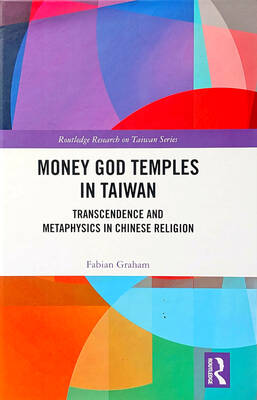
As someone who normally steers clear of books with “transcendence” or “metaphysics” in their subtitles, this reviewer — a casual observer of local belief systems since the 1990s — found Fabian Graham’s Money God Temples in Taiwan a challenging read. Those who’ve only dipped their toes into temple culture will likely need to parse several sections with special care if they’re to keep up with the author, a British ethnographic researcher whose previous books have investigated religious practices among ethnic Chinese in Southeast Asia. This scholarly volume examines a facet of Taiwan’s religious landscape that didn’t exist a century ago, and


 RSS
RSS