


In a sudden move last week, opposition lawmakers of the Chinese Nationalist Party (KMT) and Taiwan People’s Party (TPP) passed a NT$780 billion special defense budget as a preemptive measure to stop either Chinese leader Xi Jinping (習近平) or US President Donald Trump from blocking US arms sales to Taiwan at their summit in Beijing, said KMT heavyweight Jaw Shaw-kong (趙少康), speaking to the Taipei Foreign Correspondents Club on Wednesday night in Taipei.
The 76-year-old Jaw, a political talk show host who ran as the KMT’s vice presidential candidate in 2024, says that he personally brokered the deal to resolve the long-debated budget impasse at a May 6 meeting of the KMT’s Central Standing Committee, just two days before the KMT-led legislature passed the controversial budget.
“The proposal that passed was my suggestion,” said Jaw, who spoke mainly in English.
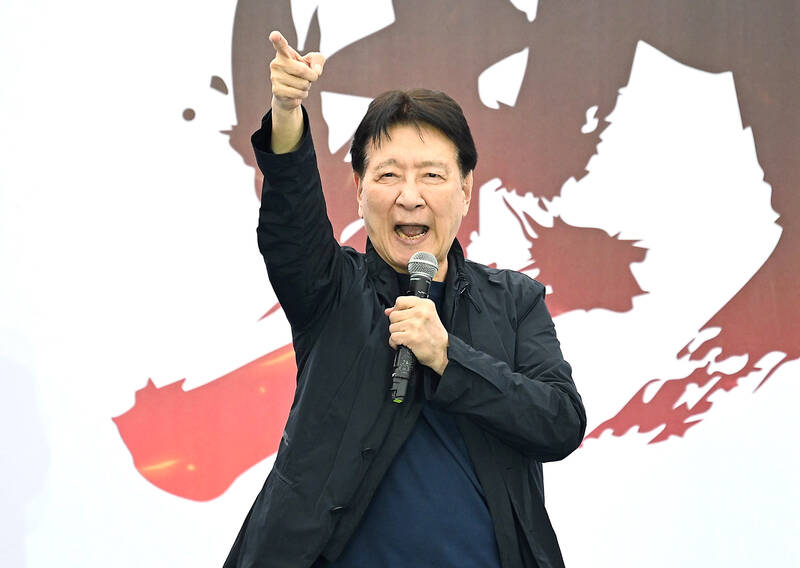
Photo: TT file photo
Jaw’s press conference came just hours before Trump landed in Beijing, where the president is scheduled to conduct two days of talks with China’s Xi from May 13 to 15.
Ahead of the Xi-Trump summit, Chinese state media argued vehemently and at length against the US selling weapons to Taiwan, prompting international speculation that Trump would use the arms sales as a bargaining chip in the talks.
To do so would be a major reversal in longstanding US policy, but has been nevertheless feared by numerous observers owing to Trump’s unpredictable nature.
The US is obligated by law to provide Taiwan with defensive weapons, and, according to a 1982 commitment known as the “Six Assurances to Taiwan,” has further promised not to discuss such arms sales with Beijing. Trump has however been vague when asked about leaving discussions of arms sales to Taiwan off the table with China’s Xi.
’MONEY IS MONEY
Anticipating this, the KMT wanted to give neither Trump nor Xi a chance to stop the arms sales, said Jaw. Though China is strongly opposed to the sales, Xi will not be able to argue: “Taiwan, they cut their own budget. Why do you want to sell them?” he said.
In regards to the US, Jaw continued, Taiwan can now say: “We already carried out our own responsibility.”
Trump can thus be reasonably assured of Taiwan’s commitment to defend itself and, in line with his transactional style, will be happy to have a check for US$25 billion now in his back pocket — a check he’ll be loath to give up, Jaw argued.
“For Trump, money is money,” he said.
To persuade Trump against selling arms to Taiwan, Jaw said, Xi would need an incredibly attractive offer. But what Xi is likely offering — purchases of Boeing aircraft, soybeans and beef — are merely measures to “give face” to the US president on the current visit.
“I don’t think Xi Jinping will give [Trump] the benefits justified to sacrifice Taiwan,” he said.
Coming just five days ahead of the Xi-Trump summit, the sudden passage of Taiwan’s arms procurement budget came to many as a surprise. For months, the the KMT had firmly opposed a larger NT$1.25 trillion version of the defense budget originally proposed by President Lai Ching-te (賴清德) in November last year. For most of the last half year, Lai’s defense budget appeared to be dead in the water.
KMT’S BUDGET CONSENSUS
As a result of both US and domestic pressure, KMT leaders in recent months came up with various counter-proposals to Lai’s budget. The most prominent came from Taichung Mayor Lu Shiow-yen (盧秀燕), former KMT Eric Chu (朱立倫) and current chair Cheng Li-wun’s (鄭麗文). Their proposed budgets ranged from NT$350 to NT$900 billion.
These various plans finally came up for a sort of battle royale style debate at a KMT Central Standing Committee meeting on May 6 –– just over a week ago.
At the meeting, Jaw told the others, “I can cover all these kinds of different opinions, and put them together,” he said.
But when he offered a compromise plan, he met strong resistance, at least initially.
“They attacked me, all kinds [of ways]. Very tough attacks,” he said.
Claiming that “everyone’s suggestions” were covered in his proposal, he added, “I really don’t understand why.”
Under the urgency of the moment, the KMT committee did finally come to a consensus. The version of the budget that passed was “almost my proposal,” Jaw said.
Two days later in the legislature, the KMT and their opposition coalition partner TPP, who control a majority between them, voted unanimously to pass the measure. All 48 Democratic Progressive Party (DPP) legislators present at the session abstained from the vote.
The budget that was passed differed significantly from the originally DPP version. Not only was it 40 percent lower in value, it exclusively approved weapons purchases from the US while eliminating the DPP’s plan for domestic development of a drone industry. Critics of the KMT plan say drones and other asymmetric capabilities are vital to Taiwan’s defense.
One powerful factor that moved the KMT to action was the influence of US lawmakers. Two US congressional delegations visited Taiwan in March and last month. These included an all-Republican delegation led by Zach Nunn, leader of a congressional national security task force, from April 5 to 11, and a bipartisan group of US senators including Jeanne Shaheen, John Curtis, Thom Tillis and Jacky Rosen on March 30 and 31.
Jaw confirmed that these US delegations met with KMT legislators in efforts to “persuade” them to pass an arms package. Jaw, however, resisted the characterization of the US as “pressuring” the KMT into passing the budget. He further denied that the US set down a bottom line for the minimum amount of the arms procurement.
Jaw also made several remarks hinting that current KMT chair Cheng Li-wun’s (鄭麗文) influence within the party is perhaps more limited than her oversized media presence would suggest.
HUANGFUXING FACTION
Cheng’s NT$380 billion arms budget proposal was the smallest of the various KMT proposals. Though Jaw did not describe her plan as rejected in favor of the larger NT$780 billion plan, he did however insinuate that Cheng has become beholden to a deep blue faction of military veterans known as the Huangfuxing (黃復興).
Jaw described Huangfuxing as the KMT’s “backbone” and said it provided “most of the votes” for Cheng in the party chair election. But when it comes to national elections, the backing of one faction is not enough, he said.
“I don’t deny Huangfuxing’s contribution. I think it’s important,” Jaw said. “But [it’s] not enough. The KMT cannot become Huangfuxing’s party.”
If that were to happen, the KMT’s support base would become “smaller and smaller,” he added.
Jaw also noted that the 65,000 votes Cheng garnered to become KMT party chair is less than the 100,000 or more votes needed to become a legislator. His implication is that Cheng has less popular support than other top KMT figures.
On Taiwan’s development of drones, Jaw said he’s not opposed. With the domestically focused NT$400 billion portion of President Lai’s defense budget that the KMT cut, the opposition’s main point of resistance is the perception of “DPP corruption,” Jaw said.
Essentially, the fear is that the DPP will award contracts to party-aligned companies, use those connections to build political strength and at the same time freeze out the opposition.
Jaw also spoke about his views on cross-strait diplomacy. Jaw believes in the eventual unification of Taiwan and China, but not under current conditions.
At present, “I think we [Taiwan] can be a lighthouse of democracy for China,” Jaw said.
He further compared China to a suitor that’s attempting to woo Taiwan, an unwilling bride.
“Taiwan should say to China, you are not qualified to marry me now, but I will not get married with another guy.”
What Taiwan should say to China is, “You think your system is good, but we feel our system is better. So for now, we rule Taiwan with our system. But in China’s history, 100 or 200 years is a very short time. So don’t be rushed,” Jaw said.

Taiwan’s English education system is being pulled apart by three opposing forces. Bilingual Nation 2030 pulls students toward English and global communication. Artificial Intelligence (AI) readiness pulls them toward digital judgment, verification and AI-mediated work. But Taiwan’s old exam culture pulls them back toward memorization, grammar drills, timed reading and correct answers. If the education system keeps using old exams to define success, it risks producing graduates who are neither genuinely bilingual nor genuinely AI-ready, but trained for tasks machines can already perform. The first force is Bilingual Nation 2030. Launched in 2018, the policy aimed to “help Taiwan’s workforce connect
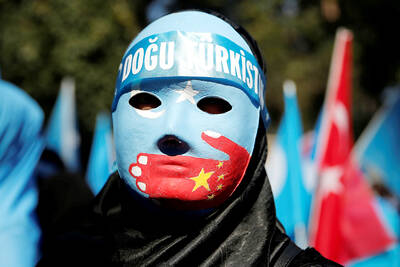
It seems every few days one bumps into one of those “real man” comments in which Taiwan is urged to “face reality” or similar, and “make a deal,” with the speaker implying that soon it will be too late. “Deal” advocates always present themselves as having a superior grip on reality, and the manly ability to make the “hard choice.” Their testosterone-laden language often echoes that of Taiwan sellout advocates. Note that such commentary always specifies a process (“make a deal, work with, make progress”), never the end state of what occupation by a violent authoritarian colonialist state will entail. In
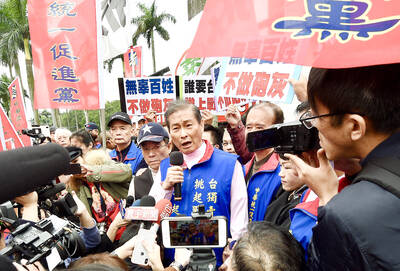
There are shadowy cabals plotting to sell out Taiwan to be annexed by China, by invasion if necessary. Fortunately, they are buffoons. In 2019, former Bamboo Union gangster and founder of the China Unification Promotion Party (CUPP), Chang An-le (張安樂, colorfully known as “White Wolf”), led a protest at the Legislative Yuan against comments made by then-premier Su Tseng-chang (蘇貞昌) that in the event of an attack by China, he would never surrender, but would protect the nation by fighting to the end, even if he only had a broom. Chang had party members bring a wooden casket that they
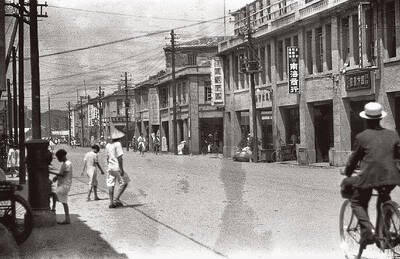
June 1 to June 7 "If all Taiwanese were as afraid of dying as you, then what would happen?” Physician Shih Chiang-nan (施江南) reportedly said this to his wife Chen Chiao-tung (陳焦桐) after she urged him to stop intervening on behalf of Taiwanese soldiers stranded overseas after serving in the Japanese Army during World War II. Shih had clashed with high-ranking officials over the issue, engaged in several heated arguments with Taiwan governor-general Chen Yi (陳儀) and allegedly shouted at general Ko Yuan-fen (柯遠芬), chief of staff of the Taiwan Garrison Command, over


 RSS
RSS