


The Chinese Nationalist Party (KMT), alongside their smaller allies the Taiwan People’s Party (TPP), are often accused of acting on behalf of the Chinese Communist Party (CCP). Some go so far as to call them “traitors.”
It is not hard to see why. They regularly pass legislation to stymie the normal functioning of the ruling Democratic Progressive Party’s (DPP) administration, and they have yet to pass this year’s annual budget.
They slashed key elements of the government’s proposed NT$1.25 trillion (US$40 billion) special military budget, and in the smaller NT$780 billion package they did pass, it is riddled with provisions that threaten to tie the proposed weapons systems purchases in bureaucratic and legal knots, leaving doubts that the full amount will ever be spent.
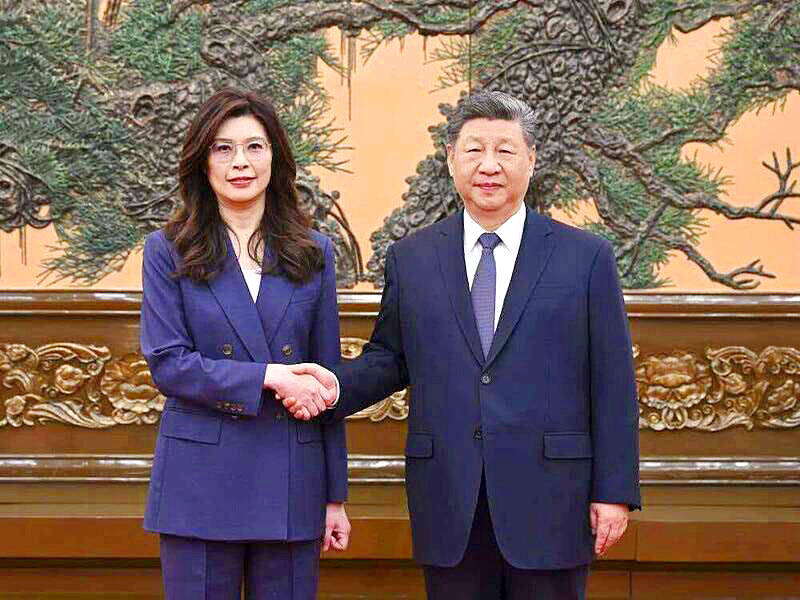
Photo courtesy of the KMT
From the Constitutional Court to several key regulatory agencies, nominees presented by the government to fill those roles are routinely rejected, often paralyzing those bodies by making them unable to form a legally mandated quorum.
KMT political figures, especially people like party Chair Cheng Li-wun (鄭麗文), regularly recite CCP talking points on issues ranging from Vladimir Putin’s legitimacy to Taiwanese culture, identity and legal status.
All of this clearly benefits the CCP. They actively work to undermine democracies worldwide to delegitimize their political systems, sow discord and sharpen political divides to break down societal and governmental unity.
The CCP is engaged in “unlimited warfare” with any and all countries they believe to be enemies, to destroy them from within without having to fire a shot, or at very least weaken their resolve if it ever comes to actual combat.
Their prize target is Taiwan, and these strategies are employed here in full force.
In practice, the KMT’s legislative caucus of 53 members and one independent, plus their eight TPP allies, are helping the CCP achieve their aims in many ways via their legislative majority.
But why? Are all 62 opposition lawmakers “traitors?”
That is highly unlikely. There are multiple layers and motivations behind these lawmakers’ actions.
In examining these motivations, it is important to note that they are not mutually exclusive, and several could be true of some individuals. This is a diverse group of people.
For example, the most important leader of the opposition is KMT caucus whip Fu Kun-chi (傅?萁), and I suspect he has multiple motivations driving his hardline stances.
LEGITIMATE OPPOSITION
Not everything is a conspiracy, and not everything is about China.
Like opposition parties everywhere, some of this is legitimate policy and ideological differences between the opposition and the ruling party.
After eight years of DPP rule under Tsai Ing-wen (蔡英文) — when they held both the executive and legislative branches — many in the opposition felt the party had ruled without proper oversight, and are now in a position to provide it. Voters seem to agree, having given them a legislative majority, and turned out en masse to defend their majority in defeating last year’s recall campaigns against KMT lawmakers.
During the Tsai years, they accused the DPP administration of corruption and using their power to benefit their political allies. In some cases, they were right.
BAD BLOOD
Often it goes deeper than that. Many hold a deep enmity towards the DPP.
Prior to the current administration, the TPP caucus dealt with issues on a case-by-case basis and did not always side with the KMT.
That changed under the leadership of former TPP caucus whip and current TPP party chair Huang Kuo-chang (黃國昌). He hates the DPP with a passion and is determined to bring them down.
During the Tsai administration, he grew increasingly frustrated and disgusted with the DPP over broken campaign promises, especially in the sphere of judicial reform, which he cares about deeply. He left the largely DPP-aligned New Power Party he cofounded and joined the TPP to battle the DPP more effectively.
With the arrest of TPP party founder Ko Wen-je (柯文哲) on corruption charges in 2024, Huang accused the president and his administration of being “authoritarian” and “weaponizing the judiciary” to “destroy the TPP.” Ko has since been convicted and is out on appeal in what appears to be a strong case against him. Prosecutors regularly target politicians of all parties, but Huang insists this is a vendetta against the political opposition.
Meanwhile, the KMT and DPP also hate each other. The DPP was founded to overthrow the KMT’s authoritarian regime during the martial law era, and some in the party would love to see the KMT destroyed — especially those whose family members or even themselves were jailed as political dissidents.
For their part, the KMT ruled Taiwan for over 50 years, and hate and resent the DPP and their fairly successful promotion of their pro-Taiwan ideology. Many in the party still view themselves as the natural rulers of the nation, and will do anything they can to bring down the DPP to restore what they view as their natural right to oppose the DPP’s efforts to “de-sinify” Taiwan.
ACTIVE TRAITORS
While the above reasons have nothing to do with China, are there active traitors who are knowingly acting on behalf of the CCP?
Unfortunately, it is very likely.
The CCP will use any leverage they can get to turn a victim: money, sex, compromising material — whatever works.
There has been a string of espionage scandals involving DPP figures, including a former presidential aide and a staff member in the foreign minister’s office — both convicted of espionage.
A former legislative assistant who won a DPP primary for a Taipei city council seat, was indicted last month on charges of spying for China.
Former DPP lawmaker and previous frontrunner to run for Kaohsiung mayor this year, Chao Tian-lin (趙天麟), had a Chinese mistress. Though it was never proven the mistress was an agent, the CCP could have used that to their advantage regardless.
If the DPP can be infiltrated by the CCP, it is almost certain that the KMT has been infiltrated. They are far more likely to have family and business ties with China.
The party officially and privately sends a steady stream of delegations to China, and of the political parties, KMT members are far more likely to make personal trips there.
The opportunities this presents to turn them into agents for the CCP is high. Lucrative contracts for the businesses of relatives, sex or blackmailing them using compromising material has almost certainly been tried many times, though we do not know if — or how often — they have been successful.
Almost certainly, they have targeted KMT caucus whip Fu. He makes frequent trips to China, is known to have had business ties there, and has been in and out of jail on financial crimes. There is no definitive proof he has been turned, but you can bet they have tried.
‘TRUE PATRIOTS’
There is another group within the KMT that actively works with the CCP, and do so openly. These are the true believers in the “one China” cause.
Officially, the KMT believes Taiwan is a province of China, but many — or even most — view “reunification” as a remote, far-off dream when conditions are right rather than a goal to be pursued in the near term.
Some, however, are working to make it a reality in the short term and actively want to lay the groundwork to smooth the path forward. KMT Chair Cheng appears to be in this camp.
These are not agents who have been turned. Rather, their agenda, aims and ideology share much in common with the CCP’s. They are not working for the CCP, they are working with the CCP — and the distinction matters.
Donovan’s Deep Dives is a regular column by Courtney Donovan Smith (石東文) who writes in-depth analysis on everything about Taiwan’s political scene and geopolitics. Donovan is also the central Taiwan correspondent at ICRT FM100 Radio News, co-publisher of Compass Magazine, co-founder Taiwan Report (report.tw) and former chair of the Taichung American Chamber of Commerce. Follow him on X: @donovan_smith.


Taiwan’s English education system is being pulled apart by three opposing forces. Bilingual Nation 2030 pulls students toward English and global communication. Artificial Intelligence (AI) readiness pulls them toward digital judgment, verification and AI-mediated work. But Taiwan’s old exam culture pulls them back toward memorization, grammar drills, timed reading and correct answers. If the education system keeps using old exams to define success, it risks producing graduates who are neither genuinely bilingual nor genuinely AI-ready, but trained for tasks machines can already perform. The first force is Bilingual Nation 2030. Launched in 2018, the policy aimed to “help Taiwan’s workforce connect

“Taiwan’s Opposition Leader Comes to US With a Message Straight Out of Beijing” read a May 31 headline in the Wall Street Journal. Top US administration officials and members of Congress almost certainly read the WSJ, and if there was a bullet point takeaway that people in Washington should absorb ahead of Chinese Nationalist Party (KMT) Chair Cheng Li-wun’s (鄭麗文) arrival in DC on June 9, that headline is it. The last few columns have discussed this very topic, and the timing is not coincidental. While those top officials likely do not read the Taipei Times, judging by the number

With weighty, anxiety-inducing geopolitical topics dominating the headlines, checking in on the wild and weird state of local politics can take some of the edge off. This November’s elections will determine who will be in charge of fixing potholes in your neighborhood, not the potholes in Taiwan’s complicated geopolitical space. Recently, after an online interview with a Taipei-based journalist, I commented that Taipei journalists never go further than the MRT can take them. He laughed and agreed. Naturally, the Taipei mayoral race is eating up much of the press attention. TAIPEI CITY Democratic Progressive Party (DPP) candidate Puma Shen (沈伯洋) has
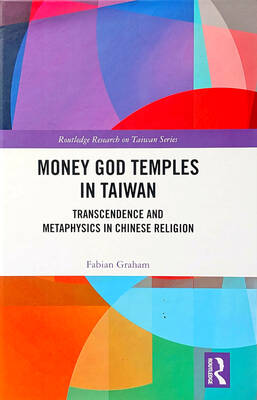
As someone who normally steers clear of books with “transcendence” or “metaphysics” in their subtitles, this reviewer — a casual observer of local belief systems since the 1990s — found Fabian Graham’s Money God Temples in Taiwan a challenging read. Those who’ve only dipped their toes into temple culture will likely need to parse several sections with special care if they’re to keep up with the author, a British ethnographic researcher whose previous books have investigated religious practices among ethnic Chinese in Southeast Asia. This scholarly volume examines a facet of Taiwan’s religious landscape that didn’t exist a century ago, and


 RSS
RSS