


Taiwan would need at least 12 submarines to reach modern fleet capabilities, CSBC Corp, Taiwan chairman Chen Cheng-hung (陳政宏) said in an interview broadcast on Friday, citing a US assessment.
CSBC is testing the nation’s first indigenous defense submarine, the Hai Kun (海鯤, Narwhal), which is scheduled to be delivered to the navy next month or in July.
The Hai Kun has completed torpedo-firing tests and is scheduled to undergo overnight sea trials, Chen said on an SET TV military affairs program.
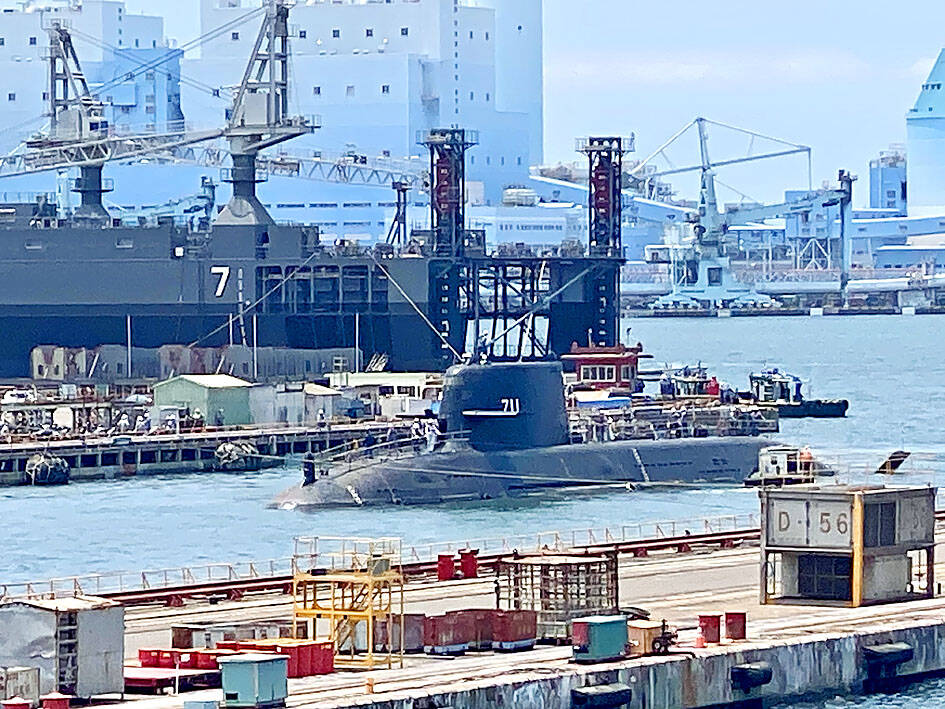
Photo: Hung Chen-hung, Taipei Times
Taiwan would require at least 12 submarines to establish a modern submarine force after assessing the nation’s operational environment and defense needs, he said, citing a US assessment.
Japan has 22 submarines, while South Korea has 20, he said.
The navy’s 256th Submarine Squadron currently operates four submarines, including the aging Hai Shih (海獅, Sea Lion) and the Hai Pao (海豹, Seal) — commissioned by the US Navy as the USS Cutlass in 1945 and the USS Tusk in 1946 respectively before being transferred to Taiwan in 1973, Chen said, adding that they are set to be retired.
The other two are the Dutch-built Chien Lung-class submarines, the Hai Lung (海龍, Sea Dragon) and the Hai Hu (海虎, Sea Tiger), commissioned in 1987 and 1988 respectively, he said.
The military plans to acquire more indigenous submarines to bolster the fleet in three phases under a “2-3-2” production plan, while the prototype Hai Kun remains in testing, he said.
Funding for the first batch of two vessels has already been approved and CSBC signed a contract with the navy last year, he said.
However, legislative budget freezes remain in place pending delivery of the prototype vessel, Chen said, adding that under the contract, the submarines are to be delivered within five years, and many components and systems must be ordered in advance from foreign suppliers.
While some onboard systems and equipment would not be identical, the design of the first two submarines would not differ significantly from the Hai Kun, he said.
In some cases, more cost-effective or better-performing products could be sourced, while differences in weight, dimensions and connectors between suppliers would require adjustments to systems and internal layouts, he said.
Major design revisions would likely not occur until later production batches, Chen added.
Taiwan sits at a strategic junction between the Strait of Malacca and northeast Asia, making the protection of maritime transportation routes and trade lifelines critically important, he said.
He highlighted the strategic importance of submarine ambush zones to counter the Chinese People’s Liberation Army (PLA) landing operations or blockades and prevent the PLA’s warships from transiting waters north and south of Taiwan.
Identifying critical zones in the waters off northeastern, southwestern and southern Taiwan, as well as a potential zone to the east, Chen said Taiwan would need at least three to four ambush zones, requiring at least four submarines to be deployed at the same time.
Most countries calculate submarine fleet sizes at about three times the number of operational boats required, as some vessels are deployed, some are used for training and others undergo maintenance, he said.
Even if only three submarines were required for active missions, the total fleet requirement would be nine or 10 vessels, he said, adding that the actual requirement would be more than 10 submarines.

NATIONAL SECURITY: Authorities are working to confirm the identities of the military personnel involved and investigating possible illegal conduct and regulatory violations Authorities are probing possible national security implications after Kinmen police and immigration officers on Sunday found a Chinese woman allegedly posing as a tourist while engaging in prostitution involving more than 10 military personnel. The woman, surnamed Chen (陳), has since been deported, authorities said, adding that investigators are still working to confirm the identities of those implicated, as the records only listed code names and aliases. The case stemmed from a report received by the Kinmen District Prosecutors’ Office on Friday last week from the Jinhu Precinct of the Kinmen County Police Bureau. On Sunday, police, along with the National Immigration

GLOBALGIVING: ‘ Caving to external pressure is not acceptable for an organization that has cultivated justice reform and human rights for 30 years,’ one NGO said A slew of non-government organizations (NGOs) have withdrawn from the GlobalGiving fundraising platform after it announced it would use “Chinese Taipei” instead of “Taiwan” from next month. The Taiwan Good Rice Association wrote on Facebook on Friday that it was informed on April 28 via a teleconference call of the change, which was made because the platform wanted to operate in China. Taiwan Good Rice is to terminate all cooperative relationships with GlobalGiving in response to the platform’s “unilateral and non-negotiable” decision to remove references to Taiwan, the NGO said. “Taiwan is in the official name of Taiwan Good Rice Association and the
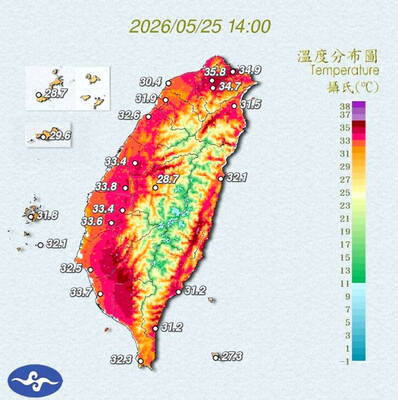
STAY COOL: The HPA recommended that people stay hydrated, use air-conditioning or fans while indoors, wear loose-fitting clothes and walk in the shade while outdoors Employers must implement measures such as installing cooling equipment, and providing drinking water and rest breaks for outdoor workers starting from Monday next week, the Taipei Department of Labor said on Sunday. Employers who fail to comply could face fines of NT$30,000 to NT$300,000 under the Occupational Safety and Health Act (職業安全衛生法), the department said. Businesses in Taipei employing fewer than 100 workers, as well as registered self-employed workers with labor insurance coverage, could receive on-site assessments and guidance from occupational safety consultants to help them apply for central government subsidies to implement or improve heat-protection measures, it said. Under the Ministry of

Chinese Nationalist Party (KMT) Chairwoman Cheng Li-wun (鄭麗文) yesterday briefed her party’s Central Standing Committee regarding her scheduled visit to the US between Monday next week and June 16, saying that her purpose would be to persuade the US that the Republic of China (ROC) Constitution was a “one China” constitution that would foster stable and peaceful cross-strait relations. The ROC Constitution is the most important defense for all Taiwanese citizens, as it upholds our democracy and has contributed to our robust economy, which aligns with international and US interests, she said. “We would not be troublemakers and drag the US under,”


 RSS
RSS