


Taiwan’s drone industry is expected to expand significantly by 2030, producing 100,000 units per month and exporting half of them, the Ministry of Economic Affairs said yesterday.
Current drone production capacity is about 15,000 units per month, but the industry can quickly scale up as demand increases, Industrial Development Administration Director-General Chiou Chyou-huey (邱求慧) told a news conference in Taipei.
Taiwan’s drone output grew 2.5-fold last year to NT$12.9 billion (US$408.3 million) under a government program to develop the uncrewed vehicle sector, he said.
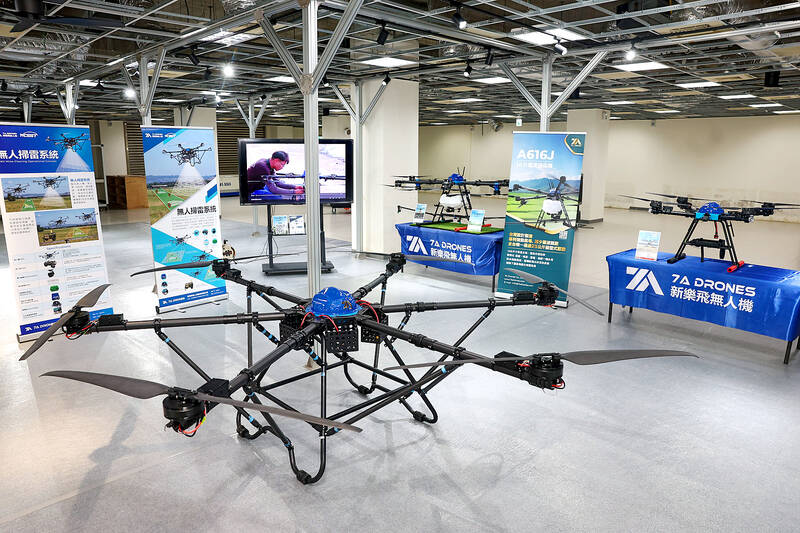
Photo: CNA
The Executive Yuan in October last year approved plans to invest NT$44.2 billion into domestic production of uncrewed aerial vehicles over the next six years, aiming to bring Taiwan’s output value to more than NT$40 billion by 2030 and to make the nation Asia’s democratic hub for the drone supply chain.
If output value doubles to NT$26 billion this year, the 2030 target could be adjusted upward, Chiou said.
The local drone industry is still mainly driven by domestic demand, with commercially produced military-grade products accounting for the bulk of output, he said.
Exports account for slightly more than 20 percent, led by the Czech Republic, Poland and the US, he added.
In the first four months of this year, drone exports reached US$147 million, he said.
At a Cabinet news conference on April 30, Chiou said that Taiwan’s drone exports totaled US$93 million last year.
By 2030, production capacity is projected to exceed 100,000 units per month, while exports are projected to exceed 50 percent of total output, he said yesterday.
Compared with China, Chinese consumer-grade drones have a significant price advantage due to large-scale production, Chiou said.
However, for military-grade commercial drones, for which anti-jamming and autonomous flight capabilities, as well as reliability, are more important, the price gap is narrower, and Taiwan remains competitive, he said.
Speaking about the XPONENTIAL 2026 uncrewed systems exhibition that ended last week in Detroit, Chiou said it featured finished products and key components from Taiwanese drone companies and drew attention from firms in the US, Japan, South Korea and Turkey for potential cooperation.
Preliminary business opportunities generated by the exhibition, which is the premier event for the drone industry, are estimated at about NT$1.3 billion across optical modules, systems and thermal imaging, he said.
During the exhibition, Taiwan signed memorandums of understanding with the Michigan Drone Association and the North Dakota Trade Office that focus on autonomous flight, urban air mobility and shared test facilities, with the aim of helping Taiwanese firms access more complete testing and certification resources, he added.
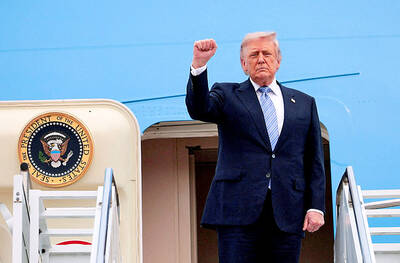
US-CHINA SUMMIT: MOFA welcomed US reassurance of no change in its Taiwan policy; Trump said he did not comment when Xi talked of opposing independence US President Donald Trump yesterday said he has not made a decision on whether to move forward with a major arms package for Taiwan after hearing concerns about it from Chinese President Xi Jinping (習近平). Trump’s comments on Taiwan came as he flew back to Washington after wrapping up critical talks in which both leaders said important progress was made in stabilizing US-China relations even as deep differences persist between the world’s two biggest powers on Iran and Taiwan. “I will make a determination,” Trump said, adding: “I’ll be making decisions. But, you know, I think the last thing we need right
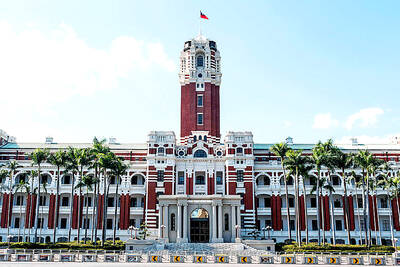
SECURITY: Taipei presses the US for arms supplies, saying the arms sales are not only a reflection of the US security commitment to Taiwan but also serve as a mutual deterrent against regional threats Taiwan is committed to preserving the cross-strait “status quo” and contributing to regional peace and stability, the Presidential Office said yesterday. “It is an undeniable fact that the Republic of China is a sovereign and independent democratic nation,” Presidential Office spokeswoman Karen Kuo (郭雅慧) reiterated, adding that Beijing has no right to claim sovereignty over Taiwan. The statements came after US President Donald Trump warned against Taiwanese independence. Trump wrapped up a state visit to Beijing on Friday, during which Chinese President Xi Jinping (習近平) had pressed him not to support Taiwan. Taiwan depends heavily on US security backing to deter China from carrying
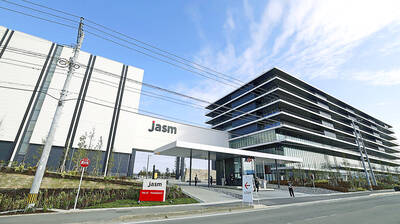
The subsidiary of Taiwan Semiconductor Manufacturing Co (TSMC, 台積電) in Kumamoto, Japan, turned a profit in the first quarter of this year, marking the first time the first fab of the unit has become profitable since mass production started at the end of 2024. According to the contract chipmaker’s financial statement released on Friday, Japan Advanced Semiconductor Manufacturing Inc (JASM), a joint venture running the fab in Kumamoto, posted NT$951 million (US$30.19 million) in profit in the January-to-March period, compared with a loss of NT$1.39 billion in the previous quarter, and a loss of NT$3.25 billion in the first quarter of
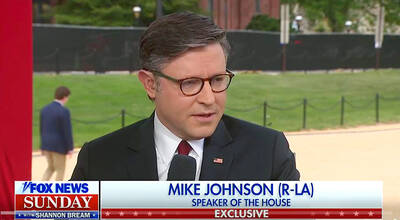
RESOLUTE BACKING: Two Republican senators are planning to introduce legislation that would impose immediate sanctions on China if it attempts to invade Taiwan US House of Representatives Speaker Mike Johnson on Sunday reaffirmed US congressional support for Taiwan, saying the US and “all freedom-loving people” have a stake in preventing China from seizing Taiwan by force. Johnson made the remarks in an interview with Fox News Sunday on US President Donald Trump’s summit with Chinese President Xi Jinping (習近平) last week. In an interview that aired on Friday on Fox News, just as Trump wrapped up a high-stakes visit to China, he said he has yet to green-light a new US$14 billion arms package to Taiwan and that it “depends on China.” “It’s a very good


 RSS
RSS