


Last week US President Donald Trump was asked by a reporter whether he would speak on the phone to the President of Taiwan. “l’ll speak to him. I speak to everybody. We have that situation very well in hand,” Trump said.
This marked the second time in a couple of weeks he had said he would talk to the President of Taiwan. In 2016 he famously took a call from then-president Tsai Ing-wen (蔡英文), when he was president-elect. Despite warnings that the apocalypse was nigh because of a phone call, the world quickly forgot about the conversation between two democratically-elected presidents.
One interesting aspect of this was the reporter’s question, which appeared to act as a reminder to Trump. He doesn’t seem to have any plan or desire to call President William Lai (賴清德), and gave the impression of simply responding extemporaneously to a question with his usual response of personal intervention (“I’ll speak to him”) followed by his constant refrain of being totally in control (“We have that situation well in hand”). Notably, he did not say that plans were being evolved.
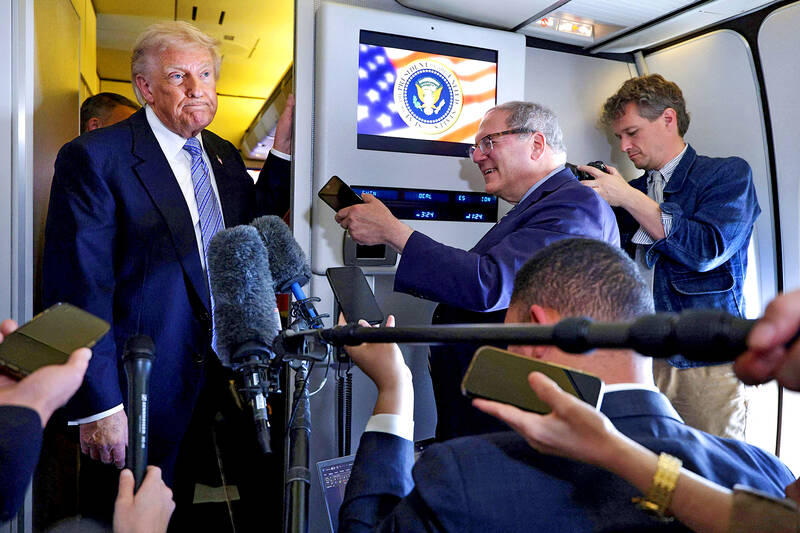
Photo: AFP
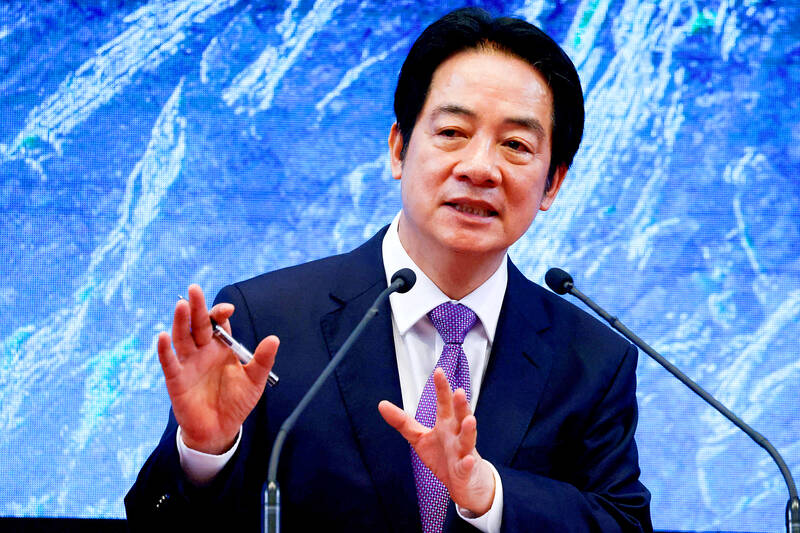
President Lai responded by saying he would be happy to speak to Trump. What else could he say?
CREATING OR REPORTING THE NEWS
The reporter’s inquiry was perfectly valid as far as it goes, but it raises the issue of whether the media is creating rather than reporting the news. In an alternate universe where no reporter raises the issue, does Trump remember his remarks about the call? Does he carry them out? Are media questions generating US foreign policy actions?
Photos: Reuters
The reason this is important is because of the now-forgotten 2017 incident in which president Tsai was asked by Reuters whether she would repeat her 2016 call with president Trump. Tsai answered carefully and sensibly: “it depends on the needs of the situation and the US government’s consideration of regional affairs.”
The question posed a hypothetical. Instead of reporting that Tsai answered “it depends,” Reuters headlined it as: “Taiwan president says phone call with Trump can take place again.”
Naturally, eyebrows rose in Washington when that sexed up headline appeared. Much mischief could have resulted.
Photos: Reuters
It turned out Reuters had submitted a list of questions in advance but that question did not appear on the list. Reuters later apologized to the Ministry of Foreign Affairs.
That was bad enough, but then Reuters asked president Trump the very next day whether he would take a phone call from Tsai. Trump said that he’d first have to talk to China’s Xi Jinping (習近平). Inevitably, that generated commentary claiming that Trump was altering US Taiwan policy, as all his comments do. His first administration in fact closely resembles the current one in that regard.
However, Reuters reported that Trump had “rebuffed an overture from Taiwan President Tsai Ing-wen.” Yet Tsai had not made an overture — she was responding to a hypothetical. The back-to-back interviews with their possibility for immense harm to US-Taiwan relations stank of a setup, as if Reuters were looking for just such an outcome.
Surely the reporter who asked Trump whether there would be a call with Lai knew when the question was asked that a phone call would roil US-PRC relations, with costs for Taiwan as well. One wonders whether the goal was to remind Trump that he said he’d call for just that reason: all the news that would be generated.
One of Trump’s traits is talking in an off-the-cuff manner about complex issues. In January 2017, new to the presidency, Trump said of China that “Everything is under negotiation, including ‘One China.’” This produced a wave of indignant commentary, along with anger from Beijing. The following month he affirmed the “one China” policy in a phone call with Xi. Everything back to normal. Commentators congratulated themselves on their timely intervention.
Before Trump’s trip to the People’s Republic of China (PRC), the media reported that the government had told journalists it was anxious about the possibility of Trump selling out Taiwan. Many commentators remarked that it was unusual for the government to signal its discomfort in that way.
In fact, in February and March 2017 rumors began circulating that Henry Kissinger would oversee a “fourth communique” under which the US would sell out Taiwan. An expert told me privately at the time that as North Korea’s nuclear weapons grow in reach, the US seeks Beijing’s help in keeping Pyongyang under control. Taiwan is an obvious bargaining chip in any such endeavor.
Because of that perception, the government representative office in New York wrote a letter to the New York Times asking the US government not to sell out Taiwan to get a deal with Beijing over North Korea.
“To use Taiwan as a bargaining chip and to undermine the Taiwan Relations Act will send the message that the United States is willing to sacrifice its allies to cut a deal,” it observed.
Rather, it should have been said: when the government has genuine fears, it will signal them to the US. The media made more of it than it should have.
MANAGING US POLICY
The media was reporting last week that the visit of US Under Secretary of Defense for Policy Elbridge Colby to Beijing was being held up over arms sales to Taiwan. Similar, in 2017 arms sales by Trump were held up due to the “fear that angering Beijing could complicate Trump’s top Asia priority: solving the North Korean crisis” (according to the Washington Post) as well as disagreements in the administration. Arms sales are routinely delayed by US presidents because they want something from Beijing.
These events are almost reassuring in the way they show how Beijing uses “anger” to manage US Taiwan policy, and how Taiwan turns into a bargaining chip the moment the US needs something from Beijing. Every US administration follows this script, and the media and commentators react each time as if it were something new.
Even if Trump and Lai actually talk on the phone, though a blow to Beijing and a lift for Lai, it will have little practical effect. The US isn’t going to recognize Taipei or change any of its major stances on Taiwan over a phone call. The PRC will continue to behave oppressively.
For the next couple of years we won’t have to make sure that the Trump administration follows several decades of US China policy. Legions of commentators and analysts exist to do just that. Rather, we will have to watch the media to see whether and how it addresses Taiwan in the context of Trump, and where it might lead him, and call it out when it appears to be provoking policy action rather than reporting the news.
Notes from Central Taiwan is a column written by long-term resident Michael Turton, who provides incisive commentary informed by three decades of living in and writing about his adoptive country. The views expressed here are his own.
Taiwan’s overtaking of South Korea in GDP per capita is not a temporary anomaly, but the result of deeper structural problems in the South Korean economy says Chang Young-chul, the former CEO of Korea Asset Management Corp. Chang says that while it reflects Taiwan’s own gains, it also highlights weakening growth momentum in South Korea. As design and foundry capabilities become more important in the AI era, Seoul risks losing competitiveness if it relies too heavily on memory chips. IMF forecasts showing Taiwan widening its lead over South Korea have fueled debate in Seoul over memory chip dependence, industrial policy and
And so, in the wake of US President Donald Trump’s trip to the People’s Republic of China (PRC), all the experts on the Strait of Hormuz suddenly became experts on US-China-Taiwan relations. The Internet has certainly expanded human knowledge. Lots of these sudden experts made noise this week about Trump’s words after the meeting with PRC dictator Xi Jin-ping (習近平). Trump is going to sell out Taiwan! Longtime Taiwan commentator J. Michael Cole summed the situation up neatly in the Guardian: “We need to keep in mind that he has a tendency to say many things — sometimes contradicting himself within

It took 12 years and months of standing in the same mountain location for director Liang Chieh-te (梁皆得) to capture a few seconds of footage: Taiwan’s largest resident raptor locking talons with its mate and spinning through the air in a courtship ritual. With only about 1,000 left in the wild and very short flight windows, the mountain hawk-eagle remains among Taiwan’s most elusive birds. The species generally produces only one offspring per year. Using forest cameras, the film crew and research teams document the arduous process the monogamous pairs go through for the chick to hatch and grow up, weathering

There is considerable frustration and confusion among many, both in Taiwan and abroad — including in Washington — as to why the Chinese Nationalist Party (KMT) seems so dead set on using their legislative leverage to slash defense spending and disrupt the ability of the ruling Democratic Progressive Party (DPP) administration to function. Are they pawns of the Chinese Communist Party (CCP)? Are they traitors? In reality, there are multiple reasons. In the first column in this series on this subject, “Donovan’s Deep Dives: How and why the TPP and KMT help Beijing” (Sat May 16, page 12), we examined three


 RSS
RSS