


Food prices have often played a major role in Taiwan’s history. The first major wave of migration from China occurred in 1628. A moderate drought, the Ming Dynasty maritime ban that prohibited fishing and trading (intended to reduce piracy) and a temporary tax, conspired to exhaust local resources, leading to famine in Fujian Province. The famed pirate and trader Zheng Zhilong (鄭芝龍), scooped up starving people from Fujian and transported them across the Taiwan Strait, where they settled under the Dutch.
Two factors enabled Zheng. First, by 1624 he had settlements around today’s Beigang (北港) in Yunlin County with a small population of people from China, and a sprinkling of Japanese. Second, in February of 1628 Zheng, wealthy and powerful, came to an understanding with the Ming and was appointed Coastal Commander.
“This was actually an important precondition of massive migration from Fujian to Taiwan,” notes academics Jie Fei and Qing Pei in a recent paper on drought in Fujian and migration to Taiwan. It is interesting to speculate, if the 17th century had been more politically and climatically stable, whether so many Fujianese would have moved over to Taiwan.
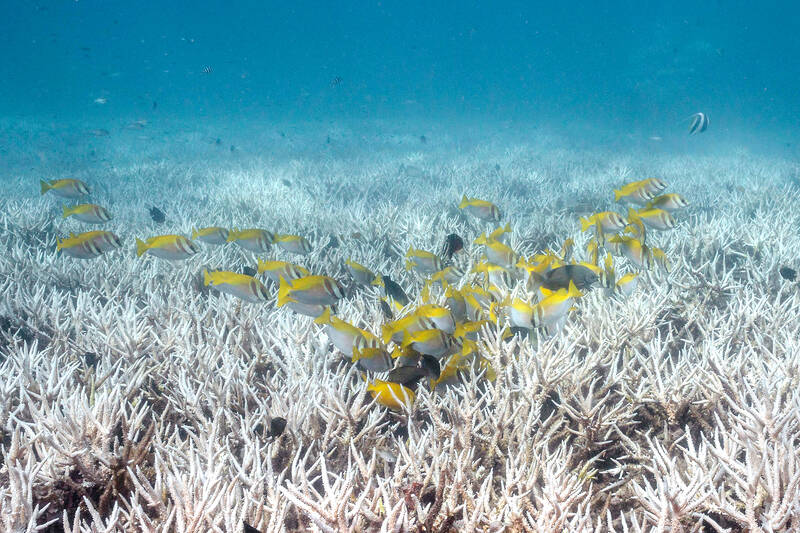
Photo: AFP
‘YEAR WITHOUT A SUMMER’
Sometimes we get lucky. In 1815 the Tambora volcano in Indonesia erupted, cooling the earth the following year. Harvests failed across the northern hemisphere, where it snowed and frosted in the summer. In the Manchu (Qing) Empire, there were famines in Yunnan. But Taiwan remained largely unaffected.
An interesting paper by Jen Yu-chien on Taiwan’s resilience during that “year without a summer” showed that based on documents from the period, “residents distributed additional rice yields to neighbors and had surplus money to donate to the temple buildings. In addition, the exportation of rice had been steadily increasing.”
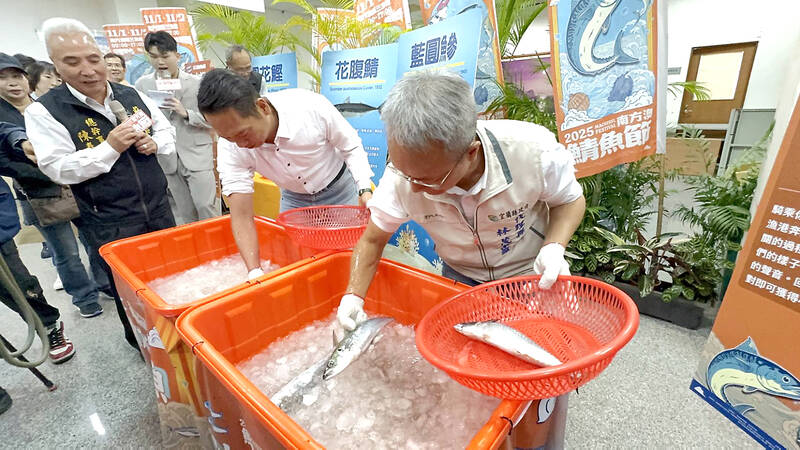
Photo: Chiang Chih-hsiung, Taipei Times
The Taiwan spirit of coming together to address community issues was alive even in that period. Taiwan also benefited from the introduction of new rice strains that were more cold-tolerant.
After the Chinese Nationalist Party (KMT) occupied Taiwan in 1945, the old Japanese system of price controls on food collapsed. A paper by academics Chen Huaide and Yang Hailiang on the topic looked at rice prices in the postwar period. It divided the rice price changes into four periods.
From August 1945 to September 1945 there was no shortage of food, and prices were stable. But from September 1945 to May 1946 grain prices rose as the postwar food shortage kicked in. From May 1946 to November 1946 the food shortage ameliorated and rice prices stabilized. In the final stage of their model, from November 1946 to April 1947, food shortages worsened and prices spiked. This was a major driver of the 228 Incident. After May of 1947 prices fell again. After 1950 price controls on rice were instituted, holding food prices at 70 percent of the level of the general price level.
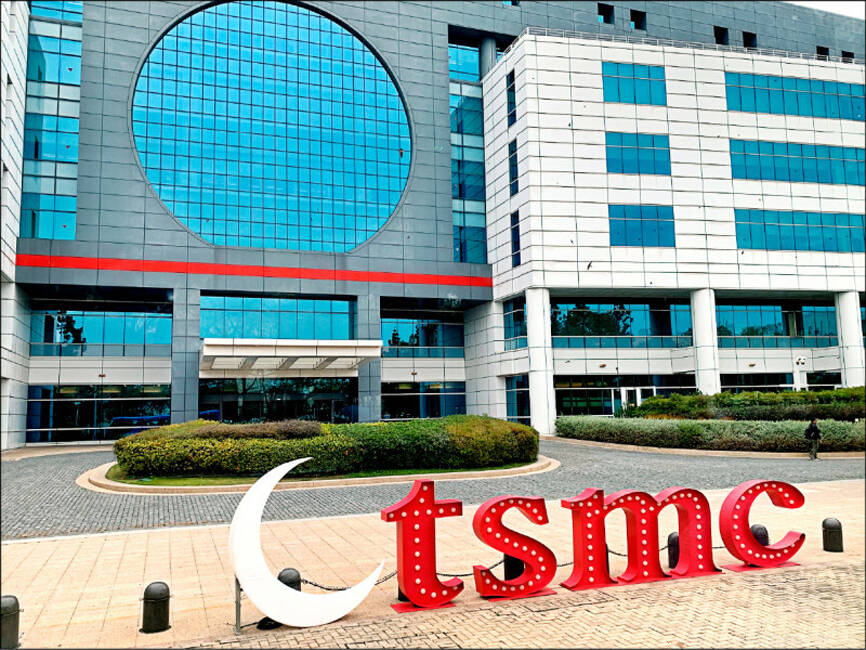
Photo: TT file photo
PRC OCCUPATION OF TAIWAN
The People’s Republic of China (PRC) is well aware of all this history, and knows that if it occupies Taiwan it will have to ship in food to feed the islanders. This will become all the more difficult because the export prowess of Taiwan Semiconductor Manufacturing Co (TSMC, 台積電) pays for the nation’s food imports. In a postwar occupation, TSMC (and other big tech firms) will likely be completely dysfunctional. Even in a “peaceful” occupation those firms will be inside the PRC and subject to technology restrictions and sanctions that will rapidly erode their production and export capabilities, while the migrant workers and technologists the tech firms depend on will flee. How then will Taiwan pay for food imports?
Surely PRC planners who wish to hold down unrest during the occupation must see the postwar food situation as a vexing issue. Or perhaps, as an issue they can use to create unrest that they can use as an excuse for brutal crackdowns.
Moreover, food shortages will also likely affect the PRC’s plans for follow-on wars against Japan and the Philippines. The PRC will have to feed its occupying troops and lay in supplies for campaigns against Tokyo and Manila, while feeding the occupied population, which will tie down much shipping. Global food price spikes will be inevitable.
EL NINO
This fall, just in time for the election in November, food prices could well spike. Rice production is expected to fall across Asia, thanks to the Iran war’s blockage of fertilizer shipments, and the expected El Nino, which many scientists see as one of the worst since the blow-out El Nino of 1877. At present food price inflation is not high, but restaurant prices are continuing to rise, a major bite out of pocketbooks.
The government can prepare for the fall to a certain extent, but recall that the pro-PRC Chinese Nationalist Party (KMT) and Taiwan People’s Party (TPP) in control of the legislature have yet to review the government’s proposed budget for this year. Agriculture Minister Chen Jun-ji (陳駿季) in March said that fertilizer shipments were inbound, and with reserves gave the nation enough fertilizer until August, with potash and phosphorous expected to last well into the fall.
As fishery experts have known for years, strong El Nino events can lower fish catches. A paper by Cheong Ju-young and Jun Tack-seung notes that “the fishery exports of countries whose climate is teleconnected to El Nino are reduced by 4.3 percent in El Nino years, an effect comparable to the trade barrier effect of tariffs.”
The paper found this effect takes place the year after the El Nino. Similarly, a 2006 paper in Ecological Economics on the strong 1997-98 El Nino found that “the harvest of mackerel purse-seine fishery in Taiwan fell sharply by 47.75 percent.”
Fishermen are an important constituency, and they will be demanding that the government take action.
The global economy is expected to slow in the fall, thanks to the Iran war and El Nino. Demand for tech products should continue, but Taiwan is also the world’s leading exporter of copper foil (roughly US$1.9 billion annually), a major component of electronics, including printed circuit boards, and exports large quantities of high quality copper wire for a myriad of applications, including 6G telecoms and AI. Taiwan will probably do better than most countries.
What can we expect? This fall as the El Nino builds and the effects of the Iran war become apparent, there will be social and political turbulence as prices rise and the economy, sizzling at present, slows. The ruling Democratic Progressive Party (DPP) may take the blame. The budget blockade by the pro-PRC parties will constrain the DPP’s room to manuever, even as the KMT criticizes the DPP and pretends it is innocent. The voting public loves to signal its displeasure with the DPP by voting for the other parties.
Will food prices shake up Taiwan’s history again? Stay tuned.
Notes from Central Taiwan is a column written by long-term resident Michael Turton, who provides incisive commentary informed by three decades of living in and writing about his adoptive country. The views expressed here are his own.
Ajay Verma, a consultant gastroenterologist at Kettering general hospital in Northamptonshire, says our gut is a “complex machine.” “It is constantly providing us with the nutrition we need, initially to grow and develop, and then for us to survive, thrive and repair from injury and illness.” How can we keep it functioning well? Put simply: “Make sure what you put into it is balanced, and that you clear out its waste products adequately,” Verma says. “In a general gastroenterology clinic, the most common conditions we see are irritable bowel syndrome (IBS), gastroesophageal reflux disease, inflammatory bowel disease and constipation,” says Nisha
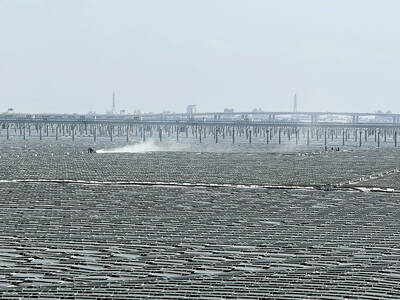
The arithmetic is straightforward and uncomfortable. By the end of 2025, Taiwan had committed itself to a 50-30-20 electricity mix — half natural gas, 30 per cent coal, 20 per cent renewables. The Ministry of Economic Affairs’s (MOEA) own monthly energy reports tell a different story. Natural gas reached 47.8 per cent of generation last year. Coal stood at 35.4 per cent, comfortably above its target ceiling. Renewables came in at 13.1 per cent, well short of the 20 per cent Taipei had pledged a decade earlier. Installed renewable capacity reached roughly half of the 12 gigawatts (GW) the government

Last week US President Donald Trump was asked by a reporter whether he would speak on the phone to the President of Taiwan. “l’ll speak to him. I speak to everybody. We have that situation very well in hand,” Trump said. This marked the second time in a couple of weeks he had said he would talk to the President of Taiwan. In 2016 he famously took a call from then-president Tsai Ing-wen (蔡英文), when he was president-elect. Despite warnings that the apocalypse was nigh because of a phone call, the world quickly forgot about the conversation between two democratically-elected presidents.
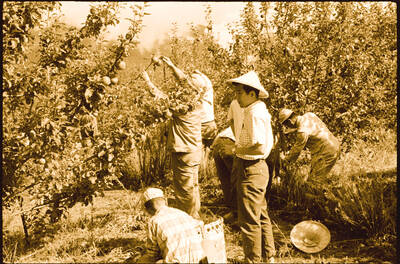
May 25 to May 31 Few believed that apples could be cultivated on a commercial scale in Taiwan’s high mountains. When horticulturalist Cheng Chao-hsiung (程兆熊) first proposed the idea in 1955, both American and Taiwanese colleagues dismissed it as implausible, arguing that temperate fruit could not be reliably grown on a subtropical island, especially on rugged terrain. However, it was this terrain in the Central Mountain Range where many Chinese Civil War veterans were resettled in the late 1950s. With limited job prospects and no family in Taiwan, they were placed on cooperative farms aimed toward self-sufficiency. Some say the conditions


 RSS
RSS