


Taiwan’s rights over its territorial waters and exclusive economic zone must not be violated by any country, the Mainland Affairs Council said yesterday, adding that it will not accept any unprovoked actions.
The council issued the remarks in response to the China Coast Guard conducting maritime enforcement drills near eastern Taiwan and claiming to fully exercise China’s maritime administrative law enforcement authority.
The Coast Guard Administration (CGA) has been closely monitoring the situation and is taking concrete steps to defend the nation’s sovereignty and secure its waters, the council said.
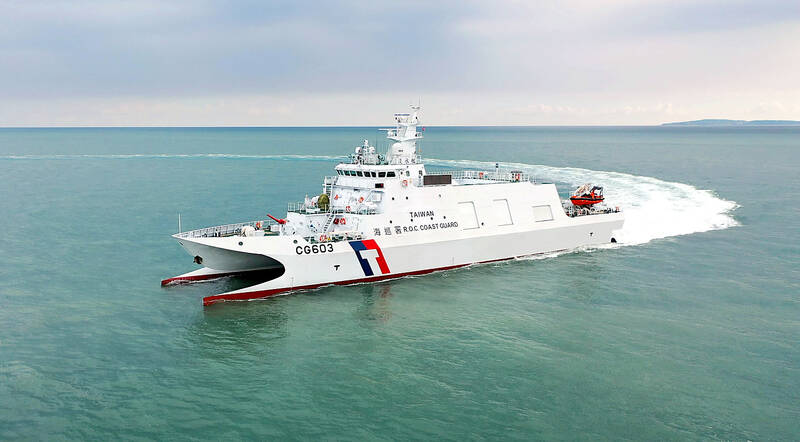
Photo courtesy of the Coast Guard Administration
China has no sovereign rights over the waters off eastern Taiwan, and its actions contravene international law and seriously deviate from the facts, the CGA said yesterday in a separate release.
Four Chinese vessels were detected departing from China’s Xiamen and sailing to waters southwest of Taiwan, remaining outside Taiwan’s restricted waters while navigating along the boundary line, the CGA said.
It said it pre-emptively deployed five patrol vessels, while also positioning 100-tonne patrol boats along the 24-nautical-mile (44.4km) line to assist with monitoring operations.
The Chinese vessels did not enter Taiwan’s restricted waters, and vessels operating in surrounding seas have maintained normal navigation, it said.
Later yesterday afternoon, the four Chinese ships, including three coast guard vessels, sailed into Taiwan’s restricted waters 30 nautical miles (55.6km) southwest of Taiwan proper’s southern tip, the CGA said.
Taiwan sent seven coast guard vessels to warn away the Chinese ships, and at 5:30pm all four Chinese government vessels were "expelled" from the restricted waters, it said in a statement.
The CGA published a recording of the Chinese warning to the Taiwanese ships in which an unidentified officer says: "These are waters under Chinese jurisdiction. Our maritime law-enforcement formation is carrying out a special traffic law-enforcement mission in the waters of the Taiwan Strait. Do not interfere with our official duties."
A Taiwanese coast guard officer replies that China does not enjoy any "sovereign rights" in the waters east of Taiwan.
"If conflict occurs, your side will face sanctions from the world. Only maritime stability can ensure your country’s development," the Taiwanese officer added.
The Chinese Ministry of Transport organized a “special maritime traffic law enforcement operation” in waters east of Taiwan on Saturday, China’s Xinhua state news agency said.
The report did not give details on the operation such as how long it lasted or whether it was still proceeding, and it did not say whether maritime police had dispatched ships to the area.
The operation involved the Fujian Maritime Safety Administration, Guangdong Maritime Safety Administration, East China Sea navigation support center and East China Sea Rescue Bureau, Xinhua said.
It said the operation was a “necessary measure” in response to Japan and the Philippines’ “unilateral announcement of launching maritime delimitation talks,” adding that the two countries’ move had “seriously infringed upon China’s territorial sovereignty and maritime rights and interests.”
Tokyo and Manila said last month they would start formal talks “to delimit the maritime boundary” of an economic zone and continental shelf between them, while Taipei on Wednesday last week said that it should be consulted on the talks.
“It [the operation] aims to fully exercise China’s maritime administrative law enforcement jurisdiction, strengthen long-range offshore patrol and law enforcement capabilities, improve traffic management in key waters, ensure maritime traffic safety, and safeguard national rights and interests,” Xinhua said.
Beijing’s move was the latest in a series of Chinese activities aimed at increasing “gray zone” pressure on Taiwan, the CGA said.
It cited Chinese research ship Tongji’s (同濟號) operation near Taiwan last month and the first coordinated operation of a China Coast Guard ship and a survey ship in waters around the Taiwan-controlled Pratas Islands (Dongsha Islands, 東沙群島) in the South China Sea on Friday and Saturday last week, calling them evidence of a broader pattern of coercive activity.
The activities are intended to create the false impression that China has jurisdiction over the area and to unilaterally alter the “status quo” in the Taiwan Strait, it said.
The CGA condemned such behavior, saying that it would take all necessary measures to safeguard Taiwan’s maritime security and sovereignty.
Meanwhile, Premier Cho Jung-tai (卓榮泰) yesterday said that the government will continue advancing an “integrated sea and air” strategy and strengthening elite coast guard capabilities to bolster maritime security and national resilience, while Minister Ocean Affairs Council Kuan Bi-ling (管碧玲) said external hostile forces have been using a so-called “special maritime traffic enforcement operation” as a pretext to harass Taiwan, falsely assert jurisdiction and challenge the nation’s maritime order.
Any attempt to change the “status quo” through coercion or undermine regional peace will not be accepted by Taiwanese, Kuan said.
Additional reporting by AFP and Reuters


RESILIENCE: Taiwan plays a key role in semiconductors, energy, information infrastructure and advanced manufacturing, AIT Director Raymond Greene said Taiwan’s continued investment in deterrence and resilience remains vital, especially in uncrewed systems and other emerging technologies, American Institute in Taiwan (AIT) Director Raymond Greene said yesterday. Greene made the remarks at the annual National Strategic Summit on Supply Chain Resilience held by the Research Institute for Democracy, Society and Emerging Technology (DSET), a government-backed think tank. As Taiwan last year became the US’ fourth-largest trading partner and supply chain security is becoming more important, cooperation in emerging technologies continues to deepen between the two countries, he said. The US is committed to accelerating innovation, building key infrastructure, strengthening cooperation

The National Chungshan Institute of Science and Technology yesterday showcased its locally developed variants of the Vision 60 robotic patrol dog, which it plans to deploy on the nation’s outlying territories in the South China Sea. The variants were produced under the Joint Lab project — created by the institute and domestic companies — and assembled with domestically produced motors, lenses and artificial intelligence (AI) systems alongside licensed tech from the US, Missile and Rocket Systems Research Division deputy director Jen Kuo-kang (任國光) told the media event at a military base in Taipei’s Dazhi (大直) area. Taiwan has built up its strengths

RIGHT DIRECTION: Taiwan’s efforts to prevent forced labor include a proposal to ‘fully prohibit’ employers from withholding workers’ documents, an official said Taiwan is to establish a mechanism to restrict imports of goods linked to forced labor, the Executive Yuan said yesterday, after the US proposed imposing additional tariffs on Taiwanese goods over labor concerns. “The Ministry of Labor and the Ministry of Economic Affairs are to establish an interministerial review procedure,” Executive Yuan spokesperson Michelle Lee (李慧芝) said at a news briefing in Taipei. “The government is to use the Foreign Trade Act [貿易法] as the legal basis to restrict imports of goods produced with forced labor” and bring its supply chain governance more in line with international standards on human rights, resilience
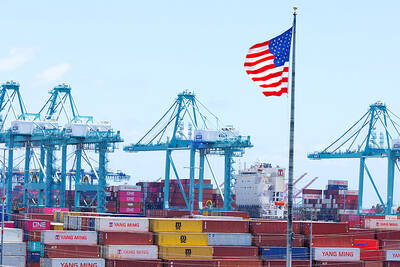
NOT IMMEDIATE: Taiwan has a chance to appeal the proposed 10 percent tariff before it starts, while other countries face a 12.5 percent tariff from the trade office Taiwan is among 60 economies determined by the US to have failed to impose or enforce a ban on the importation of goods produced with forced labor, according to a notice released on Tuesday by the Office of the US Trade Representative (USTR), which proposed imposing an additional 10 percent or more tariff on them. The USTR in a statement said that following an investigation, it had determined under Section 301 of the Trade Act of 1974 that the failure of the 60 economies to impose and effectively enforce a prohibition on the importation of goods produced with forced labor is


 RSS
RSS