


What do cocky gods, ghosts, hell contracts, temple charms and bubble tea have to do with young adulthood in Taiwan?
Quite a lot, if Netflix’s Agent from Above (乩身) is any guide. Released on April 2, the Taiwanese supernatural drama rose to No. 1 on Netflix in Taiwan and Hong Kong within 48 hours and climbed to No. 6 on the platform’s global non-English TV ranking.
At its center is Han Jie, a young man locked into service as the spirit medium, or jishen, of the deity San Taizi (三太子) after a tragic mistake. He must fight, repay and atone in a world where power comes with obligation.
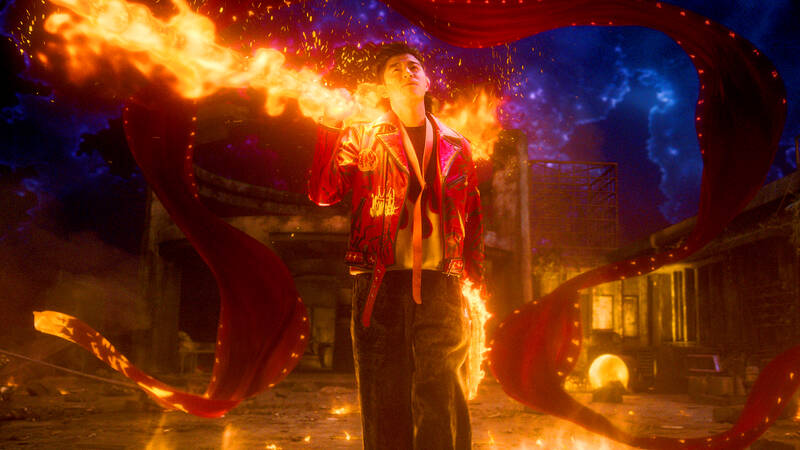
Photo courtesy of Netflix
That premise is familiar to many younger Taiwanese. Adulthood now looks like a contract with unstable terms, where inherited social burdens remain, AI is rewriting the job market and the future is harder to read.
OLD SOCIAL BURDENS
Even before AI enters the picture, young people in Taiwan already face a hard start. Taiwan’s overall unemployment rate last year was 3.35 percent, but unemployment was 11.60 percent for people aged 20 to 24 and 5.77 percent for those aged 25 to 29. University graduates had the highest unemployment rate by education level, at 4.53 percent.
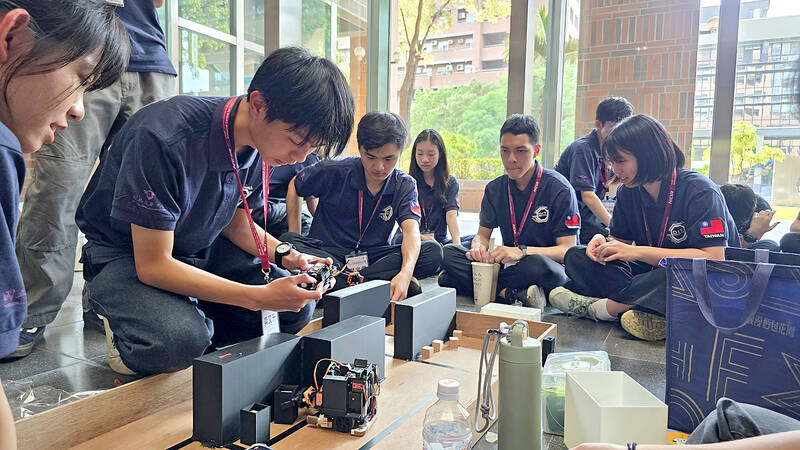
Photo: Hung Jui-chin, Taipei Times
Starting pay remains modest. Labor Ministry data for last year shows that first-job monthly salaries for university graduates averaged only NT$36,000 (US$1,141).
Housing is bleaker still. In the first quarter of last year, Taiwan’s national house-price-to-income ratio reached 9.68, while Taipei’s reached 15.57. For residents of Taipei, that means they would have to save their entire salary for more than 15 years — without spending a single dollar on food, clothes or rent — to afford a modest home.
While traditional pressures to study hard, find a stable job, buy a home, marry and raise children haven’t changed, for many younger adults, that sequence feels out of reach.
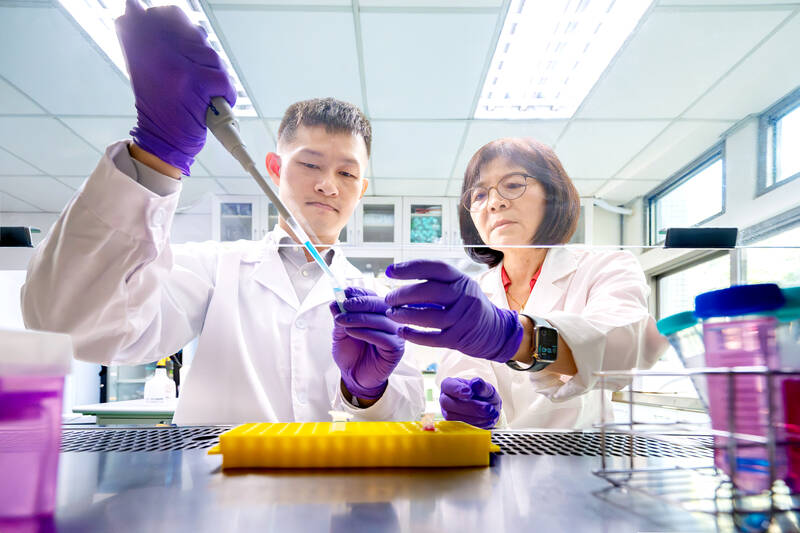
Photo courtesy of Qinghua University
This helps explain why small pleasures have become so important. Taiwanese youth seek small but certain joys and chase the best happiness-to-price ratio, in small purchases like Starbucks lattes and bubble tea to make pressure briefly bearable.
AI ANXIETIES
AI adds a new layer to this pressure. The old education-to-career pipeline is already weakening. A report last year citing 1111 Job Bank found that 48.6 percent of fresh graduates chose jobs unrelated to what they studied.
AI-related work is also growing quickly. A 104 Job Bank report found 67,000 AI-related jobs open to fresh graduates in the first quarter of this year, with 62 percent not limited by major. The report said more than 70,000 fresh graduates applied for AI-related jobs last year, up 46 percent from the previous year.
And while that sounds like opportunity, it also changes the rules. Young people are being told to enter fields that are new and unstable. They are also being told to use tools that may remove the entry-level tasks that once helped people learn.
A 1111 Job Bank survey last year found that 78.7 percent of workers felt anxious about their career future, while 61.5 percent worried their jobs might be replaced by AI. Alarmingly, 49.4 percent feared their own professional expertise would be displaced by AI.
For young workers, AI is more than a tool. It is a moving target. Learn it quickly and it may help. Fall behind and it may become another gate closing in front of you.
AI OPPORTUNITIES
The government sees this too, especially in its plan to make Taiwan an AI island. The Ten AI Initiatives Promotion Plan by the National Development Council (NDC) frames AI as central to national security, national power and economic prospects.
A related NDC talent plan aims to cultivate 450,000 AI, green-collar and cross-disciplinary digital talents by 2028.
Higher education is being pulled into this agenda. The Ministry of Education’s Taiwan Artificial Intelligence College Alliance includes 55 colleges and universities and offers cross-university AI credit programs.
At the school level, the ministry has also issued generative-AI guidance and student manuals for elementary, junior-high and senior-high students. The message is clear: AI is unavoidable and must be learned. AI is becoming less like an optional tool and more like a new social contract.
AI SKILLS?
Many Taiwanese students and workers have already signed that contract in practice.
A 1111 Job Bank survey last year found that 89.8 percent of workers had used AI tools such as ChatGPT or Midjourney, while 30.3 percent said they used them often. The same survey found that 54.4 percent had already taken AI or digital-skills courses, while 92.8 percent said they were willing to spend time on AI workplace-transition training.
But AI use is not the same as AI skills. The 2025 Taiwan Internet Report from the Taiwan Network Information Center found that among AI users, 79.25 percent believed they could evaluate AI’s strengths and weaknesses, but only 66.23 percent believed they could use AI effectively to achieve what they wanted.
The problem is sharper among students.
A Child Welfare League Foundation survey last year found that 62.5 percent of Taiwanese adolescents used generative AI at least once a week, and 20.9 percent used it daily. The same survey found that only 39.4 percent verified the accuracy of AI-generated information, while 40 percent rarely or never paid attention to avoiding uploads of personal data.
Like San Taizi, AI can look protective. It offers power, guidance, shortcuts and even comfort. But it can also mislead, distort judgment and quietly bind users into dependence.
Everyone, but especially young people, need to know its strengths and limits. They need to use it to sharpen judgment, communication, creativity, empathy and learning.
Younger generations cannot afford to let AI flatten those human qualities into automated output. To do so guarantees replacement and redundancy in an AI future. That may be why Agent from Above has struck such a nerve. Beneath its gods, ghosts, temple battles and bubble tea, it captures a dark mood many younger Taiwanese know well.
Old burdens are being intensified by AI anxieties, and the terms of adulthood keep changing.
There is no simple release. Only the need to keep moving, keep learning and keep enough of the human self intact to live and compete inside the new contract.
Taiwan’s overtaking of South Korea in GDP per capita is not a temporary anomaly, but the result of deeper structural problems in the South Korean economy says Chang Young-chul, the former CEO of Korea Asset Management Corp. Chang says that while it reflects Taiwan’s own gains, it also highlights weakening growth momentum in South Korea. As design and foundry capabilities become more important in the AI era, Seoul risks losing competitiveness if it relies too heavily on memory chips. IMF forecasts showing Taiwan widening its lead over South Korea have fueled debate in Seoul over memory chip dependence, industrial policy and

“China wants to unify with Taiwan at the lowest possible cost, and it currently believes that unification will become easier and less costly as time passes,” wrote Amanda Hsiao (蕭嫣然) and Bonnie Glaser in Foreign Affairs (“Why China Waits”) this month, describing how the People’s Republic of China (PRC) is playing the long game in its quest to seize Taiwan. This has been a favorite claim of many writers over the years, easy to argue because it is so trite. Very obviously, if the PRC isn’t attacking Taiwan, it is waiting. But for what? Hsiao and Glaser’s main point is trivial,
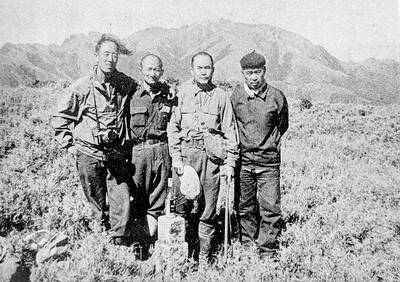
May 18 to May 24 Gathered on Yangtou Mountain (羊頭山) on Dec. 5, 1972, Taiwan’s hiking enthusiasts formally declared the formation of the “100 Peaks Club” (百岳俱樂部) and unveiled the final list of mountains. Famed mountaineer Lin Wen-an (林文安) led this effort for the Chinese Alpine Association (中華山岳協會). Working with other experienced climbers, he chose 100 peaks above 10,000 feet (3,048m) that featured triangulation points and varied in difficulty and character. The list sparked an alpine hiking craze, inspiring many to take up mountaineering and competing to “conquer” the summits. A common misconception is that the 100 Peaks represent Taiwan’s 100 tallest

Yesterday, the Democratic Progressive Party (DPP) nominated legislator Puma Shen (沈伯洋) as their Taipei mayoral candidate, the Chinese Nationalist Party (KMT) put their stamp of approval on Wei Ping-cheng (魏平政) as their candidate for Changhua County commissioner and former legislator Tsai Pi-ru (蔡壁如) of the Taiwan People’s Party (TPP) has begun the process to also run in Changhua, though she has not yet been formally nominated. All three news items are bizarre. The DPP has struggled with settling on a Taipei nominee. The only candidate who declared interest was Enoch Wu (吳怡農), but the party seemed determined to nominate anyone


 RSS
RSS