


All eyes are on Chinese Nationalist Party (KMT) Chairwoman Cheng Li-wun (鄭麗文) and whether internal divisions within the party could bring her down. Comparisons to a previous and unpopular KMT chair, Hung Hsiu-chu (洪秀柱), abound.
That both local and international press are intensely focused on Cheng is logical. Decisions she makes in concert with the KMT’s legislative caucus carry potentially massive repercussions both domestically and internationally. Legislative deadlock threatens to paralyze government, especially over the still-unpassed national budget.
President William Lai’s (賴清德) proposed NT$1.25 trillion (billed as US$40 billion at the time) eight-year special military budget has been openly endorsed by American Institute in Taiwan (AIT) Director Raymond Greene, an unusually overt attempt to assert American influence in domestic politics. Unsurprisingly, Beijing spun their propaganda machine into high gear to defeat it.
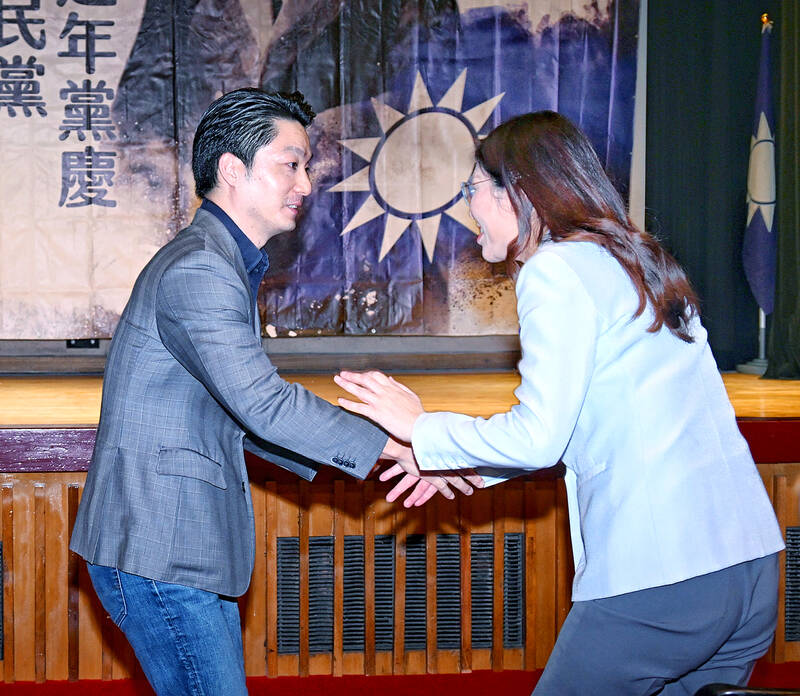
Photo: Fang Pin-chao, Taipei Times
Cheng is not a moderate and is explicitly Beijing-friendly. She hopes to convince Taiwanese to be “proud to be Chinese” and to meet with Chinese Communist Party (CCP) Secretary-General Xi Jinping (習近平) to lay the groundwork for a peace arrangement. She has convinced the KMT caucus to back a “NT$380+N” billion special military budget put forth by the party’s think tank, that tightly limits the government’s options by tying any funds above that (the “+N”) to approval by both the American bureaucracy and Taiwan’s legislature, a move that all but ensures most of Lai’s plans will be either dragged out indefinitely or killed outright.
With the defense posture of Taiwan and the stability of the region at stake, Cheng is making analysts in Washington, Tokyo and Manila nervous. Cheng denies she presents any danger and insists she is working to bring peace and stability to the region, but her intentions are met with suspicion. Her parroting of CCP talking points, including that Russian President Vladimir Putin is not a dictator, does not ease concerns.
It makes sense that signs of dissension in the party ranks draws considerable attention, both locally and abroad. Much of the pushback is from the more moderate members, raising hopes they could rise up and change the party’s direction.
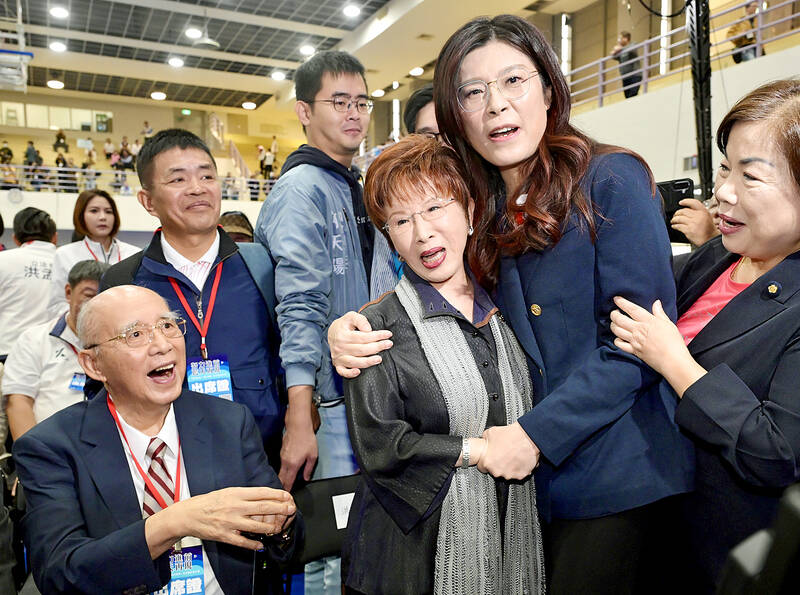
Photo: Liao Chen-huei, Taipei Times
CONTEXT MATTERS
For now, though, Cheng remains firmly in control. On a “Revolt-O-Meter” of zero to 10, with 10 a concerted effort from the majority within the party to oust her, the meter today stands at about two.
Why only two on the “Revolt-O-Meter?” Headlines suggest otherwise.
Next Apple recently ran a headline that included the hard-to-translate but highly evocative “KMT central authorities and local authorities hack each other to the bone!” (國民黨內中央、地方亂鬥殺到見骨!). The conflict is real, but exaggerated.
Aside from some lower-level nobodies, no one significant is directly and openly attacking Cheng. There is a lot of posturing, distancing from some of her stances and indirect and insinuated challenges to her authority — but no open revolt.
The KMT is a complex party, and the party chair does not have the same unquestioned authority they once did. Compared to her recent predecessors, Cheng’s authority is currently fairly strong.
At the same point in her predecessor Eric Chu’s (朱立倫) term, his revolt level stood at roughly a four. He oversaw the loss of a recall attempt, a by-election and four referendums for an oh-and-six record.
The core mission of any political party is to win elections. She has had no losses, so retains considerable authority.
She has faced opposition locally over perceived attempts to influence primary results. The KMT establishment in Taichung pushed back against her presumed favored candidate Yang Chiung-ying (楊瓊瓔), uniting behind Johnny Chiang (江啟臣).
Major KMT politicians also rallied to the moderate Chiang, including Taipei Mayor Chiang Wan-an (蔣萬安), Taoyuan Mayor Simon Chang (張善政) and Cheng’s handpicked candidates for mayor of Kaohsiung and Tainan. Similarly, major politicians showed their support for the candidate in Hsinchu County that Cheng appears to be maneuvering against.
Those are major, significant slaps in the face to Cheng. But not one of them dared to criticize or attack her directly. Cheng’s presumed candidates may lose one or both of those races, which would sting — but big picture she is in good shape.
During primary season, these sorts of conflicts and pushback by local power brokers is to be expected. Chu faced more and fiercer battles, so arguably Cheng is doing far better. However, local battles have a way of festering, and if combined with future disagreements, can both unify opposition and break out into something bigger.
IDEOLOGY AND ELECTABILITY
Cheng faces a far bigger challenge than Chu going forward: fears her ideology, comments and behavior could negatively impact the party’s electability. Chu was ideologically vague and flexible enough to appeal to the KMT base, but not turn off voters.
The press is filled with reports of “KMT insiders,” some openly and others anonymously, fretting about Cheng turning off voters. Cheng has repeatedly tried to reassure party members that any meeting with Xi will “add points” to their vote counts.
Many within the party are skeptical, and with good reason. Her previous comments have not gone down well, and polling suggests she is not only less popular than the party but is also perceived as being too pro-China.
Key figures in the party have openly distanced themselves from some of her stances and comments. When asked about Cheng promoting Chinese identity, Chiang Wan-an tartly replied: “I am Taiwanese, I am a citizen of the Republic of China.”
Following Lai’s NT$1.25 trillion proposed special budget announcement, initially the KMT was opposed, but had no alternative proposal. Within the caucus, a group coalesced around a proposal put forward by KMT Legislator Hsu Chia-hsin (徐巧芯) for an NT$810 billion alternative plan, which was much closer to the rumored NT$900 billion the Americans would find acceptable.
Under pressure, Cheng put forward the NT$380+N billion plan as the official party line, and was backed by KMT caucus convener Fu Kun-chi (傅?萁). Hsu backed down, and her proposal was shelved. When asked, Hsu said she respected the party’s authority in the matter, a tepid acknowledgment she had lost.
The closest to an overt challenge to Cheng and her ideology came from Taichung Mayor Lu Shiow-yen (盧秀燕), the presumed frontrunner to represent the KMT in the 2028 presidential election.
On her recent trip to the US, she met with high-ranking officials. Within a KMT context, she could not have sounded more different than Cheng. She sounded strongly pro-American and strong on national defense.
Nothing about “balancing” between Beijing and Washington or having no need to choose between them, as Cheng has been saying.
None of this adds up to a revolt against Cheng in the short term, but the outlines of why, how and who could spearhead one are becoming clearer.
Pressure will mount as November’s elections draw closer, but by how much remains an open question. Much will depend on any Xi-Cheng meeting and how much her ideology colors the election.
The chances that the KMT ousts her prior to the election are low. Hung Hsiu-chu was sacked by the party as presidential candidate under the direction of the party leadership.
Cheng is the leader of the party and controls the levers of power, making her hard to depose.
A more likely scenario would be for candidates to sideline and ignore her, as most politicians did to former party chair Hung in 2018. However, for now, she is in control, and crucially, still has the backing of the legislative caucus.
If the KMT does poorly in this year’s elections, she will come under intense pressure to follow the traditional custom of resigning to take responsibility. Whether it will come to that, or whether she would follow tradition in such a situation, is still far away.
Donovan’s Deep Dives is a regular column by Courtney Donovan Smith (石東文) who writes in-depth analysis on everything about Taiwan’s political scene and geopolitics. Donovan is also the central Taiwan correspondent at ICRT FM100 Radio News, co-publisher of Compass Magazine, co-founder Taiwan Report (report.tw) and former chair of the Taichung American Chamber of Commerce. Follow him on X: @donovan_smith.
“China wants to unify with Taiwan at the lowest possible cost, and it currently believes that unification will become easier and less costly as time passes,” wrote Amanda Hsiao (蕭嫣然) and Bonnie Glaser in Foreign Affairs (“Why China Waits”) this month, describing how the People’s Republic of China (PRC) is playing the long game in its quest to seize Taiwan. This has been a favorite claim of many writers over the years, easy to argue because it is so trite. Very obviously, if the PRC isn’t attacking Taiwan, it is waiting. But for what? Hsiao and Glaser’s main point is trivial,
May 18 to May 24 Gathered on Yangtou Mountain (羊頭山) on Dec. 5, 1972, Taiwan’s hiking enthusiasts formally declared the formation of the “100 Peaks Club” (百岳俱樂部) and unveiled the final list of mountains. Famed mountaineer Lin Wen-an (林文安) led this effort for the Chinese Alpine Association (中華山岳協會). Working with other experienced climbers, he chose 100 peaks above 10,000 feet (3,048m) that featured triangulation points and varied in difficulty and character. The list sparked an alpine hiking craze, inspiring many to take up mountaineering and competing to “conquer” the summits. A common misconception is that the 100 Peaks represent Taiwan’s 100 tallest

Yesterday, the Democratic Progressive Party (DPP) nominated legislator Puma Shen (沈伯洋) as their Taipei mayoral candidate, the Chinese Nationalist Party (KMT) put their stamp of approval on Wei Ping-cheng (魏平政) as their candidate for Changhua County commissioner and former legislator Tsai Pi-ru (蔡壁如) of the Taiwan People’s Party (TPP) has begun the process to also run in Changhua, though she has not yet been formally nominated. All three news items are bizarre. The DPP has struggled with settling on a Taipei nominee. The only candidate who declared interest was Enoch Wu (吳怡農), but the party seemed determined to nominate anyone
In a sudden move last week, opposition lawmakers of the Chinese Nationalist Party (KMT) and Taiwan People’s Party (TPP) passed a NT$780 billion special defense budget as a preemptive measure to stop either Chinese leader Xi Jinping (習近平) or US President Donald Trump from blocking US arms sales to Taiwan at their summit in Beijing, said KMT heavyweight Jaw Shaw-kong (趙少康), speaking to the Taipei Foreign Correspondents Club on Wednesday night in Taipei. The 76-year-old Jaw, a political talk show host who ran as the KMT’s vice presidential candidate in 2024, says that he personally brokered the deal to resolve


 RSS
RSS