


Taiwan’s culinary offerings tell a delicious tale of the nation’s history. A single meal can encompass at least 500 years of development across the earliest Aboriginal communities, the profound changes of Qing Dynasty rule and the influences of Japanese colonialism.
Hakka food, which entered this mix during the Qing era, is a distinctive category arising from the migratory history and living conditions of the Hakka people, who now number about 4.5 million, or nearly one-fifth of Taiwan’s population.
Despite being the second-largest ethnic group in the country, it’s only in recent years that Hakka food and culture have been enjoying a popular revival. Cultural festivals and Hakka-themed travel destinations are on the rise. The government plans to turn Provincial Highway 3 into a “Hakka Romantic Avenue.” Perhaps most crucially, Hakka was made an official national language in 2017, strengthening prospects for a more robust cultural identity.
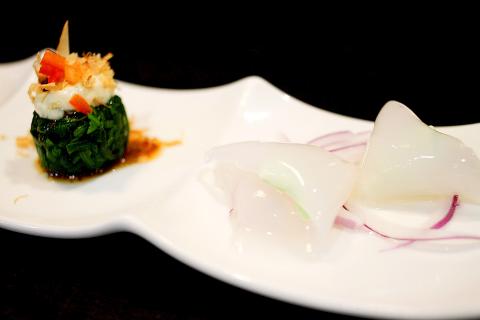
Photo: Davina Tham, Taipei Times
While Hakka populations are concentrated in central and southern Taiwan, Taipei-dwellers hunting for a taste have many choices. They include swanky Tung Hakka, also known as Blossom Restaurant (桐花), which has two locations here, and Gan’s Huofang (甘家伙房) inside the city’s Hakka Cultural Park.
The cuisine has even made inroads into the trendy private kitchen format. Husband-and-wife duo Fuchidon (夫妻檔客家料理私房) serve up refined Hakka feasts recreated from their parents’ recipes, although you’ll need a group of at least eight to secure a booking.
On any given night, the tables at May Snow Hakka Food (五月雪客家私房珍釀) in Daan District (大安) are filled with drinking buddies and silver-haired gatherings seeking a hearty and reliable dinner. The homely restaurant, founded in 2010, made its way into the Michelin Guide earlier this year.
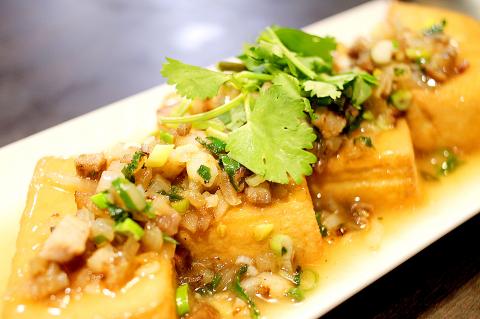
Photo: Davina Tham, Taipei Times
The common image of Hakka food is that of oil-slicked and heavily-salted dishes. Though unhealthy by contemporary standards, in earlier periods, these qualities were necessary to keep workers replenished with enough energy and minerals to perform hard labor. Other characteristics include the incorporation of rice in many guises, preservation by salting and drying and the judicious “nose-to-tail” use of precious lifestock.
May Snow prides itself on much lighter versions of Hakka dishes, and when I visited, that proved largely true while not sacrificing on quality.
The backbone of Hakka cuisine is formed along eight dishes known as the “four braises and four stir-fries” (四炆四炒), five of which feature on May Snow’s menu. Of the four braises, there is pork tripe with preserved vegetables (NT$200) and pork belly (NT$360). The most well-known wok dish is the Hakka stir-fry (客家小炒, NT$250) combining pork strips, dried squid and tofu. The restaurant also serves pig’s intestines with shredded ginger (NT$230) and black fungus with pineapple (NT$190).
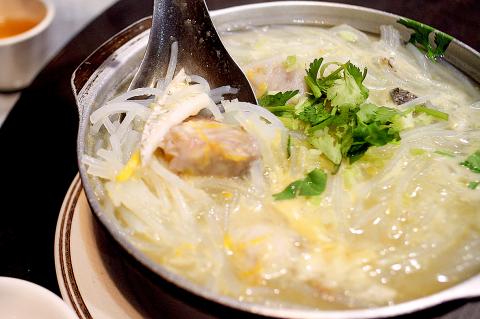
Photo: Davina Tham, Taipei Times
These may be the classics, but the restaurant’s signatures and innovation lie elsewhere, so we order a generous set meal for two (NT$1080) to sample a wider range of offerings.
A trio of appetizers arrives: perilla and plum-pickled cherry tomatoes and an elegant tower of the fern-like white water snowflake topped with tartar sauce and fish roe. The most intriguing, however, are the ghostly handkerchiefs of tasteless konnyaku coconut jelly served with a dab of wasabi, which are an excellent if unusual palate cleanser.
The rice noodle hotpot is brimming with soft pumpkin and taro, chewy meatballs and fish slices swimming in a sweet and delicate fish broth. The noodles are the best part, thick as spaghetti and retaining a firm but slippery bite.
Photos: Davina Tham, Taipei Times
That seems to confirm the special place of rice in Hakka cuisine, where the grain is eaten in many ways beyond the obvious: steamed rice cakes topped with preserved radish, tofu and Chinese chives are a common snack, while during the Dragon Boat Festival, glutinous rice flour forms a sticky dough for banzong (粄粽) or leaf-wrapped dumplings.
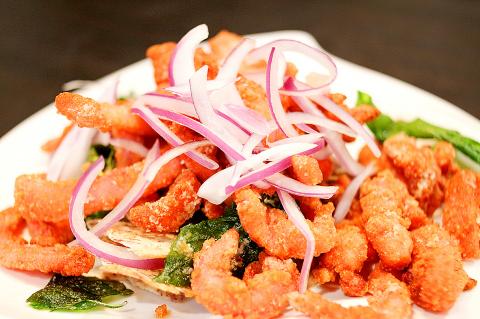
At May Snow, red yeast rice is also used to marinate squid that’s then deep-fried until airy, crisp and impressively tender. The crunch factor is cleverly raised with taro chips.
But the real showstopper is supposed to be the salt-baked wild mountain chicken, a dish so popular that pre-ordering it before your visit is essential. Having missed that crucial step, we pick the Hakka-style braised tofu, laced with a savory brown sauce of fatty pork and preserved radish.
For dessert, ask for the niuwenshui (牛汶水), Hakka-style glutinous rice balls in syrup topped with crushed peanuts. Then sit back and feel thankful that Taiwan’s melting pot of ethnicities has brought this cuisine to your doorstep.
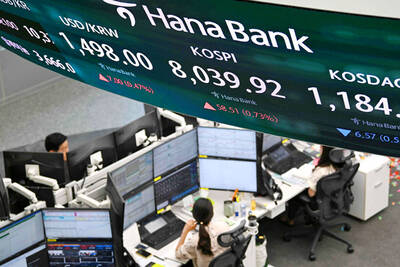
Taiwan’s overtaking of South Korea in GDP per capita is not a temporary anomaly, but the result of deeper structural problems in the South Korean economy says Chang Young-chul, the former CEO of Korea Asset Management Corp. Chang says that while it reflects Taiwan’s own gains, it also highlights weakening growth momentum in South Korea. As design and foundry capabilities become more important in the AI era, Seoul risks losing competitiveness if it relies too heavily on memory chips. IMF forecasts showing Taiwan widening its lead over South Korea have fueled debate in Seoul over memory chip dependence, industrial policy and
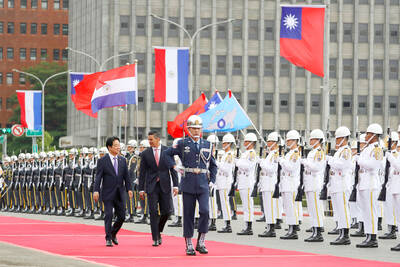
“China wants to unify with Taiwan at the lowest possible cost, and it currently believes that unification will become easier and less costly as time passes,” wrote Amanda Hsiao (蕭嫣然) and Bonnie Glaser in Foreign Affairs (“Why China Waits”) this month, describing how the People’s Republic of China (PRC) is playing the long game in its quest to seize Taiwan. This has been a favorite claim of many writers over the years, easy to argue because it is so trite. Very obviously, if the PRC isn’t attacking Taiwan, it is waiting. But for what? Hsiao and Glaser’s main point is trivial,
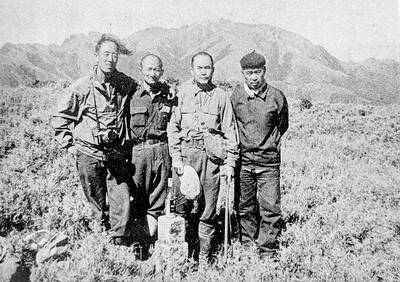
May 18 to May 24 Gathered on Yangtou Mountain (羊頭山) on Dec. 5, 1972, Taiwan’s hiking enthusiasts formally declared the formation of the “100 Peaks Club” (百岳俱樂部) and unveiled the final list of mountains. Famed mountaineer Lin Wen-an (林文安) led this effort for the Chinese Alpine Association (中華山岳協會). Working with other experienced climbers, he chose 100 peaks above 10,000 feet (3,048m) that featured triangulation points and varied in difficulty and character. The list sparked an alpine hiking craze, inspiring many to take up mountaineering and competing to “conquer” the summits. A common misconception is that the 100 Peaks represent Taiwan’s 100 tallest

Yesterday, the Democratic Progressive Party (DPP) nominated legislator Puma Shen (沈伯洋) as their Taipei mayoral candidate, the Chinese Nationalist Party (KMT) put their stamp of approval on Wei Ping-cheng (魏平政) as their candidate for Changhua County commissioner and former legislator Tsai Pi-ru (蔡壁如) of the Taiwan People’s Party (TPP) has begun the process to also run in Changhua, though she has not yet been formally nominated. All three news items are bizarre. The DPP has struggled with settling on a Taipei nominee. The only candidate who declared interest was Enoch Wu (吳怡農), but the party seemed determined to nominate anyone


 RSS
RSS