


Suicide poses a mystery to science. How do people manage to get up the nerve to shoot themselves, hang themselves or take a lethal dose of a drug, when doing so violates the strongest instinct that’s been bred into us over millions of years of evolution?
This is not morbid curiosity. The answer could be key to addressing a persistent public health problem: Suicide kills about 800,000 people every year, according to the World Health Organization. In the US, the rate has been climbing over the last two decades.
In his textbook on evolutionary psychology, David Buss of the University of Texas quotes some survey results showing suicidal thoughts are correlated with feeling burdensome to others and, especially for men, few prospects to reproduce. For people over 70, suicidal thoughts were correlated with poor health and financial trouble. But there has to be more behind the few who actually attempt suicide, because many people have such problems and feelings and do not try to kill themselves.

Photo: AFP
In his book Why People Die by Suicide, University of Florida psychologist Thomas Joiner explored the phenomenon from multiple angles: statistics, surveys, case studies, kamikaze pilots, suicide bombers and even forms of self-sacrifice in highly social animals (bees, ants and mole rats). One theme Joiner emphasizes is that individuals who die by suicide are fearless. They might be naturally fearless, or they may train themselves to overcome fears.
Voltaire recognized this when writing on the suicide of Roman orator Cato: “It seems rather absurd to say that Cato slew himself through weakness. None but a strong mind can thus surmount the most powerful instinct of nature.”
NOT COWARDS
Joiner’s quest to understand the problem is driven in part by a personal connection to suicide. When Joiner was in graduate school, his father drove off into the night and stabbed himself in the heart. His father, he said, was not a coward.
“People don’t think about this aspect of suicide … but tend to think of it in an abstract way,” he said. When you start to get into the details, it’s pretty clear how difficult it is: the logistics, the fear and pain, the self-preservation instinct.
The Centers for Disease Control and Prevention recently reported that by career category, suicide is highest among men in construction and mining — physically demanding fields that might require people to get used to injury and face down fears. The rate has been consistently elevated for physicians of both sexes, and they too may be fearless or have learned to overcome fears, making it possible to, for instance, do surgery.
Despair and mental illness are factors too, but there are many people who live with mental illness and the vast majority will not die by suicide. Joiner said the research has revealed a pattern, however. People who die by suicide tend to suffer from what he calls failure of effectiveness: They may have lost a job, or see themselves as career failures. Even more important is thwarted belonging — lack of or loss of close connections to other people.
The evolutionary psychologists have posited that this latter problem poses a suicide risk because of our nature as highly social animals. Joiner has considered this as well. In a 2016 paper published in the journal Psychological Review, he and colleagues looked at self-sacrifice among the world’s most intensely social animals. Some bees will sacrifice themselves by stinging a threatening animal. Naked mole rats will face down a snake, and get killed, to defend their colonies. Ants infected with a contagious fungus will leave a colony and starve rather than risk infecting others.
By saving their colony-mates, even if it means dying, those animals may allow for more of their genes to be propagated. Perhaps human social instincts put our species at risk, especially when people feel they are a burden to their family. As the authors state in the paper, this sort of extreme self-sacrifice, while adaptive in some animals, “represents a tragic, flawed, and sometimes fatal miscalculation (i.e., a derangement) among modern humans when made and acted upon in the context of suicide.”
In Joiner’s view, those at risk of suicide include a small subset of people suffering from thwarted belonging, failed effectiveness and mental illness, who are also fearless or who have built up a tolerance for fear and self-harm.
Understanding suicide this way doesn’t glorify the act. Nor are lives saved when people who die by suicide are stigmatized as cowards or selfish. Understanding the science of suicide in its starkest terms might help not only identify those at risk but also point to ways to address their suffering.

“China wants to unify with Taiwan at the lowest possible cost, and it currently believes that unification will become easier and less costly as time passes,” wrote Amanda Hsiao (蕭嫣然) and Bonnie Glaser in Foreign Affairs (“Why China Waits”) this month, describing how the People’s Republic of China (PRC) is playing the long game in its quest to seize Taiwan. This has been a favorite claim of many writers over the years, easy to argue because it is so trite. Very obviously, if the PRC isn’t attacking Taiwan, it is waiting. But for what? Hsiao and Glaser’s main point is trivial,
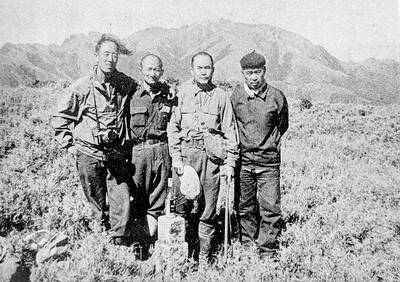
May 18 to May 24 Gathered on Yangtou Mountain (羊頭山) on Dec. 5, 1972, Taiwan’s hiking enthusiasts formally declared the formation of the “100 Peaks Club” (百岳俱樂部) and unveiled the final list of mountains. Famed mountaineer Lin Wen-an (林文安) led this effort for the Chinese Alpine Association (中華山岳協會). Working with other experienced climbers, he chose 100 peaks above 10,000 feet (3,048m) that featured triangulation points and varied in difficulty and character. The list sparked an alpine hiking craze, inspiring many to take up mountaineering and competing to “conquer” the summits. A common misconception is that the 100 Peaks represent Taiwan’s 100 tallest

Taiwan’s overtaking of South Korea in GDP per capita is not a temporary anomaly, but the result of deeper structural problems in the South Korean economy says Chang Young-chul, the former CEO of Korea Asset Management Corp. Chang says that while it reflects Taiwan’s own gains, it also highlights weakening growth momentum in South Korea. As design and foundry capabilities become more important in the AI era, Seoul risks losing competitiveness if it relies too heavily on memory chips. IMF forecasts showing Taiwan widening its lead over South Korea have fueled debate in Seoul over memory chip dependence, industrial policy and

Yesterday, the Democratic Progressive Party (DPP) nominated legislator Puma Shen (沈伯洋) as their Taipei mayoral candidate, the Chinese Nationalist Party (KMT) put their stamp of approval on Wei Ping-cheng (魏平政) as their candidate for Changhua County commissioner and former legislator Tsai Pi-ru (蔡壁如) of the Taiwan People’s Party (TPP) has begun the process to also run in Changhua, though she has not yet been formally nominated. All three news items are bizarre. The DPP has struggled with settling on a Taipei nominee. The only candidate who declared interest was Enoch Wu (吳怡農), but the party seemed determined to nominate anyone


 RSS
RSS