


Last year, an Iraqi-American artist sat down with Bahjat Abdulwahed — the so-called “Walter Cronkite of Baghdad”— with the idea of launching a radio project that would be part documentary, part radio play and part variety show.
Abdulwahed was the voice of Iraqi radio from the late 1950s to the early 1990s, but came to Philadelphia as a refugee in 2009 after receiving death threats from insurgents.
“He represented authority and respectability in relationship to the news through many different political changes,” said Elizabeth Thomas, curator of Radio Silence, a public art piece that resulted from the meeting with Abdulwahed.
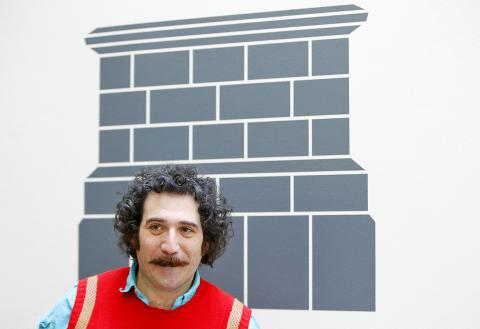
Photo: AP
Thomas had invited artist Michael Rakowitz to Philadelphia to create a project for Mural Arts Philadelphia, which has been expanding its public art reach from murals into new and innovative spaces.
After nearly five years of research, Rakowitz distilled his project into a radio broadcast that would involve putting the vivacious and caramel-voiced Abdulwahed back on the air, and using Philadelphia-area Iraqi refugees and local Iraq war veterans as his field reporters. It would feature Iraqi music, remembrances of the country and vintage weather reports from a happier time in Iraq.
“One of the many initial titles was Desert Home Companion, Rakowitz said, riffing on A Prairie Home Companion, the radio variety show created by Garrison Keillor.
Rakowitz recorded an initial and very informal session with Abdulwahed in his living room in January 2016. Two weeks later, Abdulwahed collapsed. He had to have an emergency tracheostomy and was on life support until he died seven months later.
At Abdulwahed’s funeral, his friends urged Rakowitz to continue with the project, to show how much of the country they left behind was slipping away and to help fight cultural amnesia.
Rakowitz recalibrated the project, which became Radio Silence, a 10-part radio broadcast with each episode focusing on a synonym of silence, in homage to Abdulwahed.
“The voice of Baghdad had lost his voice,” Rakowitz said, calling him a “narrator of Iraq’s history.” It will be hosted by Rakowitz and features fragments of that first recording session with Abdulwahed, as well as interviews with his wife and other Iraqi refugees living in Philadelphia.
Rakowitz and Thomas also worked with Warrior Writers, a nonprofit based in Philadelphia that helps war veterans work through their experiences using writing and art.
The first episode, on speechlessness, will launch Aug. 6. It will be broadcast on community radio stations across the country through Prometheus Radio Project. One participant is Jawad Al Amiri, an Iraqi refugee who came to the United States in the 1980s. He said silence in Iraq has been a way of life for many decades.
“Silence is a way of survival. Silence is a decree by the Baath regime, not to tell what you see in front of your eyes. Silence is synonymous with fear. If you tell, you will be put through agony,” he said at a preview Tuesday of the live broadcast. He said he saw his own sister poisoned and die and wasn’t allowed to speak of it.
When he came to the US in 1981, his father told him: “We send you here for education and to speak for the millions of Iraqis in the land where freedom of speech is practiced.”
Lawrence Davidson is an Army veteran who served during the Iraq War and works with Warrior Writers also contributed to the project. He said the project is a place to exchange ideas and honestly share feelings with refugees and other veterans.
The project kicks off today with a live broadcast performance on Philadelphia’s Independence Mall — what Rakowitz calls the symbolic home of American democracy. It will feature storytelling, food from refugees and discussions from the veterans with Warrior Writers.
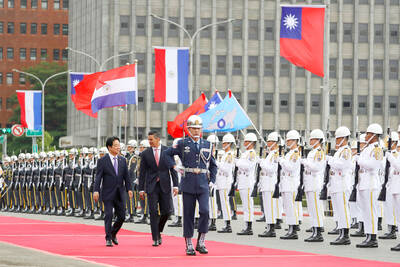
“China wants to unify with Taiwan at the lowest possible cost, and it currently believes that unification will become easier and less costly as time passes,” wrote Amanda Hsiao (蕭嫣然) and Bonnie Glaser in Foreign Affairs (“Why China Waits”) this month, describing how the People’s Republic of China (PRC) is playing the long game in its quest to seize Taiwan. This has been a favorite claim of many writers over the years, easy to argue because it is so trite. Very obviously, if the PRC isn’t attacking Taiwan, it is waiting. But for what? Hsiao and Glaser’s main point is trivial,
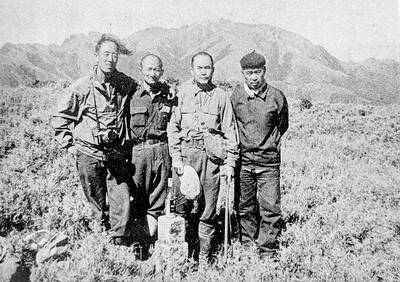
May 18 to May 24 Gathered on Yangtou Mountain (羊頭山) on Dec. 5, 1972, Taiwan’s hiking enthusiasts formally declared the formation of the “100 Peaks Club” (百岳俱樂部) and unveiled the final list of mountains. Famed mountaineer Lin Wen-an (林文安) led this effort for the Chinese Alpine Association (中華山岳協會). Working with other experienced climbers, he chose 100 peaks above 10,000 feet (3,048m) that featured triangulation points and varied in difficulty and character. The list sparked an alpine hiking craze, inspiring many to take up mountaineering and competing to “conquer” the summits. A common misconception is that the 100 Peaks represent Taiwan’s 100 tallest

Taiwan’s overtaking of South Korea in GDP per capita is not a temporary anomaly, but the result of deeper structural problems in the South Korean economy says Chang Young-chul, the former CEO of Korea Asset Management Corp. Chang says that while it reflects Taiwan’s own gains, it also highlights weakening growth momentum in South Korea. As design and foundry capabilities become more important in the AI era, Seoul risks losing competitiveness if it relies too heavily on memory chips. IMF forecasts showing Taiwan widening its lead over South Korea have fueled debate in Seoul over memory chip dependence, industrial policy and

Yesterday, the Democratic Progressive Party (DPP) nominated legislator Puma Shen (沈伯洋) as their Taipei mayoral candidate, the Chinese Nationalist Party (KMT) put their stamp of approval on Wei Ping-cheng (魏平政) as their candidate for Changhua County commissioner and former legislator Tsai Pi-ru (蔡壁如) of the Taiwan People’s Party (TPP) has begun the process to also run in Changhua, though she has not yet been formally nominated. All three news items are bizarre. The DPP has struggled with settling on a Taipei nominee. The only candidate who declared interest was Enoch Wu (吳怡農), but the party seemed determined to nominate anyone


 RSS
RSS