


After Spring, the Tamaki Family... unexpectedly opens with a heavy metal concert in Tokyo. You first wonder what it has to do with such a seemingly gentle movie, until the bass player yells between songs, “My name is Shingo, I’m from Ishigaki and I’m half Taiwanese!”
Shingo is the grandson of Tamaki Tamayo, who emigrated to Ishigaki, a tiny Okinawan island closer to Taiwan than mainland Japan, in the 1940s and became the matriarch of the largest Taiwanese immigrant family on the island.
The film’s subject matter is somewhat of a counterpoint to last year’s Wansei Back Home (灣生回家), which told the story of Taiwan-born or raised Japanese nationals who were forced to leave what they saw as their home after World War II. While the wanseis never forgot about Taiwan, the Tamakis, besides Tamayo, knew almost nothing of their ancestral land.
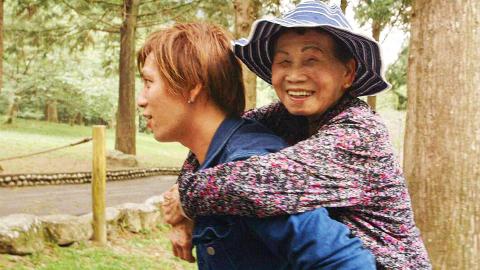
Photos courtesy of Fisfisa Media
Tamayo’s husband originally traveled to Ishigaki with many other Taiwanese pineapple farmers during Japanese colonial rule. He was sent back to Taiwan as the US launched its offensive on Okinawa, but after being persecuted by the Nationalists due to the 228 Incident, he fled with Tamayo to Ishigaki and settled there permanently despite the later decline of the pineapple industry.
Due to racial discrimination, the Tamaki family’s descendants eschewed their Taiwanese identity and have mostly become fully Japanized, as in one scene a son of Tamayo discusses how he tried hard to be more Japanese than a Japanese. Even so, due to the family’s illegal arrival and the subsequent 30 years of US occupation, it took decades for them to obtain Japanese citizenship, upon which they officially changed their surname from Wang (王) to Tamaki.
The story focuses on the many members of the Tamaki family as they return to Ishigaki from around Japan to celebrate Tamayo’s 88th birthday, where they decide to bring her back to Taiwan for one last visit.
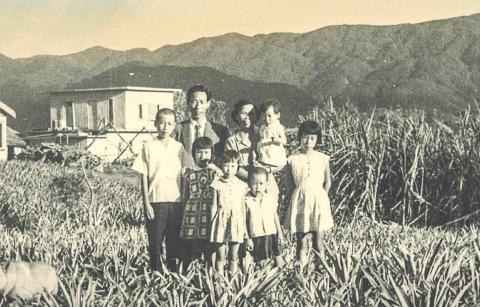
Photos courtesy of Fisfisa Media
It’s one of those films that benefits from a strong central character: Tamayo is strong-willed, sarcastic and pretty hilarious, delivering many chuckle or laughter-inducing one liners throughout the film. But the main narrator of the film is Shingo, who explains the complex history of Taiwanese immigration to Ishigaki and travels for the first time to Taiwan in the second half of the film, where he feels all kinds of emotions and experiences a closeness to his ancestral land.
In addition to the main storyline, the film makes use of extensive interviews with the various family members to explore how they have dealt with their identity. It also includes scenes that show the last traces of keeping their heritage such as learning how to make Tamayo’s signature zongzi (粽子, glutinous rice wrapped in bamboo leaves) during Dragon Boat Festival.
Director Huang Yin-yu (黃胤毓), who resides in Japan, knew about the subject matter but didn’t become interested in making the film until reading the 2012 book Taiwanese in Yaeyama Islands, which includes Ishigaki, by Matsuda Yoshitaka — which Shingo also reads to learn about his family. While the Tamaki family has the most members and Tamayo is a great character, having a compelling storyline in a documentary still takes a bit of luck — it just happened that they were about to have their reunion and visit Taiwan.
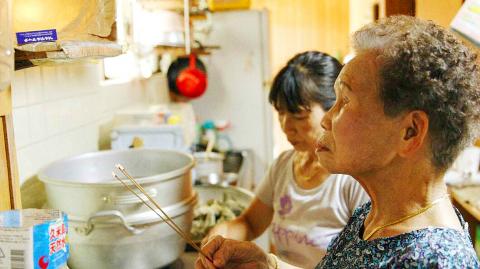
Photos courtesy of Fisfisa Media
There are a few scenes that drag on for a bit, such as when the family members were making preparations for Tamayo’s birthday, and other moments where they chatter on about trivial subjects that don’t seem to have much to do with the story. But overall the film is well-paced and the plotline is clear. At times, it feels like the characters are talking for too long during the interviews, or even that the director featured too many people at the expense of featuring more of Tamayo. In the end, however, it does help to give a better sense of who they are and how each member has struggled in their own way.
Now, with Tamayo their last link to their homeland, how, or will they preserve their heritage? Despite the heavy subject matter, the film is heart-warming and light-hearted, and is a wonderful introduction to an 80-year odyssey of a little-known history.

Taiwan’s overtaking of South Korea in GDP per capita is not a temporary anomaly, but the result of deeper structural problems in the South Korean economy says Chang Young-chul, the former CEO of Korea Asset Management Corp. Chang says that while it reflects Taiwan’s own gains, it also highlights weakening growth momentum in South Korea. As design and foundry capabilities become more important in the AI era, Seoul risks losing competitiveness if it relies too heavily on memory chips. IMF forecasts showing Taiwan widening its lead over South Korea have fueled debate in Seoul over memory chip dependence, industrial policy and

“China wants to unify with Taiwan at the lowest possible cost, and it currently believes that unification will become easier and less costly as time passes,” wrote Amanda Hsiao (蕭嫣然) and Bonnie Glaser in Foreign Affairs (“Why China Waits”) this month, describing how the People’s Republic of China (PRC) is playing the long game in its quest to seize Taiwan. This has been a favorite claim of many writers over the years, easy to argue because it is so trite. Very obviously, if the PRC isn’t attacking Taiwan, it is waiting. But for what? Hsiao and Glaser’s main point is trivial,
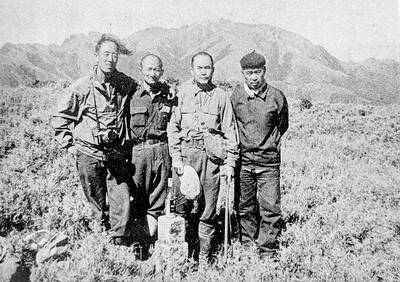
May 18 to May 24 Gathered on Yangtou Mountain (羊頭山) on Dec. 5, 1972, Taiwan’s hiking enthusiasts formally declared the formation of the “100 Peaks Club” (百岳俱樂部) and unveiled the final list of mountains. Famed mountaineer Lin Wen-an (林文安) led this effort for the Chinese Alpine Association (中華山岳協會). Working with other experienced climbers, he chose 100 peaks above 10,000 feet (3,048m) that featured triangulation points and varied in difficulty and character. The list sparked an alpine hiking craze, inspiring many to take up mountaineering and competing to “conquer” the summits. A common misconception is that the 100 Peaks represent Taiwan’s 100 tallest

Yesterday, the Democratic Progressive Party (DPP) nominated legislator Puma Shen (沈伯洋) as their Taipei mayoral candidate, the Chinese Nationalist Party (KMT) put their stamp of approval on Wei Ping-cheng (魏平政) as their candidate for Changhua County commissioner and former legislator Tsai Pi-ru (蔡壁如) of the Taiwan People’s Party (TPP) has begun the process to also run in Changhua, though she has not yet been formally nominated. All three news items are bizarre. The DPP has struggled with settling on a Taipei nominee. The only candidate who declared interest was Enoch Wu (吳怡農), but the party seemed determined to nominate anyone


 RSS
RSS