


The members of percussion ensemble iOFloat (出入游樂) see musical instruments as tools to make a statement. In their new work PercDuction (擊製) — a portmanteau of percussion and production — each of the three classically-trained musicians — Liao Hai-ting (廖海婷), Liao Wei-hsu (廖韋旭) and Hung Yu-wen (洪于雯) — has something to say.
PercDuction features three experimental percussion performances. Liao Hai-ting’s Lost in Translation reflects on how social media has altered interpersonal communication. Liao Wei-hsu’s One But One, Good One presents the diversity of percussion music. Hung’s Monodrama (獨白) showcases music about life, death and the self.
“We don’t have a central theme connecting the three performances, but we do have a common language — percussion music,” Liao Wei-hsu told the Taipei Times.
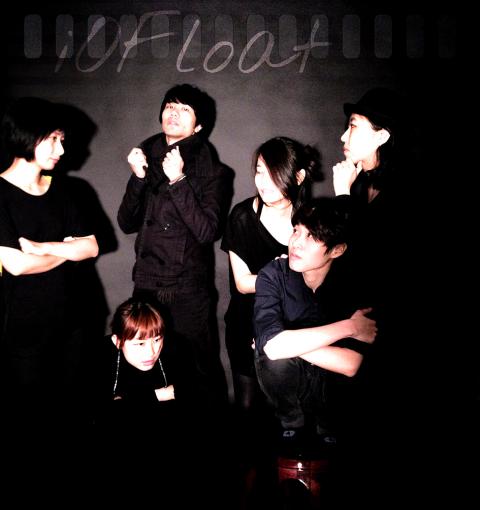
Photo courtesy of iOFloat
LIFE ON THE SCREEN
Liao Hai-ting works with director Yulia Chen (陳侑汝) and actress Chung Shih-min (鐘詩敏) to construct a scenario where Chung knows Liao only through her Facebook account.
“Nowadays, people observe other people’s lives through social networking. You probably know a lot about someone you don’t say hello to in real life. In this sense, do you actually know this person or not? ” Liao Hai-ting said.
Lost in Translation features songs by Pierre Jodlowski (Time and Money) and Edmund Campion (Losing Touch), and presents electronic music by Liao, who will play the vibraphone and drums live. The audience will also hear sounds from malletKAT, a percussion controller with trigger pads laid out like a conventional marimba.
“I want to disorient the audience’s auditory senses and lead them into a virtual reality we create,” said Liao, who will also “force” the audience to participate in the show in ways she prefers to remain a secret until opening night.
“The audience is a part of my show. They won’t just sit there and watch,” she added.
MULTIFACETED PERCUSSIONIST
In One But One, Good One, Liao Wei-hsu combines various musical compositions, including Astor Piazzolla’s Libertango, Thierry de Mey’s Table Music and Yngwie Malmsteen’s Far Beyond the Sun, but alters the original instrumental arrangements with help from guitarist Eric Hsu (徐研培) and bass player Billy Fu (傅家煌). For example, Liao uses a xylophone to interpret Piazzolla’s Libertango.
“Percussion instruments add dimension to a song, which is usually presented with piano, accordion and cello,” she said, adding “most percussionists would probably choose drums to show the rhythmic variation of tango music, but I deliberately avoid using them. It would have been too predictable.”
Liao encourages the audience to rely on their own senses to “feel” the music, rather than relying on the information in the program book.
“In most concerts, you get an introduction on the repertoire, composer’s biography and sometimes why they wrote the song. I exclude all those details on purpose, because too much information will limit one’s imagination,” Liao said.
DIALOGUE WITH ONESELF
Hung’s Monodrama (獨白) features Peter Eotvos’ New Psalm, (in memoriam Frank Zappa), Kaija Saariaho’s Six Japanese Gardens and Bruno Mantovani’s Moi, jeu, a marimba solo.
Hung said New Psalm, (in memoriam Frank Zappa), an elegy for late American musician Frank Zappa, alters how percussion instruments are generally played, as well as requiring the percussionist to perform ritualistic acts.
“For example, the metal tubes of chimes are separated and rearranged, and I use vibraphone mallets to play the drum,” Hung said.
“I will wear sharp finger nails and scratch the drum skin with ‘Zappa’ written on it,” she added.
With Six Japanese Gardens, a six-part composition written in memory of late Japanese composer Toru Takemitsu, Hung will move between temple blocks, a wooden drum and a stone she found in an aquarium shop.
“I have a vibraphone placed behind a veil, and a few helpers will make echoes following my tempo at certain points. But mostly I play solo on stage,” Hung said.
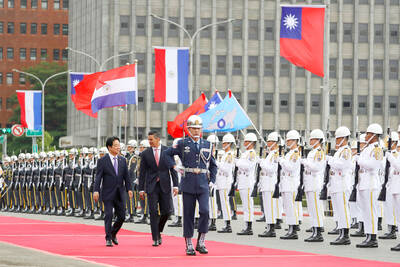
“China wants to unify with Taiwan at the lowest possible cost, and it currently believes that unification will become easier and less costly as time passes,” wrote Amanda Hsiao (蕭嫣然) and Bonnie Glaser in Foreign Affairs (“Why China Waits”) this month, describing how the People’s Republic of China (PRC) is playing the long game in its quest to seize Taiwan. This has been a favorite claim of many writers over the years, easy to argue because it is so trite. Very obviously, if the PRC isn’t attacking Taiwan, it is waiting. But for what? Hsiao and Glaser’s main point is trivial,
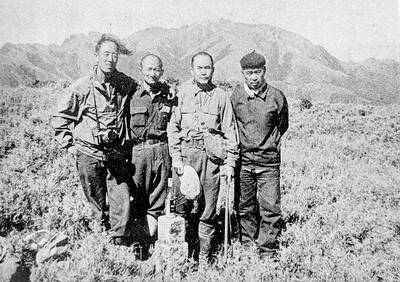
May 18 to May 24 Gathered on Yangtou Mountain (羊頭山) on Dec. 5, 1972, Taiwan’s hiking enthusiasts formally declared the formation of the “100 Peaks Club” (百岳俱樂部) and unveiled the final list of mountains. Famed mountaineer Lin Wen-an (林文安) led this effort for the Chinese Alpine Association (中華山岳協會). Working with other experienced climbers, he chose 100 peaks above 10,000 feet (3,048m) that featured triangulation points and varied in difficulty and character. The list sparked an alpine hiking craze, inspiring many to take up mountaineering and competing to “conquer” the summits. A common misconception is that the 100 Peaks represent Taiwan’s 100 tallest

Taiwan’s overtaking of South Korea in GDP per capita is not a temporary anomaly, but the result of deeper structural problems in the South Korean economy says Chang Young-chul, the former CEO of Korea Asset Management Corp. Chang says that while it reflects Taiwan’s own gains, it also highlights weakening growth momentum in South Korea. As design and foundry capabilities become more important in the AI era, Seoul risks losing competitiveness if it relies too heavily on memory chips. IMF forecasts showing Taiwan widening its lead over South Korea have fueled debate in Seoul over memory chip dependence, industrial policy and

Yesterday, the Democratic Progressive Party (DPP) nominated legislator Puma Shen (沈伯洋) as their Taipei mayoral candidate, the Chinese Nationalist Party (KMT) put their stamp of approval on Wei Ping-cheng (魏平政) as their candidate for Changhua County commissioner and former legislator Tsai Pi-ru (蔡壁如) of the Taiwan People’s Party (TPP) has begun the process to also run in Changhua, though she has not yet been formally nominated. All three news items are bizarre. The DPP has struggled with settling on a Taipei nominee. The only candidate who declared interest was Enoch Wu (吳怡農), but the party seemed determined to nominate anyone


 RSS
RSS