


The Col du Lautaret, a mountain pass that reaches 2,058m, is an hour's drive from Grenoble and sits in the heart of the Southern Alps under the imposing shadow of big peaks and vertical glaciers. It is home to an annual early-winter festival, the Snowkite Masters, which brings together hundreds to participate in this emerging sport, which mixes skiing, snowboarding, kiting and kiteboarding, with a bit of skateboarding, wakeboarding and parasailing thrown in.
Using lightweight foil-type kites that have bellows that inflate with the wind and give impressive lift and power, snowkiters are pulled across, up and over snow-covered hills, mountains, fields and frozen lakes.
Upon my arrival at the mountain pass, known locally as the Col, I walked in knee-deep snow toward a distant, shimmering flotilla of colorful snowkites flying against a deep winter sky. The kites, some as large as a motor home, zipped about the sky in graceful arcs. When hit by sudden gusts, the kites slashed furiously back and forth through the air. Then, without warning, a snowkiter passed silently 9m above me, connected to his kite by 30.5m strings.
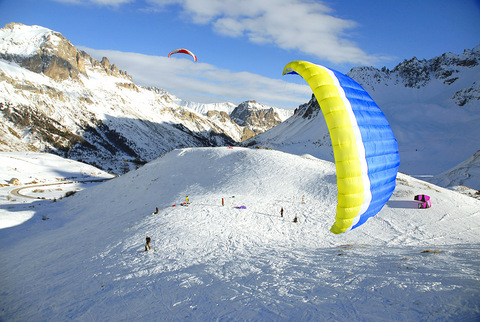
PHOTO: NY TIMES NEWS SERVICE
He looked like an oversized marionette, except for the dreadlocks coming from under his helmet and the hand-rolled cigarette dangling from his grinning mouth.
Snowkiting became popular in Europe in the mid-1990s, and the Col quickly gained cult status.
"Here we have consistent wind, varied terrain and easy road access," Xavier Petit, a local snowkiter, said in French. "And the Col is next door to big resorts, where many good skiers and snowboarders live. It's not the easiest place to kite, but it's popular because of media attention and all the crazy riders who live near here."
This year's Snowkite Masters included participants from around the world. The staging area included a teepee and a sports-drink company's promotional tent, with a DJ spinning reggae music for a crowd that was huddling around a snow-pit barbecue and drinking beer.
"We are an anti-contest, with no fees, rules, competitions or prizes," said Guillaume Chastagnol, one of the event's organizers and perhaps the sport's best-known professional. "Yet we still attract the world's top snowkiters who travel here from far away to meet friends, test new equipment and show off new tricks. And, yes, we have very good fiestas."
Pascal Joubert earned his nickname, Big Air, because of his huge jumps, which last as long as five minutes at heights of more than 91m. Jumps are measured in time, not distance. He said he converted to snowkiting 10 years ago when he grew tired of fighting for fresh powder at nearby resorts.
"In snowkiting, we are going back to the roots of the mountain, of the calm, the serenity and virgin snow," Joubert said. "The biggest pleasure for me is to flow over the snow and in the air. In snowkiting, we are no longer a victim of gravity."

Taiwan’s overtaking of South Korea in GDP per capita is not a temporary anomaly, but the result of deeper structural problems in the South Korean economy says Chang Young-chul, the former CEO of Korea Asset Management Corp. Chang says that while it reflects Taiwan’s own gains, it also highlights weakening growth momentum in South Korea. As design and foundry capabilities become more important in the AI era, Seoul risks losing competitiveness if it relies too heavily on memory chips. IMF forecasts showing Taiwan widening its lead over South Korea have fueled debate in Seoul over memory chip dependence, industrial policy and
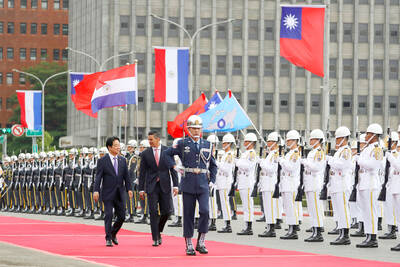
“China wants to unify with Taiwan at the lowest possible cost, and it currently believes that unification will become easier and less costly as time passes,” wrote Amanda Hsiao (蕭嫣然) and Bonnie Glaser in Foreign Affairs (“Why China Waits”) this month, describing how the People’s Republic of China (PRC) is playing the long game in its quest to seize Taiwan. This has been a favorite claim of many writers over the years, easy to argue because it is so trite. Very obviously, if the PRC isn’t attacking Taiwan, it is waiting. But for what? Hsiao and Glaser’s main point is trivial,
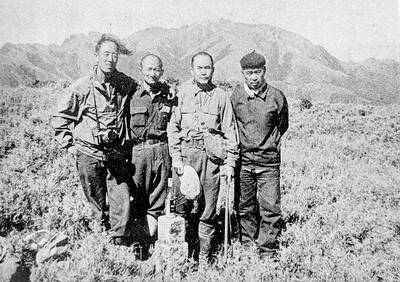
May 18 to May 24 Gathered on Yangtou Mountain (羊頭山) on Dec. 5, 1972, Taiwan’s hiking enthusiasts formally declared the formation of the “100 Peaks Club” (百岳俱樂部) and unveiled the final list of mountains. Famed mountaineer Lin Wen-an (林文安) led this effort for the Chinese Alpine Association (中華山岳協會). Working with other experienced climbers, he chose 100 peaks above 10,000 feet (3,048m) that featured triangulation points and varied in difficulty and character. The list sparked an alpine hiking craze, inspiring many to take up mountaineering and competing to “conquer” the summits. A common misconception is that the 100 Peaks represent Taiwan’s 100 tallest

Yesterday, the Democratic Progressive Party (DPP) nominated legislator Puma Shen (沈伯洋) as their Taipei mayoral candidate, the Chinese Nationalist Party (KMT) put their stamp of approval on Wei Ping-cheng (魏平政) as their candidate for Changhua County commissioner and former legislator Tsai Pi-ru (蔡壁如) of the Taiwan People’s Party (TPP) has begun the process to also run in Changhua, though she has not yet been formally nominated. All three news items are bizarre. The DPP has struggled with settling on a Taipei nominee. The only candidate who declared interest was Enoch Wu (吳怡農), but the party seemed determined to nominate anyone


 RSS
RSS