


With over 100 races without a win, Japanese racehorse Haruurara is an "also ran" that embodies the never-say-die spirit, but she has won fans' hearts and helped save a local racecourse from bankruptcy.
The eight-year-old mare extended her winless streak to 105 outings last Sunday by finishing ninth in a field of 11 at Kochi Racecourse in the Japanese coastal city of Kochi, some 600km southwest of Tokyo.
The chestnut thoroughbred, wearing her trademark pink hood, failed to deliver on the race's highest odds of 130-1, but did not disappoint the 2,600 fans who flocked to the otherwise quiet dirt course in the rain to see Japan's most famous horse.
"We are encouraged by her give-it-everything spirit," said Mitsushi Yoshinaga, a 63-year-old reti-ree. Fans identify her losing streak with their own difficulties at a time when Japan has long suffered recession," Yoshinaga said. "We feel we can work hard again when we see her racing desperately for the finishing line."
A great cheer went up from the crowd when Haruurara joined the frontrunners in the first straight. Although she was gradually overtaken by one horse after another in the muddy going, the fans rooted for her throughout the race.
"I'm satisfied with ninth. She did a good job," said Masako Kadota, 30, who works at a local politician's office. Haruurara is cute and attractive. Whenever I see her gallop here, I feel cheerful," she said. "She is my heroine."
Since her debut in November 1998, Haruurara, which means "gentle spring", has finished in second place four times, and her total prize money has barely reached 1 million yen (US$9,170).
"I named her Haruurara in the hope that she can be gentle and pleasing like the spring," said trainer Dai Muneishi, 53.
"Urara is very sensitve, fragile and unruly, but has an ability to run in any kinds of conditions. She is an all-rounder," the jockey-turned trainer said, using the horse's nickname.
"She runs at full gallop no matter what. That's her style," Muneishi said, after feeding Haruurara as she relaxed in her stable decorated with a bouquet and a string of a thousand origami paper cranes sent by her fans hoping for her first victory.
Haruurara was born in 1996 on the northern island of Hokkaido, the nation's horse-breeding center but no one wanted to buy the then-weak filly.
Sugita Farm, where she was born and raised, had little choice but to become her owner and sent her off to Muneishi's stable, which had a reputation as a repository of hopeless horses.
As the number of races without a win mounted, Haruurara faced the prospect of being slaughtered in June last year -- a common end for no-hope nags.
But her life was spared after her popularity shot up last summer when local media focused on the fact her winless streak was nearing a landmark 100 races.
Haruurara's popularity has also helped saved the troubled course, which had been on the verge of bankruptcy with debts of 9 billion yen due to a plunge in the number of fans amid the region's prolonged economic slump.
"If we hadn't had Haruurara, we might have been in a very serious situation by now," said Hidehiro Maeda, who was sent from Kochi prefectural government to operate the course, one of the nation's 18 publicly run local racetracks.
"For the past four years, five racecourses have closed. We had been said to be the next ... unless we could invite [Carlos] Ghosn," he said, referring to the executive who is famous for turning ailing carmaker Nissan around.
Betting, which had declined to one third of the peak level set in 1991, rose some 20 percent from last year to some 80 million yen a day (US$726 million) with the number of visitors up 50 percent on days when Haruurara races.
Her popularity has spread to other businesses. People queued at the track for T-shirts with "Never give up!!" printed on the front in English, and lucky charms containing clippings from her mane.
Package tours to watch her race are sold out while the horse has featured in a television commercial for Kirin beer. The CD of her second support song goes on sale nationwide in the middle of this month. Haruurara has also received a distinguished service award for tourism from the local government. In the first such award to an animal, she was presented 200kg of carrots, her favorite snack.
"Keeping up her popularity is a matter of life or death for us," Maeda said. "She is the savior of Kochi."
At this late stage in her career, the chances of Haruurara's first win are improving as Japan's top jockey Yutaka Take plans to ride her in Kochi on March 22. The unusual matching is in response to growing calls to help her achieve her first win.
Even if she fails, she may continue to run at least until she breaks the Japanese record of 161 races marked by Hakuhou Queen.
"She will have no problem with running in two years," Muneishi said. "My first desire is that she can retire uninjured. And if just possible, I want her to win."
Thanks to her popularity, Haruurara has avoided the fate of being slaughtered at the end of her racing career and will be sent to a training farm in Nasu, north of Tokyo, where she will be able to run around freely for the rest of her days -- an unusual retirement for anything but a stud stallion.

“China wants to unify with Taiwan at the lowest possible cost, and it currently believes that unification will become easier and less costly as time passes,” wrote Amanda Hsiao (蕭嫣然) and Bonnie Glaser in Foreign Affairs (“Why China Waits”) this month, describing how the People’s Republic of China (PRC) is playing the long game in its quest to seize Taiwan. This has been a favorite claim of many writers over the years, easy to argue because it is so trite. Very obviously, if the PRC isn’t attacking Taiwan, it is waiting. But for what? Hsiao and Glaser’s main point is trivial,
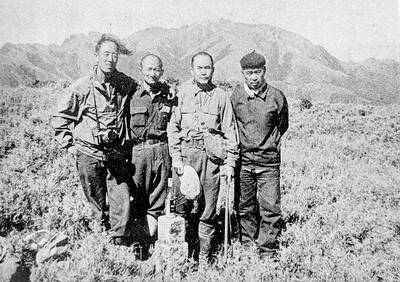
May 18 to May 24 Gathered on Yangtou Mountain (羊頭山) on Dec. 5, 1972, Taiwan’s hiking enthusiasts formally declared the formation of the “100 Peaks Club” (百岳俱樂部) and unveiled the final list of mountains. Famed mountaineer Lin Wen-an (林文安) led this effort for the Chinese Alpine Association (中華山岳協會). Working with other experienced climbers, he chose 100 peaks above 10,000 feet (3,048m) that featured triangulation points and varied in difficulty and character. The list sparked an alpine hiking craze, inspiring many to take up mountaineering and competing to “conquer” the summits. A common misconception is that the 100 Peaks represent Taiwan’s 100 tallest

Taiwan’s overtaking of South Korea in GDP per capita is not a temporary anomaly, but the result of deeper structural problems in the South Korean economy says Chang Young-chul, the former CEO of Korea Asset Management Corp. Chang says that while it reflects Taiwan’s own gains, it also highlights weakening growth momentum in South Korea. As design and foundry capabilities become more important in the AI era, Seoul risks losing competitiveness if it relies too heavily on memory chips. IMF forecasts showing Taiwan widening its lead over South Korea have fueled debate in Seoul over memory chip dependence, industrial policy and

Yesterday, the Democratic Progressive Party (DPP) nominated legislator Puma Shen (沈伯洋) as their Taipei mayoral candidate, the Chinese Nationalist Party (KMT) put their stamp of approval on Wei Ping-cheng (魏平政) as their candidate for Changhua County commissioner and former legislator Tsai Pi-ru (蔡壁如) of the Taiwan People’s Party (TPP) has begun the process to also run in Changhua, though she has not yet been formally nominated. All three news items are bizarre. The DPP has struggled with settling on a Taipei nominee. The only candidate who declared interest was Enoch Wu (吳怡農), but the party seemed determined to nominate anyone


 RSS
RSS