


Motherland, I am a river
(祖國我是一條河)
Oh Motherland, I am a river
The flip of the yellow book pages
Is the sound of my moans
Along the sailing routes covered with cordite
Was the moment I started
flowing
Bones of the dead dance in the caverns
At the foot of the mountain
Seeing your beard of white and
Eyes of spring
I feel an impulse
Do you hear the cry of the cuckoos yet?
Oh Motherland,
I am the river whence the
"Yong-le Canon (永樂大典)"
flowed out
I, oh Motherland, am a river
I can see you
The tremor behind the airport runway
Sometimes terror will thicken into blood
In the red twilight oh Motherland
Do you feel the multitude of snakes crawling
Trapping you in the eve of dawn
Yet I am a river that seeps out of the searchlights
And so have no hunger, no thirst, for the riverbed
How time
Mutates into the shapes of banners
My breath
Becomes the harvest that
followed the breaking of the
reservoir
You don't need to show me the way with your bosom
On the strings of the old guitar covered with dust
Motherland
I am a silent river
"Writing poems is a weapon for me to fight with reality," says Wang Dan (王丹), a former leader of the 1989 Tiananmen Square student movement. This is a new face for Wang, that of a poet, but it fits him well. His new book of poems, Travel in Cold Alone (我在寒冷中獨行), is a collection that he wrote during his imprisonment and has been promoting on a tour of Taiwan.
The 31-year-old is usually known these days in the political realm, in speeches and democratic campaigns. As a high-profile survivor of the massacre at Tiananmen, he is a symbol for the human rights and democracy struggles in China and the "last conscience of the June 4th incident." He was imprisoned for almost a decade for his role.
Wang looks much different nowadays. Having gained a few pounds, tanned and chosen baggy clothes and Nikes as his fashion, Wang no longer resembles the pale, rebellious student on the square.
He has made a much similar transition in his book. Highlighting his romantic and naive traits, Wang sublimates his political protest into lyrical poems. Most of the poems seem to be "love poems", with a few exceptions, like "Motherland, I am a river," which shows obvious political implications.
For You (致你)
Perhaps all four seasons would be frozen
Time passes by and a long scar carves
Perhaps the beauty of youth
Has tumbled and turned into a gray nightmare
Perhaps we've never had dawns
All one can see is the eternal dusk
Then would you please
Please believe
Not every dark spot is ugly as the morass
Not every love is attached with willful pursuit
Then would you please
Please hold my hands
Hold my gentle hands that are soft as the still water
Memory, imagination and expressing emotion are the three main elements of the 60 poems in the book, Wang says. "In the dark gray cell of prison, I always remember my green days as a Beijing University student before the incident." Every night, Wang remembers, he used to take a walk with classmates along a lake on the campus, forgetting about the 11pm curfew as they talked about their ideals and passionate concern for China's future.
In the many sleepless winter nights in prison, Wang wrote poems of those youthful days and his friendships. "For me, writing poems was therapy, a method to reach a spiritual balance during those lonely days," he says. "For eight months I was locked on a floor where I could not hear any sound, which was frightening, so I had to make sound myself." The poems helped, in a small way, to infuse sound and color into those bleak days, marked by despair as his youth drained away in a prison cell.
The suffering of imprisonment often nurtures the growth of literature. In the preface for Wang's book, Cheng Cho-yu (
Wang also found himself influenced by Taiwanese poems. "His poems read like Taiwan's modern poems and folk songs in the 1970s, very pure and fresh," says poet Chen Ke-hua (
"I grew up in an environment where almost any literature has a purpose. So when I began reading Taiwan's poems in the mid-80s -- the aftermath of Cultural Revolution -- I felt a cultural shock from the clear and bright souls of those Taiwan poems," Wang says.
His knowledge of Taiwan literature surprises Chen and other Taiwan literati. His favorite Taiwanese poets are Lo Fu (洛夫), Lo Chih-cheng (羅智成) and Cheng Cho-yu, who is also a favorite poet of President Chen Shui-bian (陳水扁), whom Wang met during the inauguration.
On this trip, Wang has met and befriended another of the DPP's stars, a man as much a romantic revolutionary as Wnag himself. DPP legislator Shih Ming-teh (施明德) hosted Wang for a night of drinking and storytelling, during which they were joined by Wuer Kaixi (吾爾開希), another student leader from Tiananmen who now lives in Taiwan.
As a leading member of the Kaohsiung Incident, and a politician noted for his romantic revolutionary remarks as well as his frequent romances, Shih seemed to have a lot to share with Wang, who said he would include Shih in a study of "romantics and revolutions".
"When I see Shih, who spent 25 years in prison, still holding his romantic ideas and passion for Taiwan's society, I feel inspired and enlightened," Wang said.
Poems translated by Francis Huang.

Taiwan’s overtaking of South Korea in GDP per capita is not a temporary anomaly, but the result of deeper structural problems in the South Korean economy says Chang Young-chul, the former CEO of Korea Asset Management Corp. Chang says that while it reflects Taiwan’s own gains, it also highlights weakening growth momentum in South Korea. As design and foundry capabilities become more important in the AI era, Seoul risks losing competitiveness if it relies too heavily on memory chips. IMF forecasts showing Taiwan widening its lead over South Korea have fueled debate in Seoul over memory chip dependence, industrial policy and
“China wants to unify with Taiwan at the lowest possible cost, and it currently believes that unification will become easier and less costly as time passes,” wrote Amanda Hsiao (蕭嫣然) and Bonnie Glaser in Foreign Affairs (“Why China Waits”) this month, describing how the People’s Republic of China (PRC) is playing the long game in its quest to seize Taiwan. This has been a favorite claim of many writers over the years, easy to argue because it is so trite. Very obviously, if the PRC isn’t attacking Taiwan, it is waiting. But for what? Hsiao and Glaser’s main point is trivial,
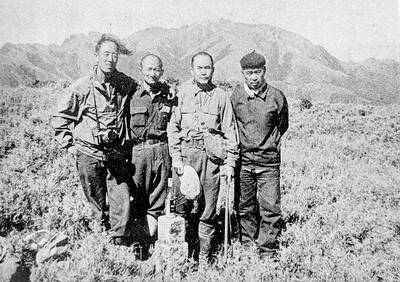
May 18 to May 24 Gathered on Yangtou Mountain (羊頭山) on Dec. 5, 1972, Taiwan’s hiking enthusiasts formally declared the formation of the “100 Peaks Club” (百岳俱樂部) and unveiled the final list of mountains. Famed mountaineer Lin Wen-an (林文安) led this effort for the Chinese Alpine Association (中華山岳協會). Working with other experienced climbers, he chose 100 peaks above 10,000 feet (3,048m) that featured triangulation points and varied in difficulty and character. The list sparked an alpine hiking craze, inspiring many to take up mountaineering and competing to “conquer” the summits. A common misconception is that the 100 Peaks represent Taiwan’s 100 tallest

Yesterday, the Democratic Progressive Party (DPP) nominated legislator Puma Shen (沈伯洋) as their Taipei mayoral candidate, the Chinese Nationalist Party (KMT) put their stamp of approval on Wei Ping-cheng (魏平政) as their candidate for Changhua County commissioner and former legislator Tsai Pi-ru (蔡壁如) of the Taiwan People’s Party (TPP) has begun the process to also run in Changhua, though she has not yet been formally nominated. All three news items are bizarre. The DPP has struggled with settling on a Taipei nominee. The only candidate who declared interest was Enoch Wu (吳怡農), but the party seemed determined to nominate anyone


 RSS
RSS