


Argentine President Javier Milei on Sunday hailed his party’s runaway victory in midterm elections as a “turning point” for the country, and vowed to charge ahead with his agenda of shrinking the state and deregulating the economy.
Milei’s small La Libertad Avanza (LLA) party rebounded from a series of setbacks to win 40.84 percent of the vote cast for members of Congress, far outpacing the opposition in an election closely watched by jittery investors.
“Today we reached a turning point, today begins the construction of a great Argentina,” the 55-year-old president told supporters at a victory party in Buenos Aires.

Photo: EPA
He promised to continue on the reform path with what he predicted would be “the most reformist Congress in Argentina’s history.”
US President Donald Trump, a close ally, congratulated Milei and said his Argentine counterpart was doing a “wonderful job.”
Half of the seats in the Chamber of Deputies and one-third of the Senate seats were up for grabs on Sunday.
Milei said the LLA had more than tripled its seat count, winning 101 seats in the lower house Chamber of Deputies, up from 37, and 20 seats in the Senate, up from six.
The center-left Peronist movement, in power for much of Argentina’s post-war history, trailed in second place with 31.64 percent.
“Far more Argentines want to move forward than go backwards,” Milei said on the demise of the opposition.
The elections were the first national test of Milei’s support since he won office two years ago on a promise to revive the long-ailing Argentine economy through a series of painful reforms.
The buildup to the vote was marked by a run on the national currency, the peso, that forced Milei to seek a bailout from Trump.
Washington promised an unprecedented US$40 billion package of aid, but the assistance came with a warning from Trump to Argentines that he would not “be generous” if the election did not go Milei’s way.
At the LLA election party, hundreds of Milei’s supporters celebrated the results with cheers, hugs, chants and even tears.
“I’m very happy and excited; I didn’t expect such a large number,” said Facundo Campos, a 38-year-old marketing consultant, comparing the joy to the “last goal of the last World Cup won by Argentina.”
Maria Jesus Galan, a 45-year-old health official, said that while there “some room for improvement” in Milei’s government, “it has a great future.”
Ahead of the election, several Milei voters had spoken about their disappointment with his leadership, particularly the corruption scandals involving members of his inner circle, but they remained viscerally opposed to the Peronist movement, whose figurehead, former Argentine president Cristina Kirchner, is under house arrest after being convicted of corruption.
At 67.9 percent, turnout was the lowest in a national election in four decades, reflecting disillusionment with the entire political class.
The most surprising results were in Buenos Aires Province, a Peronist stronghold, where the LLA clawed its way back from a defeat by the Peronists in last month’s local elections to a toss-up.
Adriana Cotoneo, a 69-year-old pensioner voting in Buenos Aires, said that she backed Milei’s party “not because I believe it’s the best option, but because I’m clear about who I want to be gone.”
Former TV pundit Milei has cut tens of thousands of public-sector jobs, frozen public works, cut spending on health, education and pensions, and led a major deregulation drive since taking office in December 2023.
His reforms were blamed for initially plunging millions of Argentines deeper into poverty, but they did slow inflation by two-thirds — to the relief of many — although at the expense of faltering economic growth, consumption and manufacturing.
Investors began dumping the Argentine peso last month amid concerns over the economy and support for Milei, but Trump stepped in to shore up his closest Latin American ally.
The US Treasury has intervened several times in the market, buying pesos to help keep it afloat.
Expectations were high that the government could depreciate or devalue the peso, widely seen as too strong, immediately after the vote, but questioned about the possibility on Sunday, Argentine Minister of Economy Luis Caputo replied with an emphatic: “No.”

SPEAKING OUT: After Siranudh Scott’s allegations surfaced, celebrities and public figures took to social media to share their own experiences of sexual misconduct and abuse A high-profile alleged sexual abuse case within a wealthy Thai beer brewing family has prompted a wave of painful accounts from survivors of unconnected abuse in the conservative nation. Siranudh Scott, a member of the billionaire Thai family that founded the ubiquitous Singha beer brand, posted an emotional video this month accusing his elder brother Sunit of repeatedly abusing him when he was a teenager. Sunit, who is in his 30s, later denied the allegations in a video posted online, but Singha parent Boonrawd dismissed him from his executive role with the company on Tuesday last week. “I felt I needed to speak

SEEKING ORDER: Rodrigo Paz said that ‘anyone who wants to destroy the nation will have to deal with this president and the full force of the constitution’ Bolivian President Rodrigo Paz on Wednesday said that the nation was at a “breaking point” after nearly a month of protests that have caused shortages of food, fuel and medicine. Paz, who took office six months ago amid the worst economic crisis there in four decades, is battling a groundswell of fury over his policies. The political capital, La Paz, has been besieged by low-income workers and members of the indigenous majority calling for his resignation. “The country needs order and is reaching breaking point,” the 58-year-old said at a public event in La Paz, renewing his appeal for dialogue. On Tuesday, the Bolivian

A Hong Kong astronaut is to join a Chinese space mission for the first time as part of a three-person crew launching today, as Beijing edges closer to its goal of landing people on the moon. The Tiangong space station — crewed by teams of three astronauts that are typically rotated every six months — is the crown jewel of China’s space program, boosted by billions in state investment in a bid to catch up with the US and Russia. The Shenzhou-23 mission is to blast off at 11:08pm from the Jiuquan Satellite Launch Center in northwestern China, carrying three astronauts to
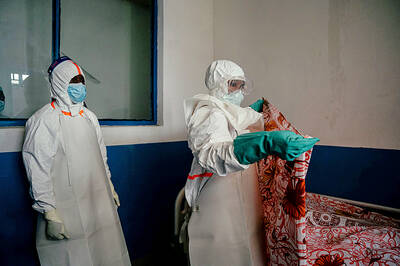
UPGRADED ALERT: The risk inside DR Congo is now considered ‘very high,’ while neighboring countries face a ‘high’ threat as the outbreak continues, the WHO said Ebola is spreading faster than responders can track it in eastern Congo, where health workers managed to follow up with barely one in five identified contacts in a single day. Authorities in the Democratic Republic of the Congo (DR Congo) reported 83 confirmed infections, 746 suspected cases and 1,603 identified contacts as of Thursday, but health workers were able to follow up on only 342 contacts that day — about 21 percent of the total under monitoring — data released by the DR Congo Ministry of Public Health on Friday showed. The figures suggest the response is falling behind the outbreak itself,


 RSS
RSS