


Countries signed their first UN treaty targeting cybercrime in Hanoi yesterday, despite opposition from an unlikely band of tech companies and rights groups warning of expanded state surveillance.
The new global legal framework aims to bolster international cooperation to fight digital crimes, from child pornography to transnational cyberscams and money laundering.
More than 60 countries signed the declaration, which means it would go into force once ratified by those states.
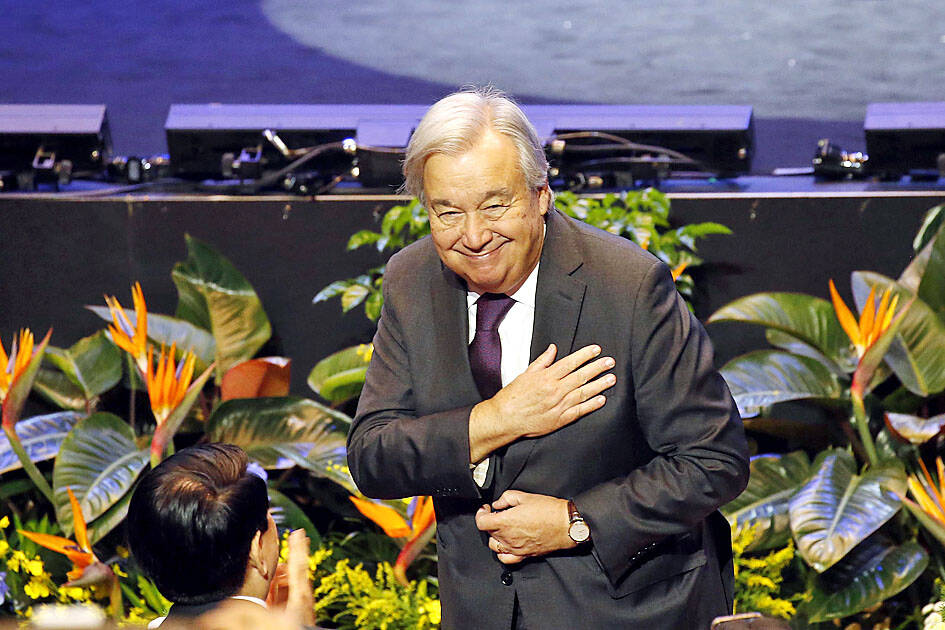
Photo: EPA
UN Secretary-General Antonio Guterres described the signing as an “important milestone,” and that it was “only the beginning.”
“Every day, sophisticated scams destroy families, steal migrants and drain billions of dollars from our economy... We need a strong, connected global response,” he said.
The UN Convention against Cybercrime was first proposed by Russian diplomats in 2017, and approved by consensus last year after lengthy negotiations.
Critics said its broad language could lead to abuses of power and enable the cross-border repression of government critics.
“There were multiple concerns raised throughout the negotiation of the treaty around how it actually ends up compelling companies to share data,” Tech Global Institute founder Sabhanaz Rashid Diya said. “It’s almost rubber-stamping a very problematic practice that has been used against journalists and in authoritarian countries.”
The Vietnamese government said that 60 countries were registered for the official signing, without disclosing which ones, but the list would probably not be limited to Russia, China and their allies.
“Cybercrime is a real issue across the world,” Diya said. “I think everybody’s kind of grappling with it.”
SCAM INDUSTRY
For example, the online scam industry has ballooned in Southeast Asia over the past few years, with thousands of scammers estimated to be involved and victims worldwide conned out of billions of dollars annually.
“Even for the most democratic states, I think they need some degree of access to data that they’re not getting under existing mechanisms,” Diya said.
Democratic countries might describe the UN convention as a “compromise document,” as it contains some human rights provisions, she said.
However, these safeguards were slammed as “weak” in a letter signed by more than a dozen rights groups and other organizations.
TECH SECTOR
Big technology companies have also raised concerns.
The Cybersecurity Tech Accord delegation to the treaty talks, representing more than 160 firms, including Meta, Dell and India’s Infosys, would not be present in Hanoi, its head Nick Ashton-Hart said.
Those companies previously warned that the convention could criminalize cybersecurity researchers and “allows states to cooperate on almost any criminal act they choose,” he said.
Potential overreach by authorities poses “serious risks to corporate [information technology] IT systems relied upon by billions of people every day,” they said during the negotiation process.
In contrast, an existing international accord, the Budapest Convention on Cybercrime, includes guidance on using it in a “rights-respecting” way, Ashton-Hart said.
The location for the signing has also raised eyebrows, given Vietnam’s record of crackdowns on dissent.
“Vietnamese authorities typically use laws to censor and silence any online expression of views critical of the country’s political leadership,” Human Rights Watch Deputy Director for Technology, Rights and Investigations Deborah Brown said.
“Russia has been a driving force behind this treaty and will certainly be pleased once it’s signed,” she said. “But a significant amount of cybercrime globally comes from Russia, and it has never needed a treaty to tackle cybercrime from within its borders.”
“This treaty can’t make up Russia’s lack of political will in that regard,” she added.

SPEAKING OUT: After Siranudh Scott’s allegations surfaced, celebrities and public figures took to social media to share their own experiences of sexual misconduct and abuse A high-profile alleged sexual abuse case within a wealthy Thai beer brewing family has prompted a wave of painful accounts from survivors of unconnected abuse in the conservative nation. Siranudh Scott, a member of the billionaire Thai family that founded the ubiquitous Singha beer brand, posted an emotional video this month accusing his elder brother Sunit of repeatedly abusing him when he was a teenager. Sunit, who is in his 30s, later denied the allegations in a video posted online, but Singha parent Boonrawd dismissed him from his executive role with the company on Tuesday last week. “I felt I needed to speak

SEEKING ORDER: Rodrigo Paz said that ‘anyone who wants to destroy the nation will have to deal with this president and the full force of the constitution’ Bolivian President Rodrigo Paz on Wednesday said that the nation was at a “breaking point” after nearly a month of protests that have caused shortages of food, fuel and medicine. Paz, who took office six months ago amid the worst economic crisis there in four decades, is battling a groundswell of fury over his policies. The political capital, La Paz, has been besieged by low-income workers and members of the indigenous majority calling for his resignation. “The country needs order and is reaching breaking point,” the 58-year-old said at a public event in La Paz, renewing his appeal for dialogue. On Tuesday, the Bolivian
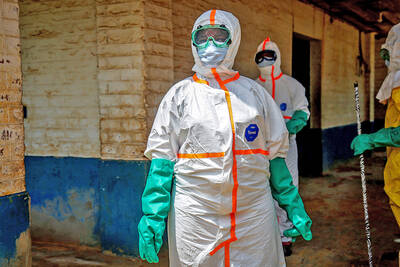
COMMUNITY CONFLICT: Concerns about disease spread from corpses has run up against friends and families’ desire to bury their dead as infection spreads in the area Angry residents of a town at the epicenter of the Ebola outbreak in the Democratic Republic of the Congo (DR Congo) attacked and burned a tent that was part of a health center where people are being treated for the virus, the staff there said Saturday. It was the second such attack in the region in a week. No one was hurt in the attack, according to reports but as patients ran out to escape the fire, 18 people with suspected Ebola infections fled the facility and are unaccounted for, a hospital director said. Angry residents arrived at the clinic in the

Forecasters in Europe yesterday warned of exceptional heat as record temperatures driven by a “heat dome” push temperatures well above seasonal norms across the continent. The surge follows a record-breaking Monday, with France logging its hottest day in the month of May on record, its weather agency said, and the UK also posting unprecedented highs. A so-called “heat dome” of warm air from northern Africa trapped under a high-pressure system over western Europe is behind the high temperatures not usually seen until high summer. Restrictions on outdoor work were imposed in parts of Italy, beaches in southwest France filled earlier than usual and


 RSS
RSS