


The hunt was on yesterday for the band of thieves who stole eight priceless royal pieces of jewelry from the Louvre Museum in the heart of Paris in broad daylight.
Officials said a team of 60 investigators was working on the theory that the raid was planned and executed by an organized crime group.
The heist reignited a row over a lack of security in France’s museums, with French Minister of Justice yesterday admitting to security flaws in protecting the Louvre.
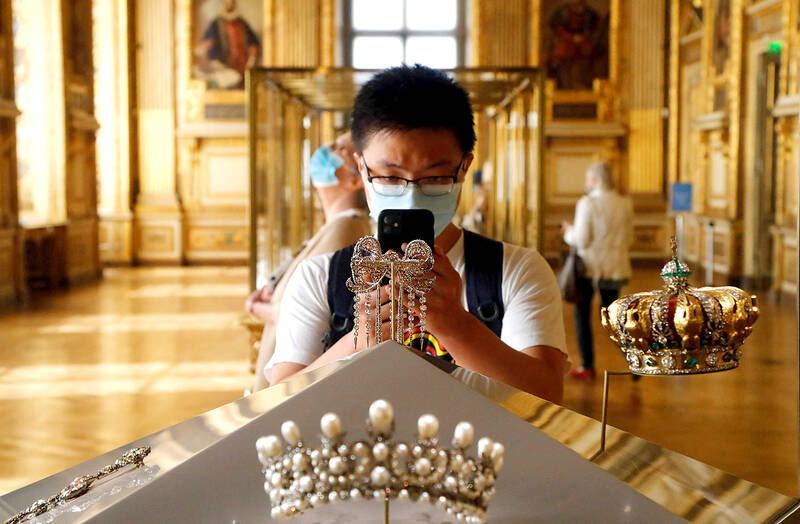
Photo: AFP
“What is certain is that we have failed, since people were able to park a furniture hoist in the middle of Paris, get people up it in several minutes to grab priceless jewels and give France a terrible image,” he told France Inter radio.
After several other robberies from French museums in recent months, French Minister of the Interior Laurent Nunez on Sunday acknowledged that securing them was a “major weak spot.”
The thieves arrived between 9:30 and 9:40am on Sunday, shortly after the museum opened to the public at 9am, a source close to the investigation said.
They used a truck with an extendable ladder like those used by movers to get access to the Apollo Gallery, home to the royal collection, and cutting equipment to get in through a window and open the display cases.
A brief clip of the raid, apparently filmed on the phone of a visitor to the museum, was broadcast on French news channels.
The masked thieves stole nine 19th-century items of jewelry, one of which — the crown of the Empress Eugenie — they dropped and damaged as they made their escape.
It is covered in 1,354 diamonds and 56 emeralds, according to the museum’s Web site.
Eight “priceless” items of jewelry were stolen, the French Ministry of Culture said on Sunday.
The list they released included an emerald-and-diamond necklace that Napoleon gave his wife Empress Marie-Louise.
Also stolen was a diadem that once belonged to the Empress Eugenie, which is dotted with nearly 2,000 diamonds, and a necklace that once belonged to Marie-Amelie, the last queen of France. It has eight sapphires and 631 diamonds, the Louvre Web site says.
The whole raid took just seven minutes and is thought to have been carried out by an experienced team, possibly “foreigners,” Nunez said.
The intervention of the museum’s staff forced the thieves to flee, leaving behind some of the equipment used in the raid, the culture ministry said.
The loot would be impossible to sell on in its current state, said Alexandre Giquello, president of the auctioneer house Drouot.
It was the first theft from the Louvre since 1998, when a painting by Camille Corot was stolen and never seen again.
Sunday’s raid relaunched a debate over what critics says is poor security at the nation’s museums, far less secure than banks and increasingly targeted by thieves.
Last month, criminals broke into Paris’s Natural History Museum, making off with gold samples worth US$700,000.
The same month, thieves stole two dishes and a vase from a museum in the central city of Limoges, the losses estimated at US$7.6 million.
Sunday’s robbery sparked angry political reactions.
“How far will the disintegration of the state go?” National Rally party leader Jordan Bardella said on social media, calling the theft “an unbearable humiliation for our country.”
French President Emmanuel Macron said on social media that “everything” was being done to catch the perpetrators and recover the stolen treasures.

An American scientist convicted of lying to US authorities about payments from China while he was at Harvard University has rebuilt his research lab in Shenzhen, China, to pursue technology the Chinese government has identified as a national priority: embedding electronics into the human brain. Charles Lieber, 67, is among the world’s leading researchers in brain-computer interfaces. The technology has shown promise in treating conditions such as amyotrophic lateral sclerosis and restoring movement in paralyzed people. It also has potential military applications: Scientists at the Chinese People’s Liberation Army have investigated brain interfaces as a way to engineer super soldiers by boosting
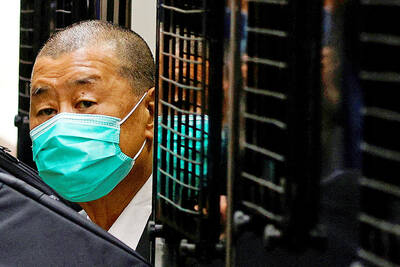
Jailed media entrepreneur Jimmy Lai (黎智英) has been awarded Deutsche Welle’s (DW) freedom of speech award for his contribution to Hong Kong’s pro-democracy movement. The German public broadcaster on Thursday said Lai would be presented in absentia with the 12th iteration of the award on June 23 at the DW Global Media Forum in Bonn. Deutsche Welle director-general Barbara Massing praised the 78-year-old founder of the now-shuttered news outlet Apple Daily for standing “unwaveringly for press freedom in Hong Kong at great personal risk.” “With Apple Daily, he gave journalists a platform for free reporting and a voice to the democracy movement in
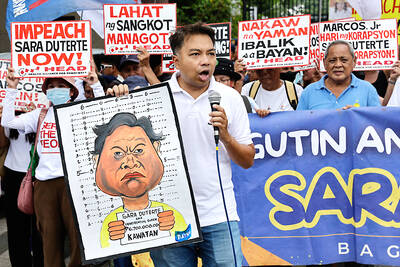
PHILIPPINE COMMITTEE: The head of the committee that made the decision said: ‘If there is nothing to hide, there is no reason to hide, there is no reason to obstruct’ A Philippine congressional committee on Wednesday ruled that there was “probable cause” to impeach Philippine Vice President Sara Duterte after hearing allegations of unexplained wealth, misuse of state funds and threats to have the president assassinated. The unanimous decision of the 53-member committee in the Philippine House of Representatives sends the two impeachment complaints to deliberations and voting by the entire lower chamber, which has more than 300 lawmakers. The complaints centered on Duterte’s alleged illegal use and mishandling of intelligence funds from the vice president’s office, and from her time as education secretary under Philippine President Ferdinand Marcos Jr. Duterte and the

Burmese President Min Aung Hlaing yesterday cut all prisoners’ sentences by one-sixth, a blanket measure that a source close to deposed leader Aung San Suu Kyi said would further shorten her detention. Aung San Suu Kyi has been sequestered since a 2021 military coup, but the senior member of her dissolved National League for Democracy (NLD) party said that while her term had been reduced, her remaining sentence is still unclear. “We also don’t know exactly how many years she has left,” the source told reporters, speaking on condition of anonymity for security reasons. The military toppled Aung San Suu Kyi’s elected government


 RSS
RSS