


The Executive Yuan yesterday announced that registration for a one-time universal NT$10,000 cash handout to help people in Taiwan survive US tariffs and inflation would start on Nov. 5, with payouts available as early as Nov. 12.
Who is eligible for the handout?
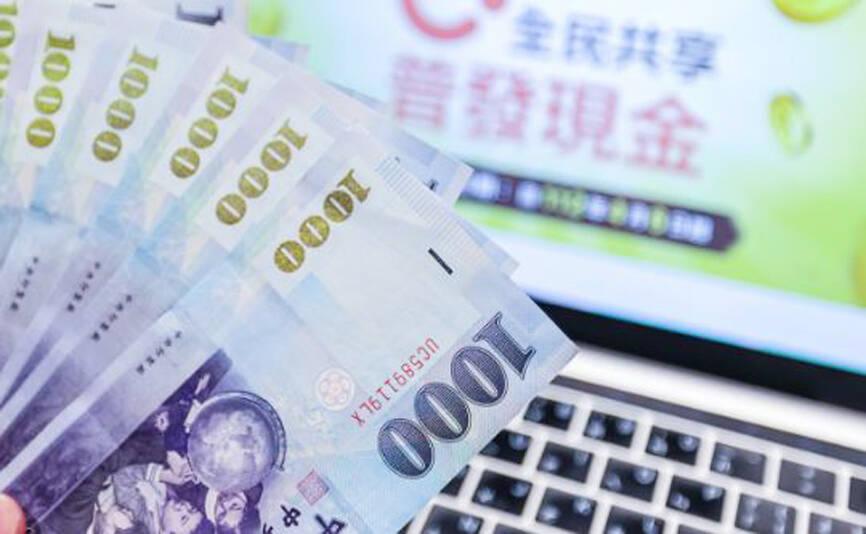
Photo: CNA
Registered Taiwanese nationals are eligible, including those born in Taiwan before April 30 next year with a birth certificate.
Non-registered nationals with residence permits, foreign permanent residents and foreign spouses of Taiwanese citizens with residence permits also qualify for the handouts.
For people who meet the eligibility requirements, but passed away between yesterday and April 30 next year, surviving family members may collect the payment on their behalf at a post office.
How to collect the handout?
From 8am on Nov. 5, online registration for the cash handout would be conducted on a dedicated Web site in stages based on the last digit of the applicant's national ID number or Alien Resident Certificate (ARC) number.
The payment would be deposited into the applicant's bank account once available.
Those whose numbers end in 0 or 1 can register on Nov. 5, followed by 2 or 3 on Nov. 6, 4 or 5 on Nov. 7, 6 or 7 on Nov. 8, and 8 or 9 on Nov. 9.
From Nov. 10 to April 30 next year, registration would be open on the Web site regardless of the ID card's last digit, with the option to modify and verify information available starting on Nov. 13.
Registrants must enter the recipient's National Health Insurance (NHI) card number, a national ID number or residence permit number, and a bank account number.
For children aged 12 and under, a parent or legal guardian may register on their behalf using their own ID number and bank account, together with the child's NHI card number.
People can also withdraw cash at ATMs identified with the "universal cash handout" sticker, using an ATM card, a national ID or ARC number, and an NHI card number.
In addition, people can pick up the payment at a post office for themselves or on others' behalf by showing an NHI card, a national ID or a residence certificate.
Those withdrawing for others at a post office would also have to show an NHI card, a national ID, a residence certificate or a household registration of those they are collecting for.
For those covered by government-run pension or social welfare allowance programs, the payment would be automatically deposited into their bank account.
Additionally, residents in three "remote areas" can register at local police stations from today to Tuesday next week, including Hualien County's Wanrong Township (萬榮), Taitung County's Jinfong Township (金峰) and Pingtung County's Shihzih Township (獅子).
When will the payouts be available?
Deposits for registered accounts and automatic deposits are to become available starting on Nov. 12.
ATM cash withdrawals would be available from Nov. 17.
Post office cash withdrawals would start on Nov. 24.
The deadline to receive the payment for those methods is April 30 next year, while parents of babies born in April next year have until May 22 to collect the cash at a post office, considering the time needed to prepare the a birth certificate.
Distributions in the specified remote areas would run from Nov. 12 to 25 at local police stations.
For more information, visit this government's cash handout Web site.
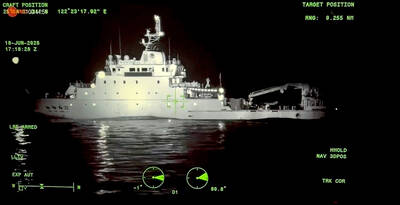
EXCUSES: Beijing is using government and research vessels as a pretext to harass the nation and enter its EEZ, and engage in ‘hegemonic expansion,’ the coast guard said The Coast Guard Administration yesterday said it drove away Chinese oceanographic research vessel Xiang Yang Hong 22 (向陽紅33) from restricted waters after warning it that it was in Taiwan’s exclusive economic zone (EEZ). The Chinese vessel entered restricted waters off the coast of Yilan County’s Suao (蘇澳) at 11:35pm on Thursday, the coast guard said, adding that it dispatched the Lanyu patrol vessel and the boat PP-10077 to shadow the Chinese ship and issue radio warnings ordering it to leave. China has no sovereignty over waters off Taiwan’s east coast, Lanyu’s crew told Xiang Yang Hong 22 over the radio, and demanded

BAIT AND SWITCH: Allowing KMT-run counties to sell to China while the threat of abrupt cancelations hangs overhead is another form of coercion, officials said Beijing is using agricultural purchase offers announced during the Straits Forum to deepen Taiwan’s dependence on the Chinese market, a Taiwanese official said yesterday as they criticized the Taitung County commissioner’s participation in the initiative. During the Straits Forum held in Xiamen on Saturday, Chinese officials announced a sales and purchase agreement for agricultural products from some counties led by the Chinese Nationalist Party (KMT). Taitung County Commissioner Yao Ching-ling (饒慶鈴), who was barred from attending the event in person by the Mainland Affairs Council, participated via video. Under the agreement, China would purchase atemoyas, pomeloes, tea and grouper harvested in Taitung,

Four Taiwanese universities have been ranked among the world's top 200 institutions in the Quacquarelli Symonds (QS) World University Rankings for next year, the highest Taiwan has ever placed in the category, with National Taiwan University (NTU) achieving its best performance at 54th globally and 17th in Asia. The four Taiwanese institutions in the global top 200 are NTU (54th), National Tsing Hua University (142nd), National Yang Ming Chiao Tung University (177th) and National Cheng Kung University (191st), the rankings showed. All four universities achieved their highest-ever global rankings this year, QS data showed. National Cheng Kung University entered the top 200 for
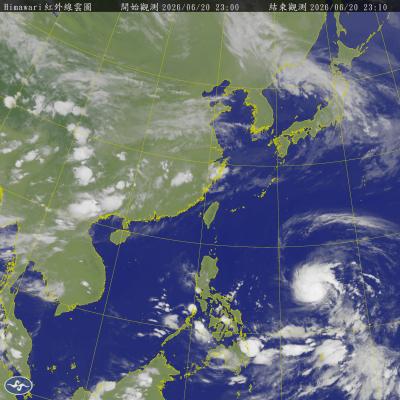
Tropical Storm Mekkhala is forecast to strengthen into a typhoon tomorrow and could come close enough to Taiwan later in the week to prompt a sea warning, the Central Weather Administration (CWA) said yesterday. As of 2 pm, the storm was located 1,870 kilometers southeast of Taiwan's southern tip and moving west- northwest at 23 km per hour. CWA forecaster Cheng Chieh-jen (鄭傑仁) said Mekkhala is expected to continue moving west-northwest through Tuesday under the influence of the Pacific high- pressure system before gradually turning north toward waters east of Taiwan or south of the Ryukyu Islands. The timing and angle of the


 RSS
RSS