


EVA Airways president Sun Chia-ming (孫嘉明) and other senior executives yesterday bowed in apology over the death of a flight attendant, saying the company has begun improving its health-reporting, review and work coordination mechanisms.
“We promise to handle this matter with the utmost responsibility to ensure safer and healthier working conditions for all EVA Air employees,” Sun said.
The flight attendant, a woman surnamed Sun (孫), died on Friday last week of undisclosed causes shortly after returning from a work assignment in Milan, Italy, the airline said.
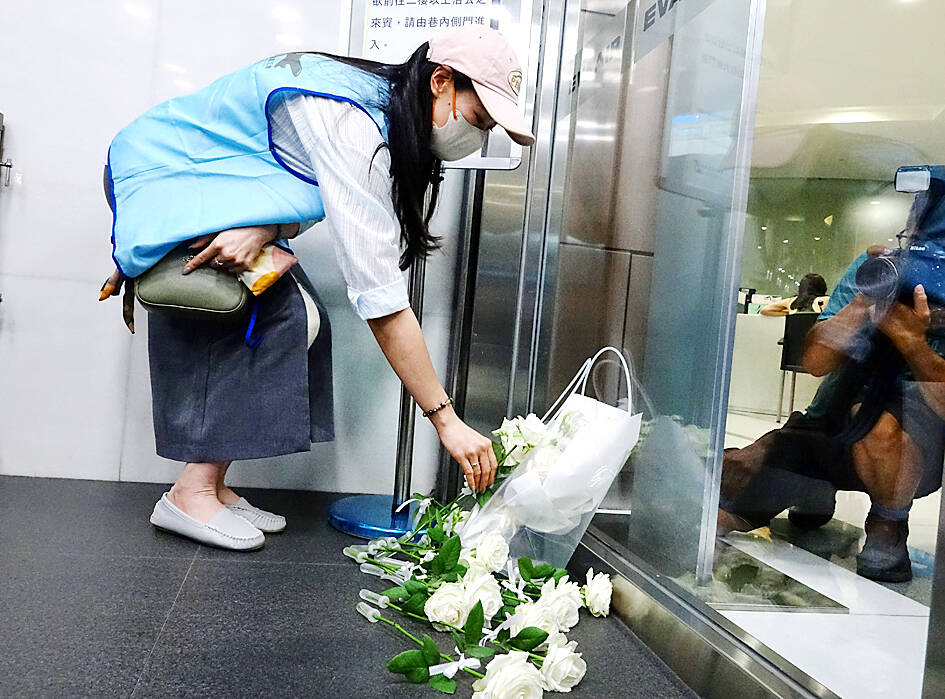
Photo: Tien Yu-hua, Taipei Times
Chinese-language media reported that the woman fell ill working on a Taipei-to-Milan flight on Sept. 22 and the cabin crew supervisor allegedly ignored her complaints.
Two days later, she worked on the return flight amid deteriorating health and was hospitalized shortly after the plane arrived at Taiwan Taoyuan International Airport on Sept. 25.
She was later transferred to Linkou Chang Gung Memorial Hospital, where she died following several weeks of treatment.
At a news conference, Sun expressed condolences to the flight attendant’s family and apologized for the incident’s impact on them and on the public.
EVA Air “humbly accepts the voices of criticism and correction from society,” he said, adding that the airline is taking steps to compensate the woman’s family, investigating the incident and identifying procedural failings.
The death of the flight attendant was a painful reminder that the airline must review its internal procedures concerning employee health, personnel management and communication mechanisms, Sun said.
The company’s policy on employee health would be reconstructed from scratch to conform to the highest possible standards, he said.
Executive vice president Hsiao Chin-lung (蕭錦隆) said the company expects to conclude its internal investigation within a week, as many of the deceased woman’s colleagues are on international duty.
EVA Air would improve procedures for monitoring employee health before and during flights, including the establishment of a self-reporting system for employees to declare medical concerns, he said.
The airline also plans to revise its protocols to ensure that staff who report feeling unwell are properly heard, and to implement standard operating procedures for handling in-flight medical incidents involving crew members, he added.
Training for supervisors would be improved to address the flaws in decisionmaking and communication that appeared to have played a role in the incident, Hsiao said.
Performance evaluation criteria would also be revised to ensure that employees can take necessary medical or self-care leave without fear of negative career repercussions, he said.
Junior vice president Yang Hsiu-hui (楊秀慧) said the current “priced assignment” system was intended to reward high-performing employees rather than penalize those who need to rest.
Additional reporting by CNA

NATIONAL SECURITY: Authorities are working to confirm the identities of the military personnel involved and investigating possible illegal conduct and regulatory violations Authorities are probing possible national security implications after Kinmen police and immigration officers on Sunday found a Chinese woman allegedly posing as a tourist while engaging in prostitution involving more than 10 military personnel. The woman, surnamed Chen (陳), has since been deported, authorities said, adding that investigators are still working to confirm the identities of those implicated, as the records only listed code names and aliases. The case stemmed from a report received by the Kinmen District Prosecutors’ Office on Friday last week from the Jinhu Precinct of the Kinmen County Police Bureau. On Sunday, police, along with the National Immigration
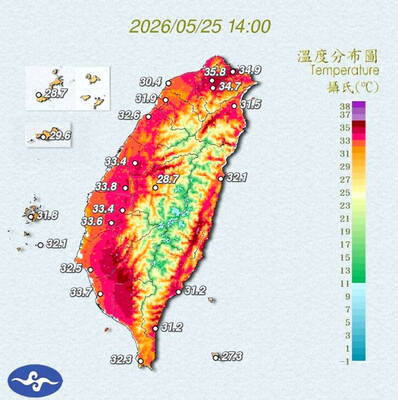
STAY COOL: The HPA recommended that people stay hydrated, use air-conditioning or fans while indoors, wear loose-fitting clothes and walk in the shade while outdoors Employers must implement measures such as installing cooling equipment, and providing drinking water and rest breaks for outdoor workers starting from Monday next week, the Taipei Department of Labor said on Sunday. Employers who fail to comply could face fines of NT$30,000 to NT$300,000 under the Occupational Safety and Health Act (職業安全衛生法), the department said. Businesses in Taipei employing fewer than 100 workers, as well as registered self-employed workers with labor insurance coverage, could receive on-site assessments and guidance from occupational safety consultants to help them apply for central government subsidies to implement or improve heat-protection measures, it said. Under the Ministry of

GLOBALGIVING: ‘ Caving to external pressure is not acceptable for an organization that has cultivated justice reform and human rights for 30 years,’ one NGO said A slew of non-government organizations (NGOs) have withdrawn from the GlobalGiving fundraising platform after it announced it would use “Chinese Taipei” instead of “Taiwan” from next month. The Taiwan Good Rice Association wrote on Facebook on Friday that it was informed on April 28 via a teleconference call of the change, which was made because the platform wanted to operate in China. Taiwan Good Rice is to terminate all cooperative relationships with GlobalGiving in response to the platform’s “unilateral and non-negotiable” decision to remove references to Taiwan, the NGO said. “Taiwan is in the official name of Taiwan Good Rice Association and the

Chinese Nationalist Party (KMT) Chairwoman Cheng Li-wun (鄭麗文) yesterday briefed her party’s Central Standing Committee regarding her scheduled visit to the US between Monday next week and June 16, saying that her purpose would be to persuade the US that the Republic of China (ROC) Constitution was a “one China” constitution that would foster stable and peaceful cross-strait relations. The ROC Constitution is the most important defense for all Taiwanese citizens, as it upholds our democracy and has contributed to our robust economy, which aligns with international and US interests, she said. “We would not be troublemakers and drag the US under,”


 RSS
RSS