


A drunk woman was sexually assaulted inside a crowded concourse of Taipei Railway Station on Thursday last week before a foreign tourist notified police, leading to calls for better education on bystander intervention and review of security infrastructure.
The man, surnamed Chiu (邱), was taken into custody on charges of sexual assault, taking advantage of the woman’s condition and public indecency.
Police discovered that Chiu was a fugitive with prior convictions for vehicle theft.
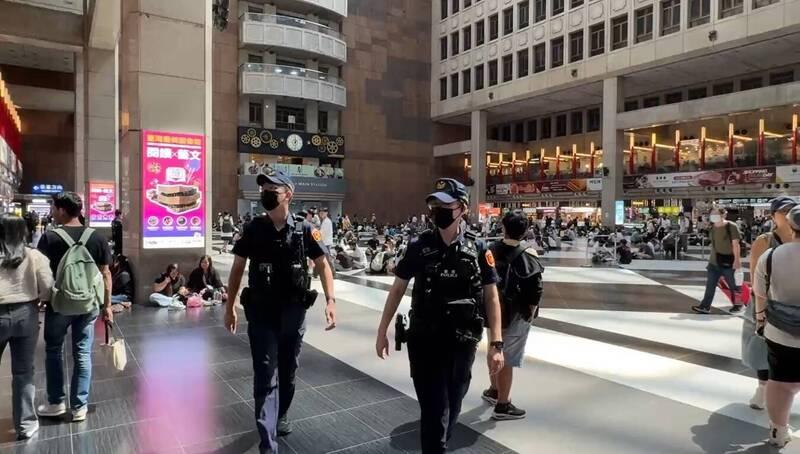
Photo: Wang Kuan-jen, Taipei Times
He has been taken into custody and is to complete his unserved six-month sentence, police said.
On Thursday last week, Chiu was seen wearing a white shirt, looking disheveled and pacing around outside the station, when he discovered the drunk woman lying on the floor inside the main concourse.
Despite passengers rushing through the station during the middle of the day, he took the woman by the hand and dragged her to a quiet corner at about 4pm, where he assaulted her against the wall for 10 minutes in public view.
The man only stopped when spotted by a foreign tourist, who called the police.
Chiu fled the scene before police arrived, although they quickly tracked his whereabouts and arrested him.
The case has been transferred to the Taipei District Prosecutors’ Office for investigation.
Chiu was wanted by the Taoyuan Police Department after he stole a small truck that had been left with the key in the ignition.
He drove the truck to New Taipei City, where he also stole an electric scooter that he transported on the back of the stolen vehicle.
He failed to report to serve his six-month sentence and did not pay the court-imposed fines.
The Taoyuan District Prosecutors’ Office then issued a warrant for his arrest.
The incident has sparked public outrage, with many questioning how the man was able to commit the crime in the middle of the day in a busy concourse.
A police officer familiar with Taipei Railway Station said that the area is often filled with people seeking shelter, and it is not unusual to see drunk people beside the station’s main entrances or sleeping on the floor.
As Chiu reportedly looked disheveled and the woman was drunk, many passengers likely thought the two were homeless and knew each other, and therefore did not take notice or report the incident, they said.
Taipei Railway Station is regularly patrolled by police, but was particularly busy that day and that particular area was left unchecked, the Railway Police Bureau said.
Following the incident, police have increased patrols around the station to ensure public safety, it added.
In a joint statement, the Taipei Women’s Rescue Foundation and Judicial Reform Foundation called on the Taipei City Government to review monitoring and emergency response mechanisms in public spaces such as train stations, including installing emergency call buttons and clearly marking methods for reporting incidents.
The groups further urged the public not to share videos of the incident and for the media to refrain from using CCTV images to prevent secondary harm to the victim and inciting victim-blaming rhetoric.
Following incidents of sexual assault, the perpetrator, not the victim, should take the blame, they said.
Public comments on news reports and social media posts showed victim-blaming and circulation of sensitive images, perpetuating a culture that enables and sensationalizes gender-based violence, they said.
They called on social media companies to monitor the situation and remove harmful comments.
They also called on the government to educate the public on the importance of bystander intervention, such as shouting to draw attention, notifying on-site personnel and calling the police.
Additional reporting by CNA


UPGRADE: The Kang Ding-class frigate is replacing its Chaparall missiles with Tien Chien II and Hua Yang VLS, which would provide it with long-range, 360° air defense Taiwan plans to produce 1,200 to 1,376 Hai Chien II missiles (海劍二, Sea Sword II) — also known as TC-2N — to serve as the standard air defense system of the navy’s surface combatant fleet, a source said yesterday. Last week, the Hai Chien II, the naval version of the Tien Kung II missile (天劍二, Sky Sword II), completed a live-fire test in waters off the National Chungshan Institute of Science and Technology’s Jiupeng facility (九鵬) in Pingtung County’s Manjhou Township (滿州). The MIM72 Chaparral and other dated air defense missiles that currently arm Taiwanese ships have inadequate range to combat Chinese

REASONS FOR TRAVEL: An assistant professor said that proposed amendments to penalize drivers if they used drugs overseas would not deter people from traveling People who operate a motor vehicle under the influence of marijuana would have their driver’s license revoked, even if they used the substance while overseas, the Ministry of Transportation and Communications said yesterday, citing proposed amendments to the Road Traffic Management and Penalty Act (道路交通管理處罰條例). The amendments would also authorize the government to revoke the licenses of people determined to have used Category 1 or Category 2 narcotics, even if they were not operating a vehicle while under the influence of drugs, as well as ban them from taking the license test for three years, the ministry said. People aged 18 or
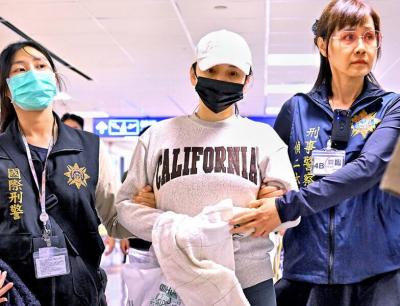
Johanne Liou (劉喬安), a Taiwanese woman who shot to unwanted fame during the Sunflower movement protests in 2014, returned to Taiwan last night after being deported from the US. She is to stand trial in Taiwan for charges involving embezzlement, fraud and drug crimes. The Criminal Investigation Bureau (CIB) said it took her into custody at Taiwan Taoyuan International Airport and would first question her before transferring her to the New Taipei District Prosecutors’ Office. She was arrested upon disembarking a flight from San Francisco that landed shortly before 7pm. Liou absconded to the US in 2019 after jumping bail
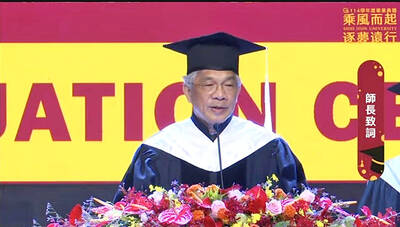
Shih Hsin University President Chen Ching-he (陳清河) yesterday issued a public apology for comments made in his commencement speech last week, stating that he has asked the school to suspend his duties and halt his wages for two months as a show of contrition. At the commencement ceremony on May 30, Chen said, “If you don’t manage your time well, or your own emotions, or your health, then I am telling every one of you — put a quick end to ‘you,’ because the world has no need for ‘you.’” The comments have sparked significant controversy online, and Chen through an open


 RSS
RSS