


President William Lai (賴清德) yesterday called for bipartisan support for Taiwan’s investment in self-defense capabilities at the christening and launch of two coast guard vessels at CSBC Corp, Taiwan’s (台灣國際造船) shipyard in Kaohsiung.
The Taipei (台北) is the fourth and final ship of the Chiayi-class offshore patrol vessels, and the Siraya (西拉雅) is the Coast Guard Administration’s (CGA) first-ever ocean patrol vessel, the government said.
The Taipei is the fourth and final ship of the Chiayi-class offshore patrol vessels with a displacement of about 4,000 tonnes, Lai said.
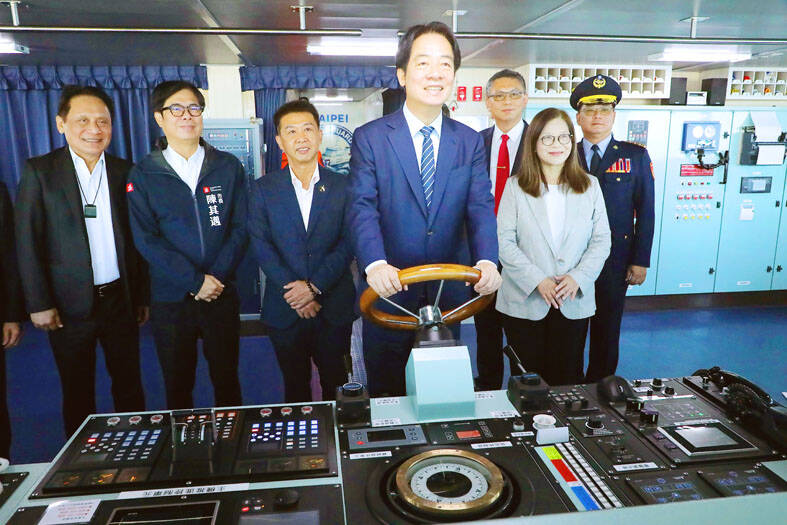
Photo courtesy of the Presidential Office
This ship class was ordered as a result of former president Tsai Ing-wen’s (蔡英文) 2018 initiative to increase the coast guard fleet to 141 ships by 2027, he added,
The Siraya came from Tsai’s 2022 initiative to build six ships capable of patrolling in high-latitude waters such as the northern Pacific over a decade, Lai said.
The northern Pacific is a crucial fishing region and issues surrounding illegal, unreported and unregulated fishing have been growing.
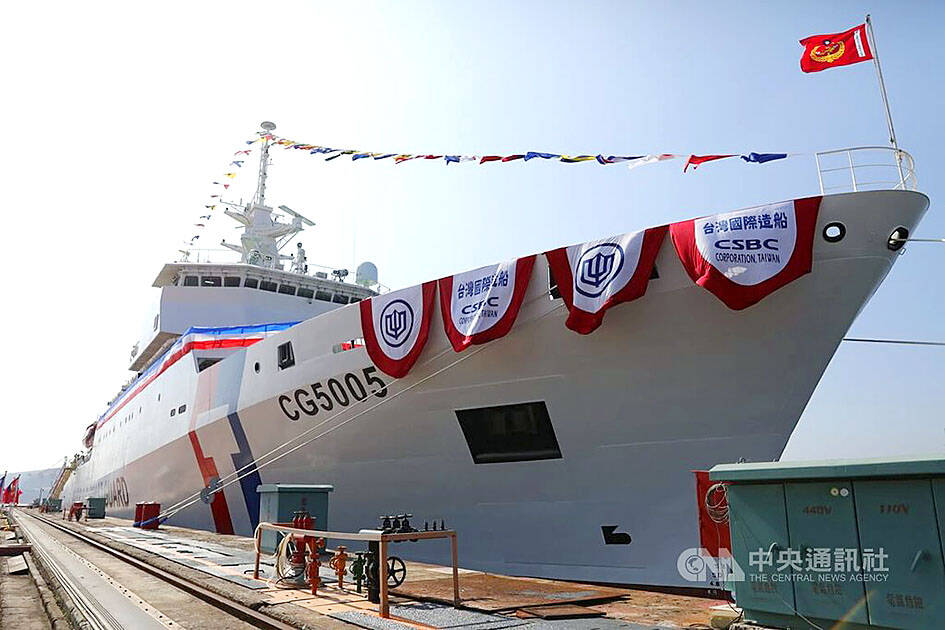
Photo: CNA
Sister ships of the Siraya would receive names honoring Taiwan’s indigenous peoples, he said.
The CGA is the first line of defense for Taiwan’s territorial waters amid increasingly challenging geopolitical conditions, Lai said, adding that the service bears the burden of simultaneously upholding maritime law and order, national security and navigational safety.
Under Tsai’s leadership, Taiwan in 2018 and 2022 initiated plans to build 141 coast guard vessels by 2027 and six ocean patrol vessels by 2032 respectively, he said.
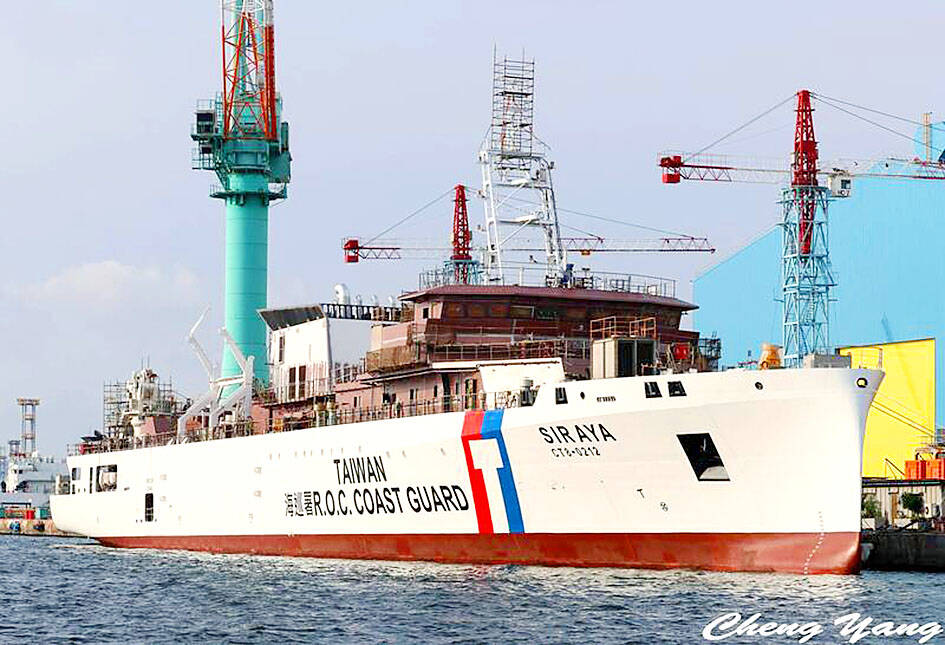
Photo courtesy of a reader via the Liberty Times
Taiwan continues to expand its homegrown defense industrial base, shipbuilding capacity and capability to project maritime law enforcement and humanitarian operations in international waters, he said.
Lai thanked CBSC and the CGA, saying their state-of-the-art ships and tireless dedication to duty have protected Taiwan’s sovereignty and safety.
The government has prepared seven bills centered on protecting undersea Internet cables, Lai said, referring to the threat posed by Chinese sabotage and storms to the nation’s telecommunications infrastructure.
Lai called on lawmakers across party lines to ensure the livelihood of Taiwanese and that national security is protected.
In a news release, the CBSC said the company has delivered all 15 100-tonne vessels, four out of six 1,000-tonne vessels, and all four 4,000-tonne vessels ordered by the coast guard.
The Taipei is expected to serve in the CGA’s Central Sector Flotilla, it said.
Chiyai-class vessels are equipped with two 20mm cannons and a 2.75-inch rocket launcher controlled by a domestically developed fire control system, as well as three water cannons with an effective range of 120m, it said.
This class of ships additionally features a sick bay equipped with negative-pressure quarantine facilities, surgical suites and a large number of beds to enable humanitarian aid and pandemic response operations, the shipbuilder said.
The vessels have an elevator-equipped helicopter hangar to enable aviation operations, it said.
Chiayi-class ships are fitted with fin stabilizers and auxiliary propulsion units mounted on the hull to increase maneuverability, stability and crew comfort during long-distance patrols, the shipbuilder said.
Ocean patrol vessel the Siraya is a 5,000-tonne ship with an all-steel hull designed for operational endurance, CSBC said, adding that the design is a developmental platform for a patrol vessel variant and a supply ship variant.
The patrol ship variant of the ship is equipped with a 20mm cannon, uncrewed aerial vehicles, three water cannon systems: one high-pressure unit and two dedicated firefighting units capable of projecting foam, the shipbuilder said.
The supply ship variant would be equipped with two multi-purpose cargo containers, a multi-purpose boat and an assault boat to conduct a variety of rescue, law enforcement and transport missions, it said.
The Taipei would take part in maritime exercises and equipment tests as part of a friendship flotilla soon to depart from Taiwan, the CGA said in a separate announcement.

A signaling system malfunction disrupted high-speed rail (HSR) services beginning at 8am today, with trains temporarily reduced to three northbound and three southbound trains per hour as authorities conduct inspections. The malfunction occurred on a section of track in Miaoli County during pre-operation checks early this morning, forcing northbound and southbound trains to use a single track, the HSR operator said. The regular schedule has been replaced with three hourly trains offering only nonreserved seating in each direction, stopping at every station, it said, adding that business class cars would still have reserved seating. Departures from terminal stations are scheduled at the top
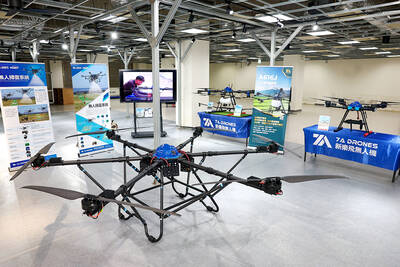
DRONE CENTRAL: Taiwan aims to become Asia’s democratic hub for drones, with most exports focused on high-quality military-grade models, an official said Taiwan’s drone industry is expected to expand significantly by 2030, producing 100,000 units per month and exporting half of them, the Ministry of Economic Affairs said yesterday. Current drone production capacity is about 15,000 units per month, but the industry can quickly scale up as demand increases, Industrial Development Administration Director-General Chiou Chyou-huey (邱求慧) told a news conference in Taipei. Taiwan’s drone output grew 2.5-fold last year to NT$12.9 billion (US$408.3 million) under a government program to develop the uncrewed vehicle sector, he said. The Executive Yuan in October last year approved plans to invest NT$44.2 billion into domestic production of uncrewed aerial
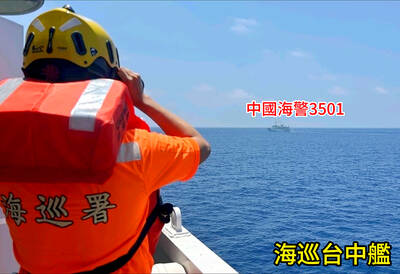
VERBOSE VESSELS: A CGA cutter and a China Coast Guard exchanged verbal barbs for more than a day in Taiwanese-controlled waters before the Chinese vessel left The Taiwanese and Chinese coast guards had a standoff near the strategically located Pratas Islands (Dongsha Islands, 東沙群島) in the north of the South China Sea, the Coast Guard Administration (CGA) said yesterday. The two sides engaged in intense radio exchanges over sovereignty claims during the 33-hour standoff. China Coast Guard vessel 3501 eventually left the restricted waters, 26.6 nautical miles (49.2km) west of the Pratas Islands, at 5pm yesterday, the CGA said. Lying approximately between southern Taiwan and Hong Kong, the Taiwan-controlled Pratas are seen by some security experts as vulnerable to Chinese attack due to their distance — more than
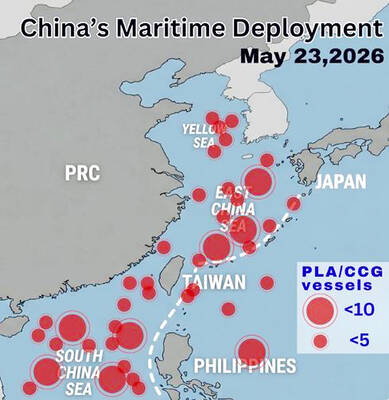
WARNING: China should stop engaging in actions that undermine regional peace and stability, as it would only build resentment among people across the Strait, the CGA said China has deployed more than 100 navy, coast guard and other vessels in waters from the Yellow Sea to the South China Sea and the western Pacific since US President Donald Trump and Chinese President Xi Jinping (習近平) met in Beijing, National Security Council Secretary-General Joseph Wu (吳釗燮) said yesterday. “In this part of the world, #China is the one & only PROBLEM wrecking the #StatusQuo & threatening regional peace & stability,” Wu wrote on X. In a separate post, he said Beijing was coercing Taiwan’s maritime domain, calling it illegal and provocative, after the Coast Guard Administration (CGA) expelled a


 RSS
RSS