


US President Donald Trump is delaying a multibillion-dollar arms sale to Taiwan to ensure his visit to Beijing is successful, a New York Times report said.
The weapons sales package has stalled in the US Department of State, the report said, citing US officials it did not identify.
The White House has told agencies not to push forward ahead of Trump’s meeting with Chinese President Xi Jinping (習近平), it said.
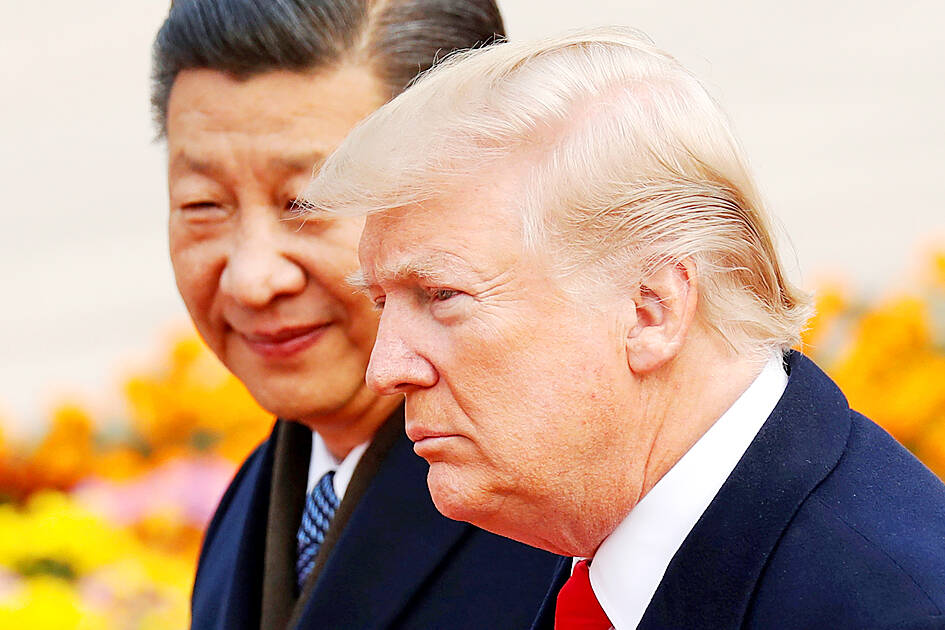
Photo: Reuters
The two last month held a phone call to discuss trade and geopolitical flashpoints ahead of the summit.
Xi raised the Taiwan issue and urged the US to handle arms sales to Taipei with the “utmost caution,” the Chinese government said after the call.
Beijing would never allow Taiwan to be “separated” from China, Xi was cited as telling Trump.
The US Department of State did not comment on the pending arms sales, but said that the US administration “has been very clear” that Washington’s commitment to Taiwan continues.
The arms package is worth about US$13 billion, larger than the US$11 billion previously announced in December last year, the New York Times said, citing one of the officials.
The Financial Times in January reported that the US is preparing a new round of arms sales to Taiwan, which has unsettled Chinese officials.
The US and Taiwan finalized a trade agreement last month, further linking the two economies. That deal cuts tariff rates, boosts market access for US products in Asia and channels billions of dollars into US energy and technology projects.
In Taipei, Democratic Progressive Party Legislator Puma Shen (沈伯洋) said that how the US conducts its diplomacy is for the US to decide.
“Taiwan’s approach is to act in its own national interest and try to secure the best possible defense systems,” he said.
Acknowledging the complexity and volatility of the international situation, Chinese Nationalist Party (KMT) caucus secretary-general Lin Pei-hsiang (林沛祥) said the KMT has always respected the US’ strategic timing and considerations in diplomacy and security.
The KMT hopes that the US would continue to honor its commitments, helping Taiwan bolster its self-defense capabilities and improve overall deterrence, he added.
Additional reporting by Chen Cheng-yu and Liu Wan-lin

The Tourism Administration yesterday announced that it would reward repeat international visitors with incentives of up to NT$8,000 to boost inbound tourism. The incentives are available to all international tourists, it said, adding that repeat visitors would be rewarded with NT$5,000 and would receive an additional NT$3,000 if they bring travel companions. The nation received 2,990,657 inbound visitors during the first quarter, marking a 3.8 percent increase from the same period last year, agency data showed. Japanese nationals are among groups visiting Taiwan the most. About 1.48 million Japanese tourists arrived last year, a year-on-year increase of more than 12
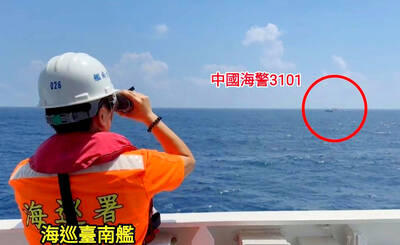
‘BRAZEN’: The holiday did not stop China from activities that infringe on Taiwan’s maritime jurisdiction, but the CGA is ready to defend the nation, Kuan Bi-ling said Beijing is intensifying maritime pressure on Taiwan, but the nation will never yield, Ocean Affairs Council Deputy Minister Sung Chen-en (宋承恩) said. The Coast Guard Administration (CGA) has adopted a “shadowing and monitoring” approach to avoid falling into a Chinese trap to escalate tensions and deepen the conflict, Sung said in an interview published yesterday in the Chinese-language Liberty Times (the Taipei Times’ sister newspaper). China Coast Guard formations patrolling waters east of Taiwan, as well as official Chinese vessels entering areas around Itu Aba Island (Taiping Island, 太平島) and Pratas Islands (Dongsha Islands, 東沙群島) show Beijing’s attempts to significantly step up
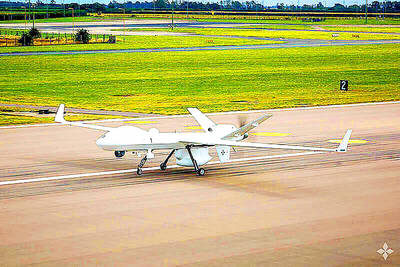
BOOST: By operating the same advanced systems as the US military, Taiwan would be better positioned to share and integrate intelligence with partners, an expert said The first batch of MQ-9B SkyGuardian drones has arrived in Taiwan, and is being assembled and tested by drone manufacturer General Atomics and the military ahead of flight trials as part of the air force’s acquisition to bolster its aerial surveillance capabilities, a source said yesterday. The air force allocated a budget of NT$21.7 billion (US$687 million) from 2022 to 2029 to procure four MQ-9B uncrewed aerial vehicles (UAVs) manufactured by General Atomics along with associated equipment such as ground control stations. The US has agreed to deliver the four MQ-9Bs to Taiwan in two batches this year and next
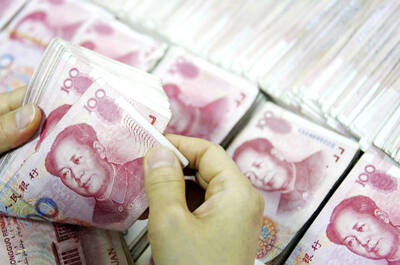
Taiwanese firms’ China investments have dwindled to less than 1 percent of their total foreign investments, putting China-based investments on track for a record low this year, Ministry of Economic Affairs data showed. Taiwan’s investments abroad in the first five months of this year reached US$35.92 billion, Department of Investment Review data showed. Investments outside China totaled US$35.61 billion, up 133.94 percent year-on-year, while investments in China totaled US$310.3 million, down 32.3 percent and about 0.86 percent of the total, data showed. Major overseas projects included Taiwan Semiconductor Manufacturing Co’s (TSMC, 台積電) US$30 billion capital injection into an overseas subsidiary,


 RSS
RSS