


The government is to allow the hospitality industry to recruit mid-level migrant workers for housekeeping and three other lines of work after the Executive Yuan yesterday approved a proposal by the Ministry of Labor.
A shortage of workers at hotels and accommodation facilities was discussed at a meeting of the legislature’s Transportation Committee.
A 2023 survey conducted by the Tourism Administration found that Taiwan’s lodging industry was short of about 6,600 housekeeping and cleaning workers, the agency said in a report to the committee.

Photo courtesy of the Workforce Development Agency
The shortage of workers in the industry is being studied, the report said.
Hotel and Lodging Division Deputy Director Cheng Yi-ping (鄭憶萍) said that hoteliers from the first quarter of next year could begin recruiting migrant workers to do housekeeping and cleaning, as well as operate the front desk, and provide food and beverage services.
However, they must adhere to a rule requiring a NT$2,000 monthly salary increase for a Taiwanese worker before hiring a migrant worker, Cheng told reporters on the sidelines of the committee meeting.
The number of migrant workers that a hotel would be permitted to hire would be capped at 10 percent of its employees covered by the Labor Insurance program, she said.
Migrant workers in the hospitality industry are most likely to be recruited from the Philippines, Cheng said, adding that they must be able to communicate in basic Mandarin and should be paid at least NT$32,000 per month.
Qualifications for migrant workers would be finalized through further negotiations between the Tourism Administration and the Ministry of Labor, she added.
The new policy drew mixed reactions from lawmakers.
Chinese Nationalist Party (KMT) Legislator Hung Meng-kai (洪孟楷) asked whether lower personnel costs would lead to a decrease in hotel room prices.
Taiwan’s People Party Legislator Lin Kuo-cheng (林國成) said that the “one-to-one” ratio requiring wage hikes for Taiwanese before hiring migrant workers was too great, as the construction industry is required to hire five Taiwanese before they can hire a foreign worker.
From April 2023 to September last year — prior to the proposal — hotels that hired Taiwanese for housekeeping and cleaning duties received subsidies, the Tourism Administration said.
The agency also worked with the Ministry of Education to allow international students who graduated from colleges and universities in Taiwan to work in the hospitality industry, the agency added.
Those initiatives helped recruit 3,964 people for the industry, it added.
Separately, the Tourism Administration faced criticism from lawmakers over a widening gap between inbound and outbound tourists.
As of September, the nation had welcomed 6.05 million international visitors, while 14.10 million Taiwanese traveled overseas during the period, or a difference of 8.05 million.
The Tourism Administration initially set a goal of attracting 12 million international tourists after COVID-19 pandemic restrictions were lifted in 2023.
It lowered the target to 9 million for this year.
Lin said that Taiwan does not give international tourists a compelling reason to visit, adding that some hoteliers take advantage of tourists by increasing room prices when there are concerts or other events.
Democratic Progressive Party Legislator Lee Kun-tse (李昆澤) said that National Immigration Agency data showed that about 8.3 million to 8.4 million international tourists would arrive this year, short of the agency’s revised goal.
“Many of the tourist attractions in Taiwan look similar. There needs to be a better integration of tourism and transportation information, so more tourists would not limit their travel to Taipei, Keelung and Taoyuan,” Lee said.
“The quality of popular scenic spots are affected when they are inundated with tourists, while less-well-known tourist attractions are not promoted as much and receive fewer resources,” he said.
“A shortage of workers is another issue,” he added.
Tourism Administration Director-General Chen Yu-hsiu (陳玉秀) said that outbound travel does not hurt domestic tourism and boosts national revenue.
From January to July, there was a 10 percent increase in visitors to Taiwan compared with the same period last year, with arrivals from China up 62 percent, Chen said.
Tourists from Japan, the US and Canada, and the Philippines were up 12 percent, 10 percent and 35 percent respectively, she said.
Domestic travel so far this year has surpassed last year’s levels, although it faces three main challenges, the Tourism Administration said.
Most trips are day trips due to convenient transportation and high accommodation costs, while demand is too low on weekdays and too high on weekends, it said.
The agency plans to introduce measures next year to address those issues, it added.
The hospitality industry needs to narrow the price gap between weekdays and weekends, Chen said, adding that favorable exchange rates are another factor driving Taiwanese to travel abroad.

SILENCING CRITICS: In addition to blocking Taiwan, China aimed to prevent rights activists from speaking out against authoritarian states, a Cabinet department said The Ministry of Foreign Affairs (MOFA) yesterday condemned transnational repression by Beijing after RightsCon, a major digital human rights conference scheduled to be held in Zambia this week, was abruptly canceled due to Chinese pressure over Taiwanese participation. This year’s RightsCon, the world’s largest conference discussing issues “at the intersection of human rights and technology,” was scheduled to take place from tomorrow to Friday in Lusaka, and expected to draw 2,600 in-person attendees from 150 countries, along with 1,100 online participants. However, organizers were forced to cancel the event due to behind-the-scenes pressure from China, the ministry said, expressing its “strongest condemnation”
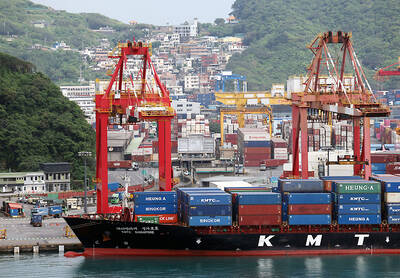
Taiwan’s economy grew far faster than expected in the first quarter, as booming demand for artificial intelligence (AI) applications drove a surge in exports, spilling over into investment and consumption, the Directorate-General of Budget, Accounting and Statistics (DGBAS) said yesterday. GDP growth was 13.69 percent year-on-year during the January-to-March period, beating the DGBAS’ February forecast by 2.23 percentage points and marking the most robust growth in nearly four decades, DGBAS senior official Chiang Hsin-yi (江心怡) told a news conference in Taipei. The result was powered by exports, which remain the backbone of Taiwan’s economy, Chiang said. Outbound shipments jumped 51.12 percent year-on-year to
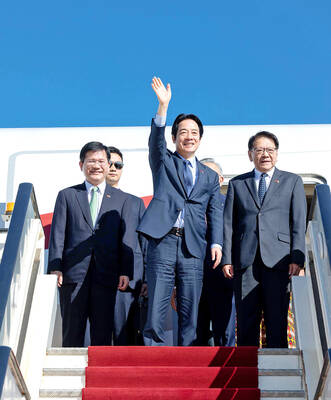
DELAYED BUT DETERMINED: The president’s visit highlights Taiwan’s right to international engagement amid regional pressure from China President Willaim Lai (賴清德) yesterday arrived in Eswatini, more than a week after his planned visit to Taiwan’s sole African ally was suspended because of revoked overflight permits. “The visit, originally scheduled for April 22, was postponed due to unforeseen external factors,” Lai wrote on social media. “After several days of careful arrangements by our diplomatic and national security teams, we successfully arrived today.” Lai said he looked forward to further deepening Taiwan-Eswatini relations through closer cooperation in the economy, agriculture, culture and education, as well as advancing the nation’s international partnerships. The president was initially scheduled to arrive in time to celebrate
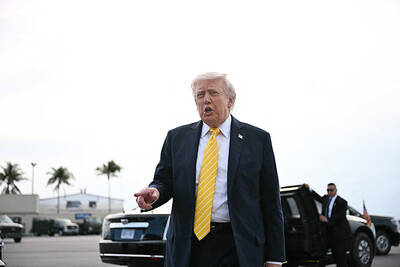
Iran’s Islamic Revolutionary Guard Corp (IRGC) yesterday said the US faced a choice between an “impossible” military operation or a “bad deal” with Tehran, after US President Donald Trump disparaged Iran’s latest peace proposal. Negotiations between the two countries have been deadlocked since a ceasefire came into effect on April 8, with only one round of direct peace talks held so far. Iran’s Tasnim and Fars news agencies reported that Tehran had submitted a 14-point proposal to mediator Pakistan, but Trump was quick to cast doubt on it. “I will soon be reviewing the plan that Iran has just sent to us, but


 RSS
RSS