


China-born media influencer Guan Guan’s (關關) residency permit has been revoked for repeatedly posting pro-China content that threatens national security, the National Immigration Agency said yesterday.
Guan Guan has said many controversial things in her videos posted to Douyin (抖音), including “the red flag will soon be painted all over Taiwan” and “Taiwan is an inseparable part of China,” while expressing hope for expedited “reunification.”
The agency received multiple reports alleging that Guan Guan had advocated for armed reunification last year.

Photo: screen grab from Guan Guan’s Douyin page
After investigating, the agency last month issued a notice requiring her to appear and account for her actions.
Guan Guan appeared as required, but the agency determined she threatened national security and social stability, it said.
The agency revoked her residency permit in accordance with Article 14 of the Measures for the Permission of Family-based Residence, Long-term Residence and Settlement of People from the Mainland Area in the Taiwan Area (大陸地區人民在台灣地區依親居留長期居留或定居許可辦法), it said.
Guan Guan reportedly left Taiwan on Friday last week.
Sources said that Guan Guan came from Guangdong and married a Taiwanese man, but they have since divorced. To avoid a government investigation, she last year removed controversial videos from Douyin and changed her Internet handle to “Little Chili Pepper” to avoid attention, sources said, adding that social media users discerned that she was the same person.
Under the name “Little Chili Pepper,” Guan Guan continued to post pro-China, anti-Taiwan content.
After her residency was revoked, she filmed a video angrily accusing Minister of the Interior Liu Shyh-fang (劉世芳) and High Prosecutors’ Office prosecutor Chen Shu-yi (陳舒怡) of being Taiwan independence supporters, alluding to an announcement by China’s Taiwan Affairs Office earlier this month that it had designated Liu, Chen and Minister of Education Cheng Ying-yao (鄭英耀) as “diehard Taiwan independence advocates.”
Guan Guan said in the video: “When Taiwan is liberated, I will reunite with my daughter and let her know she is a proud Chinese.”
An official speaking anonymously said yesterday that supporting the use of force to invade Taiwan, advocating for the destruction of the Republic of China (ROC) or making statements that undermine the sovereignty of the nation are all unacceptable, adding that these actions go against the original purpose of coming to Taiwan.
“You were allowed to come and live here, so how can you turn around and harm the people here?” the official asked.
The official said that the comments Guan Guan made have gone beyond the threshold of free speech, as she advocated for the destruction of the ROC.
Since she does not recognize this land, and is unwilling to live peacefully and prosperously with Taiwanese, her residency permit was revoked and she was “sent back to China,” the official said.
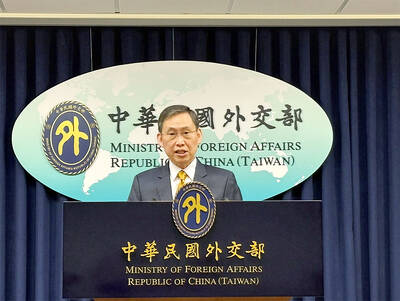
A Ministry of Foreign Affairs official yesterday said that a delegation that visited China for an APEC meeting did not receive any kind of treatment that downgraded Taiwan’s sovereignty. Department of International Organizations Director-General Jonathan Sun (孫儉元) said that he and a group of ministry officials visited Shenzhen, China, to attend the APEC Informal Senior Officials’ Meeting last month. The trip went “smoothly and safely” for all Taiwanese delegates, as the Chinese side arranged the trip in accordance with long-standing practices, Sun said at the ministry’s weekly briefing. The Taiwanese group did not encounter any political suppression, he said. Sun made the remarks when
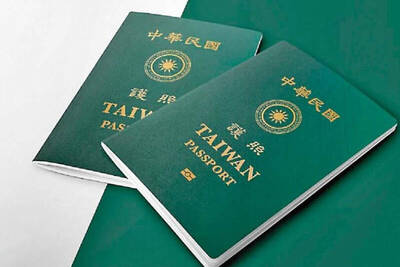
The Taiwanese passport ranked 33rd in a global listing of passports by convenience this month, rising three places from last month’s ranking, but matching its position in January last year. The Henley Passport Index, an international ranking of passports by the number of designations its holder can travel to without a visa, showed that the Taiwan passport enables holders to travel to 139 countries and territories without a visa. Singapore’s passport was ranked the most powerful with visa-free access to 192 destinations out of 227, according to the index published on Tuesday by UK-based migration investment consultancy firm Henley and Partners. Japan’s and

BROAD AGREEMENT: The two are nearing a trade deal to reduce Taiwan’s tariff to 15% and a commitment for TSMC to build five more fabs, a ‘New York Times’ report said Taiwan and the US have reached a broad consensus on a trade deal, the Executive Yuan’s Office of Trade Negotiations said yesterday, after a report said that Washington is set to reduce Taiwan’s tariff rate to 15 percent. The New York Times on Monday reported that the two nations are nearing a trade deal to reduce Taiwan’s tariff rate to 15 percent and commit Taiwan Semiconductor Manufacturing Co (TSMC, 台積電) to building at least five more facilities in the US. “The agreement, which has been under negotiation for months, is being legally scrubbed and could be announced this month,” the paper said,
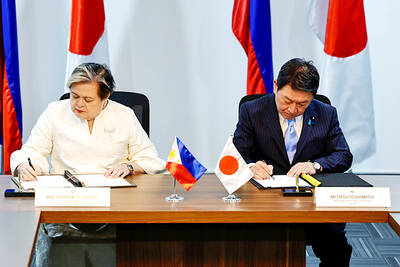
Japan and the Philippines yesterday signed a defense pact that would allow the tax-free provision of ammunition, fuel, food and other necessities when their forces stage joint training to boost deterrence against China’s growing aggression in the region and to bolster their preparation for natural disasters. Japan has faced increasing political, trade and security tensions with China, which was angered by Japanese Prime Minister Sanae Takaichi’s remark that a Chinese attack on Taiwan would be a survival-threatening situation for Japan, triggering a military response. Japan and the Philippines have also had separate territorial conflicts with Beijing in the East and South China


 RSS
RSS