


The Yilan District Court has handed four members of a syndicate prison terms ranging from one year and two months to two years and two months for their involvement in a scheme to purchase Taiwanese passports and resell them abroad at a massive markup.
A Chinese human smuggling syndicate purchased Taiwanese passports through local criminal networks, exploiting the passports’ visa-free travel privileges to turn a profit of more than 20 times the original price, the court said.
Such criminal organizations enable people to impersonate Taiwanese when entering and exiting Taiwan and other countries, undermining social order and the credibility of the nation’s travel documents, and posing a significant threat to border security, the presiding judge said.
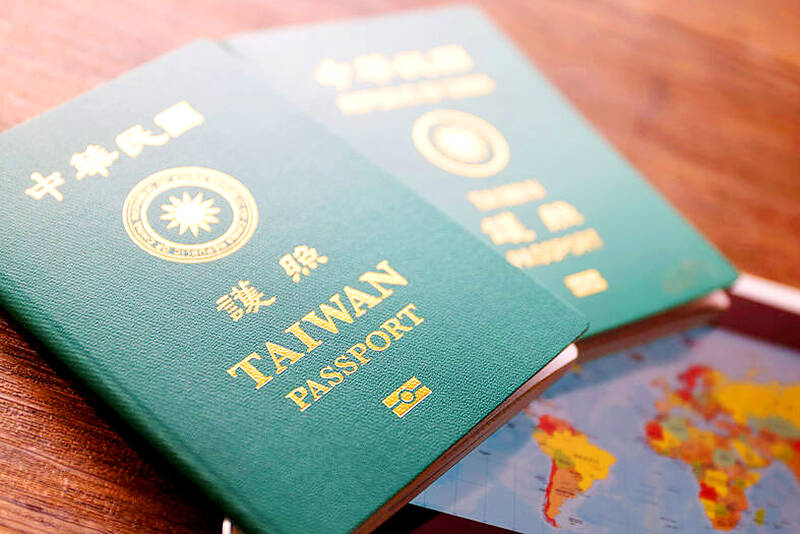
Photo: CNA
It could facilitate illegal activities by international human smuggling rings or terrorist organizations, the judge said.
Investigators believe that gangs exploit the visa-free access Taiwanese passports provide to 139 countries and territories, selling them at premium prices to clients who treat the documents as “invisibility cloaks” for unrestricted international travel.
Cheng Tzu-chuan (鄭子娟), 47, who obtained Taiwanese citizenship through marriage, left Taiwan after divorce and remarried her former Chinese husband, Ho Tsai-lung (何財龍), in China, where the couple was recruited by a gang in China’s Fujian Province, police said.
The couple set up a passport-buying criminal organization with a Taiwanese man surnamed Lai (賴), 32, who recruited two others, surnamed Shen (沈) and Lin (林), in August 2023, police said.
Ho and another man allegedly directed the operation from abroad, instructing Cheng and her accomplices to buy passports in Yilan County for between NT$6,000 and NT$10,000 each, police said.
Ho would pay NT$17,000 per passport upon receiving them, while the human-smuggling ring resold each document to Chinese buyers for about 10,000 euros (US$11,597).
The Criminal Investigation Bureau referred the case to the Yilan District Prosecutors’ Office after receiving intelligence on the case.
The suspects were arrested in March and prosecuted in April last year, while six suspects involved in selling passports were sentenced to prison terms ranging from three to six months in July.
The Yilan District Court in its ruling said that Cheng and Lai, under the instruction of Ho and his accomplice, purchased passports in Taiwan by paying cash or using them to offset debts.
Shen and Lin bought passports from others and handed them over to Lai, earning between NT$2,000 and NT$4,000 per passport, while Cheng and Lai mailed the documents via international courier to Greece and Indonesia, the court said.
Cheng, Shen and Lin admitted to the crimes, while Lai denied recruiting others into the organization, a claim rejected by the court.
Cheng and Lai were sentenced to two years, and two years and two months respectively for participating in a criminal organization, trading passports and using passports to offset debts.
Both have appealed.
Shen was sentenced to one year and four months for trading passports.
Lin, who had no prior convictions and confessed, received a sentence of one year and two months, suspended for three years, and was ordered to pay NT$200,000.
Ho, a Chinese national, remains at large and would be tried separately, the court said.

SILENCING CRITICS: In addition to blocking Taiwan, China aimed to prevent rights activists from speaking out against authoritarian states, a Cabinet department said The Ministry of Foreign Affairs (MOFA) yesterday condemned transnational repression by Beijing after RightsCon, a major digital human rights conference scheduled to be held in Zambia this week, was abruptly canceled due to Chinese pressure over Taiwanese participation. This year’s RightsCon, the world’s largest conference discussing issues “at the intersection of human rights and technology,” was scheduled to take place from tomorrow to Friday in Lusaka, and expected to draw 2,600 in-person attendees from 150 countries, along with 1,100 online participants. However, organizers were forced to cancel the event due to behind-the-scenes pressure from China, the ministry said, expressing its “strongest condemnation”

Taiwan’s economy grew far faster than expected in the first quarter, as booming demand for artificial intelligence (AI) applications drove a surge in exports, spilling over into investment and consumption, the Directorate-General of Budget, Accounting and Statistics (DGBAS) said yesterday. GDP growth was 13.69 percent year-on-year during the January-to-March period, beating the DGBAS’ February forecast by 2.23 percentage points and marking the most robust growth in nearly four decades, DGBAS senior official Chiang Hsin-yi (江心怡) told a news conference in Taipei. The result was powered by exports, which remain the backbone of Taiwan’s economy, Chiang said. Outbound shipments jumped 51.12 percent year-on-year to
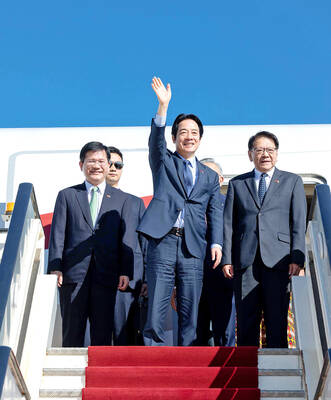
DELAYED BUT DETERMINED: The president’s visit highlights Taiwan’s right to international engagement amid regional pressure from China President Willaim Lai (賴清德) yesterday arrived in Eswatini, more than a week after his planned visit to Taiwan’s sole African ally was suspended because of revoked overflight permits. “The visit, originally scheduled for April 22, was postponed due to unforeseen external factors,” Lai wrote on social media. “After several days of careful arrangements by our diplomatic and national security teams, we successfully arrived today.” Lai said he looked forward to further deepening Taiwan-Eswatini relations through closer cooperation in the economy, agriculture, culture and education, as well as advancing the nation’s international partnerships. The president was initially scheduled to arrive in time to celebrate

Iran’s Islamic Revolutionary Guard Corp (IRGC) yesterday said the US faced a choice between an “impossible” military operation or a “bad deal” with Tehran, after US President Donald Trump disparaged Iran’s latest peace proposal. Negotiations between the two countries have been deadlocked since a ceasefire came into effect on April 8, with only one round of direct peace talks held so far. Iran’s Tasnim and Fars news agencies reported that Tehran had submitted a 14-point proposal to mediator Pakistan, but Trump was quick to cast doubt on it. “I will soon be reviewing the plan that Iran has just sent to us, but


 RSS
RSS