


The year-long funeral ceremony of former Thai queen Sirikit started yesterday, with grieving royalists set to salute the procession bringing her body to lie in state at Bangkok’s Grand Palace.
Members of the royal family are venerated in Thailand, treated by many as semi-divine figures, and lavished with glowing media coverage and gold-adorned portraits hanging in public spaces and private homes nationwide.
Sirikit, the mother of Thai King Vajiralongkorn and widow of the nation’s longest-reigning monarch, died late on Friday at the age of 93.
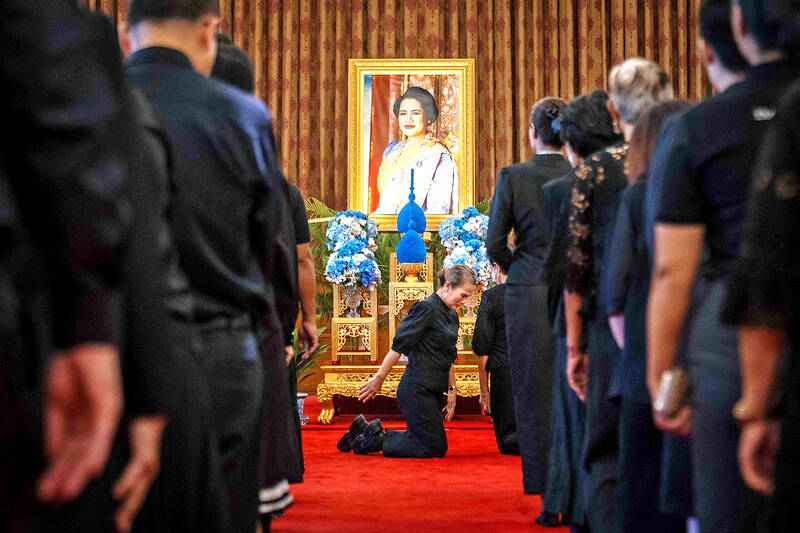
Photo: AFP
Black-and-white tributes to the royal matriarch are being beamed onto towering digital advertizing billboards, on TVs in supermarkets and hotel lobbies, and as pop-up notices on Thai banking apps.
Tanaburdee Srimuang has kept a vigil outside the Grand Palace since confirmation of Sirikit’s death broke in the early hours of Saturday.
“I am not tired,” the 24-year-old said. “I am happy to be here for her for the last time, to be part of her send-off on this historic day.”
The former Thai queen’s body was due late yesterday afternoon to make the short trip from Chulalongkorn Hospital to the seat of the Thai royalty, where she is to lie in state for one year before cremation.
Television newscasters are wearing black, and media Web sites have turned monochrome, while citizens have been asked to dress in muted colors and curtail celebratory public events for 90 days.
About half of the people in a supermarket and on a shopping street in central Bangkok were wearing the traditional Thai mourning colors of black or white.
K-pop supergroup Blackpink went ahead with two sold-out weekend shows at Bangkok’s 50,000-seat Rajamangala National Stadium, but attendees were asked “to wear black attire as a mark of mourning.”
Hundreds of black-clad mourners also filed into the Grand Palace from yesterday morning, even before Sirikit’s remains arrived, paying tribute to ornate portraits depicting her.
“I knew today would come one day, but now it has come I am sad — very sad,” 52-year-old insurance worker Taksina Puttisan said. “Her kindness toward Thais will be in our minds forever.”
Throughout her 66-year marriage to former Thai king Bhumibol Adulyadej, Sirikit carved a dual reputation as a glittering fashionista and the nation’s caring mother figure.
Some Western media compared Sirikit favorably to former US first lady Jackie Kennedy, in rapturous coverage on the front pages of their glossy magazines.
Thai Prime Minister Anutin Charnvirakul delayed his departure to Malaysia on Saturday for a summit of ASEAN leaders to sign a peace deal with Cambodia, witnessed by US President Donald Trump.
However, he still jetted out for a quick turnaround endorsement of the pact, made after cross-border clashes in July killed more than 40 people and forced about 300,000 to flee their homes.
“I send my condolences to the Great People of Thailand,” Trump said on social media, en route to Malaysia where the pact was signed yesterday afternoon.
The lengthy reign of Sirikit’s husband, from 1946 until 2016, was bookended by World War II and Trump’s first election win.
Although Bhumibol’s son inherited the throne about nine years ago, many still revere him as the nation’s most steadfast figurehead — and Sirikit as his constant companion. She retired from the public eye in recent years, her privacy sealed by strict lese-majeste laws that limit what can be reported about the royal family. Sirikit had “suffered several illnesses” while hospitalized since 2019, including a blood infection this month, the palace said in a statement.
However, in her glamorous heyday in the 1960s she mingled with US presidents and superstars such as Elvis Presley, while at home touring Thailand to visit villagers in rural areas.
She was referred to as the “mother of the nation” and her birthday was designated the country’s Mother’s Day.

SPEAKING OUT: After Siranudh Scott’s allegations surfaced, celebrities and public figures took to social media to share their own experiences of sexual misconduct and abuse A high-profile alleged sexual abuse case within a wealthy Thai beer brewing family has prompted a wave of painful accounts from survivors of unconnected abuse in the conservative nation. Siranudh Scott, a member of the billionaire Thai family that founded the ubiquitous Singha beer brand, posted an emotional video this month accusing his elder brother Sunit of repeatedly abusing him when he was a teenager. Sunit, who is in his 30s, later denied the allegations in a video posted online, but Singha parent Boonrawd dismissed him from his executive role with the company on Tuesday last week. “I felt I needed to speak

A Hong Kong astronaut is to join a Chinese space mission for the first time as part of a three-person crew launching today, as Beijing edges closer to its goal of landing people on the moon. The Tiangong space station — crewed by teams of three astronauts that are typically rotated every six months — is the crown jewel of China’s space program, boosted by billions in state investment in a bid to catch up with the US and Russia. The Shenzhou-23 mission is to blast off at 11:08pm from the Jiuquan Satellite Launch Center in northwestern China, carrying three astronauts to

UPGRADED ALERT: The risk inside DR Congo is now considered ‘very high,’ while neighboring countries face a ‘high’ threat as the outbreak continues, the WHO said Ebola is spreading faster than responders can track it in eastern Congo, where health workers managed to follow up with barely one in five identified contacts in a single day. Authorities in the Democratic Republic of the Congo (DR Congo) reported 83 confirmed infections, 746 suspected cases and 1,603 identified contacts as of Thursday, but health workers were able to follow up on only 342 contacts that day — about 21 percent of the total under monitoring — data released by the DR Congo Ministry of Public Health on Friday showed. The figures suggest the response is falling behind the outbreak itself,

SEEKING ORDER: Rodrigo Paz said that ‘anyone who wants to destroy the nation will have to deal with this president and the full force of the constitution’ Bolivian President Rodrigo Paz on Wednesday said that the nation was at a “breaking point” after nearly a month of protests that have caused shortages of food, fuel and medicine. Paz, who took office six months ago amid the worst economic crisis there in four decades, is battling a groundswell of fury over his policies. The political capital, La Paz, has been besieged by low-income workers and members of the indigenous majority calling for his resignation. “The country needs order and is reaching breaking point,” the 58-year-old said at a public event in La Paz, renewing his appeal for dialogue. On Tuesday, the Bolivian


 RSS
RSS