


US and Taiwan military officials have warned that the Chinese People’s Liberation Army (PLA) could implement a blockade within “a matter of hours” and need only “minimal conversion time” prior to an attack on Taiwan, a report released on Tuesday by the US Senate’s China Economic and Security Review Commission said.
“While there is no indication that China is planning an imminent attack, the United States and its allies and partners can no longer assume that a Taiwan contingency is a distant possibility for which they would have ample time to prepare,” it said.
The commission made the comments in its annual report to the US Congress, a 700-page document with a 49-page chapter dedicated to Taiwan.
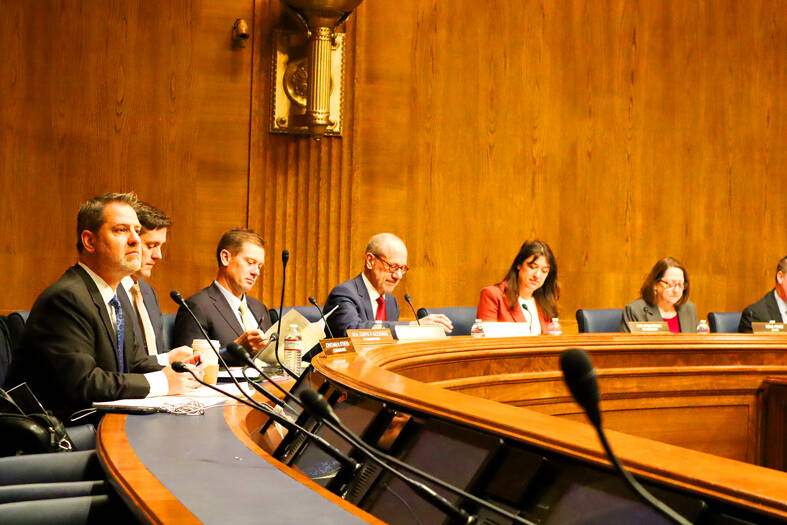
Photo: CNA
“Beijing has continued to escalate military pressure on Taiwan both through near-daily military operations near Taiwan and large-scale exercises designed to rehearse invasion and blockade scenarios,” it said.
China’s activity in the Taiwan Strait and the South China Sea is rapidly increasing, while Beijing ramps up military capabilities and develops new weapons such as self-propelled landing barges, the world’s largest amphibious ship and hypersonic missiles that could target US deployed forces, commission Vice Chair Randy Schriver said in a briefing.
The PLA escalated military pressure against Taiwan by 300 percent last year, the report said, citing testimony by US Indo-Pacific Commander Admiral Samuel Paparo.
“As of Oct. 10, 2025, there have been 3,056 PLA incursions into Taiwan’s ADIZ [air defense identification zone] this year, up 33 percent from 2,301 incursions during the same period in 2024,” the report said.
The large-scale, unannounced exercises are designed to normalize military activity near Taiwan, “making it more difficult to detect if China is preparing for an actual blockade or invasion and potentially dramatically reducing the time Taiwan and the United States would have to respond,” it said.
Beijing continues to downplay the possibility of a Taiwan invasion in English-language statements, while domestically, Chinese-language propaganda suggests China might take action in the near future, it said.
The report closely aligns with the Ministry of National Defense’s August report that identified 2049 as a potential flash point, as it would be Beijing’s date for “the great rejuvenation of the Chinese nation.”
Analysts have pointed to three dates for a potential Chinese invasion: 2027, 2035 and 2049, which are based on public reports about US intelligence assessments and Beijing’s own statements about Taiwan and the PLA’s military modernization ambitions, the US report said.
“Beijing has never publicly acknowledged a specific deadline for taking Taiwan,” it said.
Chinese President Xi Jinping (習近平) denied having plans to invade Taiwan in 2027 or 2035 during a meeting with then-US president Joe Biden in 2023, the report said.
However, Xi has on two occasions said that the Taiwan issue “should not be passed down to generation after generation,” which has been interpreted by some to indicate his intent to “solve” the issue during his lifetime, it added.
The 2027 date is reportedly Beijing’s deadline to be prepared to invade Taiwan, to accelerate the development of the PLA’s capabilities, while also marking the 100th anniversary of the founding of the PLA, it said.
The 2035 date is China’s deadline for completing military modernization and constructing a high-speed railway to Taiwan, it said.
Beijing has clearly indicated its goal to “unify” with Taiwan prior to the 100th anniversary of the founding of the People’s Republic of China in 2049, and Xi has also said that “solving the Taiwan question” is an “inevitable requirement for realizing the great rejuvenation of the Chinese nation,” the report said.
Meanwhile, China has continued to expand its use of cyberattacks and information warfare targeting Taiwan’s government and society, it said.
The campaigns seek to weaken Taiwanese society’s will to resist and sow doubt in the US’ commitment to Taiwan, using economic coercion, espionage, disruption to undersea cables and cognitive warfare, including social media propaganda, it said.
China has also ramped up smear campaigns and attempts to intimidate “Taiwanese separatists,” it said, referencing a planned attack on Vice President Hsiao Bi-khim (蕭美琴) last year.
However, “Taiwan’s overall economic picture remains strong with continued growth,” despite punitive trade measures, the report said.
Beijing is unwilling to target Taiwan Semiconductor Manufacturing Co (台積電) or the information communication technology supply chain, demonstrating its “limitations in taking actions that would truly damage Taiwan’s economy,” it said.
Taiwan has also stepped up self-defense capabilities through increased military spending, defense procurements, US training collaboration and President William Lai’s (賴清德) “whole-of-society resilience” initiative, it said.

A signaling system malfunction disrupted high-speed rail (HSR) services beginning at 8am today, with trains temporarily reduced to three northbound and three southbound trains per hour as authorities conduct inspections. The malfunction occurred on a section of track in Miaoli County during pre-operation checks early this morning, forcing northbound and southbound trains to use a single track, the HSR operator said. The regular schedule has been replaced with three hourly trains offering only nonreserved seating in each direction, stopping at every station, it said, adding that business class cars would still have reserved seating. Departures from terminal stations are scheduled at the top

DRONE CENTRAL: Taiwan aims to become Asia’s democratic hub for drones, with most exports focused on high-quality military-grade models, an official said Taiwan’s drone industry is expected to expand significantly by 2030, producing 100,000 units per month and exporting half of them, the Ministry of Economic Affairs said yesterday. Current drone production capacity is about 15,000 units per month, but the industry can quickly scale up as demand increases, Industrial Development Administration Director-General Chiou Chyou-huey (邱求慧) told a news conference in Taipei. Taiwan’s drone output grew 2.5-fold last year to NT$12.9 billion (US$408.3 million) under a government program to develop the uncrewed vehicle sector, he said. The Executive Yuan in October last year approved plans to invest NT$44.2 billion into domestic production of uncrewed aerial

VERBOSE VESSELS: A CGA cutter and a China Coast Guard exchanged verbal barbs for more than a day in Taiwanese-controlled waters before the Chinese vessel left The Taiwanese and Chinese coast guards had a standoff near the strategically located Pratas Islands (Dongsha Islands, 東沙群島) in the north of the South China Sea, the Coast Guard Administration (CGA) said yesterday. The two sides engaged in intense radio exchanges over sovereignty claims during the 33-hour standoff. China Coast Guard vessel 3501 eventually left the restricted waters, 26.6 nautical miles (49.2km) west of the Pratas Islands, at 5pm yesterday, the CGA said. Lying approximately between southern Taiwan and Hong Kong, the Taiwan-controlled Pratas are seen by some security experts as vulnerable to Chinese attack due to their distance — more than

WARNING: China should stop engaging in actions that undermine regional peace and stability, as it would only build resentment among people across the Strait, the CGA said China has deployed more than 100 navy, coast guard and other vessels in waters from the Yellow Sea to the South China Sea and the western Pacific since US President Donald Trump and Chinese President Xi Jinping (習近平) met in Beijing, National Security Council Secretary-General Joseph Wu (吳釗燮) said yesterday. “In this part of the world, #China is the one & only PROBLEM wrecking the #StatusQuo & threatening regional peace & stability,” Wu wrote on X. In a separate post, he said Beijing was coercing Taiwan’s maritime domain, calling it illegal and provocative, after the Coast Guard Administration (CGA) expelled a


 RSS
RSS